

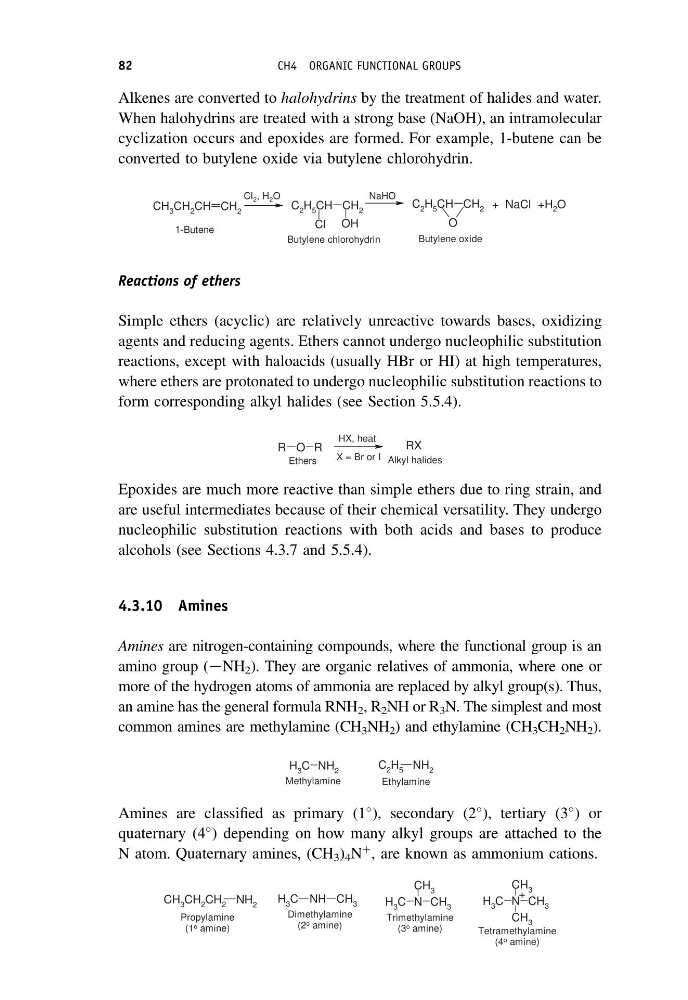
Alkenes are converted to halohydrins by the treatment of halides and water.
When halohydrins are treated with a strong base (NaOH), an intramolecular
cyclization occurs and epoxides are formed. For example, 1-butene can be
converted to butylene oxide via butylene chlorohydrin.
O
CH 3 CH 2 CH CH 2
C 2 H 5 CH CH 2
OH
Cl
C 2 H 5 CH CH 2
Cl 2 , H 2 O
N a H O
1-Butene
Butylene chlorohydrin
Butylene oxide
+ NaCl +H 2 O
Reactions of ethers
Simple ethers (acyclic) are relatively unreactive towards bases, oxidizing
agents and reducing agents. Ethers cannot undergo nucleophilic substitution
reactions, except with haloacids (usually HBr or HI) at high temperatures,
where ethers are protonated to undergo nucleophilic substitution reactions to
form corresponding alkyl halides (see Section 5.5.4).
O R
R
Ethers
HX, heat
Alkyl halides
RX
X = Br or I
Epoxides are much more reactive than simple ethers due to ring strain, and
are useful intermediates because of their chemical versatility. They undergo
nucleophilic substitution reactions with both acids and bases to produce
alcohols (see Sections 4.3.7 and 5.5.4).
4.3.10 Amines
Amines are nitrogen-containing compounds, where the functional group is an
amino group (À ÀNH 2 ). They are organic relatives of ammonia, where one or
more of the hydrogen atoms of ammonia are replaced by alkyl group(s). Thus,
an amine has the general formula RNH 2 , R 2 NH or R 3 N. The simplest and most
common amines are methylamine (CH 3 NH 2 ) and ethylamine (CH 3 CH 2 NH 2 ).
C
H 3 NH 2
C 2 H 5 NH 2
Methylamine
Ethylamine
Amines are classified as primary (1
), secondary (2
), tertiary (3
) or
quaternary (4
) depending on how many alkyl groups are attached to the
N atom. Quaternary amines, (CH 3 ) 4 N
þ , are known as ammonium cations.
CH 3 CH 2 CH 2 NH 2
C
H 3
NH
N
C
H 3
CH 3
CH 3
CH 3
N
C
H 3
CH 3
CH 3
CH 3
+
Propylamine
(1 o amine)
Dimethylamine
(2 o amine)
Trimethylamine
(3 o amine)
Tetramethylamine
(4 o amine)
82
CH4 ORGANIC FUNCTIONAL GROUPS
When halohydrins are treated with a strong base (NaOH), an intramolecular
cyclization occurs and epoxides are formed. For example, 1-butene can be
converted to butylene oxide via butylene chlorohydrin.
O
CH 3 CH 2 CH CH 2
C 2 H 5 CH CH 2
OH
Cl
C 2 H 5 CH CH 2
Cl 2 , H 2 O
N a H O
1-Butene
Butylene chlorohydrin
Butylene oxide
+ NaCl +H 2 O
Reactions of ethers
Simple ethers (acyclic) are relatively unreactive towards bases, oxidizing
agents and reducing agents. Ethers cannot undergo nucleophilic substitution
reactions, except with haloacids (usually HBr or HI) at high temperatures,
where ethers are protonated to undergo nucleophilic substitution reactions to
form corresponding alkyl halides (see Section 5.5.4).
O R
R
Ethers
HX, heat
Alkyl halides
RX
X = Br or I
Epoxides are much more reactive than simple ethers due to ring strain, and
are useful intermediates because of their chemical versatility. They undergo
nucleophilic substitution reactions with both acids and bases to produce
alcohols (see Sections 4.3.7 and 5.5.4).
4.3.10 Amines
Amines are nitrogen-containing compounds, where the functional group is an
amino group (À ÀNH 2 ). They are organic relatives of ammonia, where one or
more of the hydrogen atoms of ammonia are replaced by alkyl group(s). Thus,
an amine has the general formula RNH 2 , R 2 NH or R 3 N. The simplest and most
common amines are methylamine (CH 3 NH 2 ) and ethylamine (CH 3 CH 2 NH 2 ).
C
H 3 NH 2
C 2 H 5 NH 2
Methylamine
Ethylamine
Amines are classified as primary (1
), secondary (2
), tertiary (3
) or
quaternary (4
) depending on how many alkyl groups are attached to the
N atom. Quaternary amines, (CH 3 ) 4 N
þ , are known as ammonium cations.
CH 3 CH 2 CH 2 NH 2
C
H 3
NH
N
C
H 3
CH 3
CH 3
CH 3
N
C
H 3
CH 3
CH 3
CH 3
+
Propylamine
(1 o amine)
Dimethylamine
(2 o amine)
Trimethylamine
(3 o amine)
Tetramethylamine
(4 o amine)
82
CH4 ORGANIC FUNCTIONAL GROUPS