

Nomenclature of amines
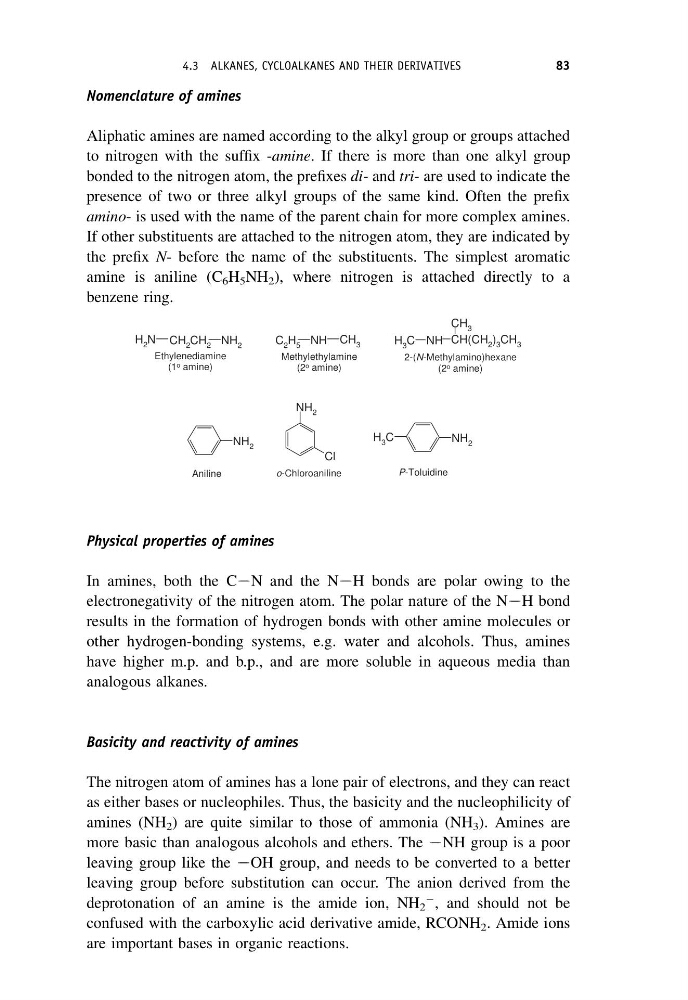
Aliphatic amines are named according to the alkyl group or groups attached
to nitrogen with the suffix -amine. If there is more than one alkyl group
bonded to the nitrogen atom, the prefixes di- and tri- are used to indicate the
presence of two or three alkyl groups of the same kind. Often the prefix
amino- is used with the name of the parent chain for more complex amines.
If other substituents are attached to the nitrogen atom, they are indicated by
the prefix N- before the name of the substituents. The simplest aromatic
amine is aniline (C 6 H 5 NH 2 ), where nitrogen is attached directly to a
benzene ring.
C 2 H 5 NH
C
H 3
NH
CH 3
CH(CH 2 ) 3 CH 3
CH 3
CH 2 CH 2 NH 2
N
H 2
Methylethylamine
(2 o amine)
2-(N-Methylamino)hexane
(2 o amine)
Ethylenediamine
(1 o amine)
C
H 3
NH 2
NH 2
Cl
NH 2
Aniline
P-Toluidine
o-Chloroaniline
Physical properties of amines
In amines, both the CÀ ÀN and the NÀ ÀH bonds are polar owing to the
electronegativity of the nitrogen atom. The polar nature of the NÀ ÀH bond
results in the formation of hydrogen bonds with other amine molecules or
other hydrogen-bonding systems, e.g. water and alcohols. Thus, amines
have higher m.p. and b.p., and are more soluble in aqueous media than
analogous alkanes.
Basicity and reactivity of amines
The nitrogen atom of amines has a lone pair of electrons, and they can react
as either bases or nucleophiles. Thus, the basicity and the nucleophilicity of
amines (NH 2 ) are quite similar to those of ammonia (NH 3 ). Amines are
more basic than analogous alcohols and ethers. The À ÀNH group is a poor
leaving group like the À ÀOH group, and needs to be converted to a better
leaving group before substitution can occur. The anion derived from the
deprotonation of an amine is the amide ion, NH 2
À , and should not be
confused with the carboxylic acid derivative amide, RCONH 2 . Amide ions
are important bases in organic reactions.
4.3 ALKANES, CYCLOALKANES AND THEIR DERIVATIVES
83
Aliphatic amines are named according to the alkyl group or groups attached
to nitrogen with the suffix -amine. If there is more than one alkyl group
bonded to the nitrogen atom, the prefixes di- and tri- are used to indicate the
presence of two or three alkyl groups of the same kind. Often the prefix
amino- is used with the name of the parent chain for more complex amines.
If other substituents are attached to the nitrogen atom, they are indicated by
the prefix N- before the name of the substituents. The simplest aromatic
amine is aniline (C 6 H 5 NH 2 ), where nitrogen is attached directly to a
benzene ring.
C 2 H 5 NH
C
H 3
NH
CH 3
CH(CH 2 ) 3 CH 3
CH 3
CH 2 CH 2 NH 2
N
H 2
Methylethylamine
(2 o amine)
2-(N-Methylamino)hexane
(2 o amine)
Ethylenediamine
(1 o amine)
C
H 3
NH 2
NH 2
Cl
NH 2
Aniline
P-Toluidine
o-Chloroaniline
Physical properties of amines
In amines, both the CÀ ÀN and the NÀ ÀH bonds are polar owing to the
electronegativity of the nitrogen atom. The polar nature of the NÀ ÀH bond
results in the formation of hydrogen bonds with other amine molecules or
other hydrogen-bonding systems, e.g. water and alcohols. Thus, amines
have higher m.p. and b.p., and are more soluble in aqueous media than
analogous alkanes.
Basicity and reactivity of amines
The nitrogen atom of amines has a lone pair of electrons, and they can react
as either bases or nucleophiles. Thus, the basicity and the nucleophilicity of
amines (NH 2 ) are quite similar to those of ammonia (NH 3 ). Amines are
more basic than analogous alcohols and ethers. The À ÀNH group is a poor
leaving group like the À ÀOH group, and needs to be converted to a better
leaving group before substitution can occur. The anion derived from the
deprotonation of an amine is the amide ion, NH 2
À , and should not be
confused with the carboxylic acid derivative amide, RCONH 2 . Amide ions
are important bases in organic reactions.
4.3 ALKANES, CYCLOALKANES AND THEIR DERIVATIVES
83