

O
CH 3 CH CH 2
C
H 2
CH 2
O
O
CH 3 CH 2 CH CH 2
O
O
O
Propylene oxide
(1,2-Epoxy propane)
Butylene oxide
(1,2-Epoxy butane)
Ethylene oxide
(Epoxy ethane)
Oxolane (THF)
Oxane
Oxirane ring (epoxide)
Physical properties of ethers
An ether cannot form hydrogen bonds with other ether molecules since there
is no H to be donated as there is no À ÀOH group, but can be involved in
hydrogen bonding with hydrogen bonding systems, e.g. water, alcohols and
amines. Ethers have much lower m.p. and b.p., and less water solubility than
analogous alcohols. They are fairly unreactive, and this makes them useful
as good polar protic solvents to carry out many organic reactions. For
example, diethyl ether and THF are common solvents used in the Grignard
reaction. Ethers often form complexes with molecules that have vacant
orbitals, e.g. THF complexes with borane (BH 3 .THF), which is used in the
hydroboration–oxidation reaction (see Section 5.3.1).
Preparation of ethers
Ethers are prepared from alkyl halides by the treatment of metal alkoxide.
This is known as Williamson ether synthesis (see Sections 4.3.6 and 5.5.2).
Williamson ether synthesis is an important laboratory method for the
preparation of both symmetrical and unsymmetrical ethers. Symmetrical
ethers are prepared by dehydration of two molecules of primary alcohols
and H 2 SO 4 (see Sections 4.3.7 and 5.5.3). Ethers are also obtained from
alkenes either by acid-catalysed addition of alcohols or alkoxymercuration–
reduction (see Section 5.3.1).
R CH CH 3
OMe
R CH CH 3
OMe
H
H
R
H
ii. NaBH 4 , NaOH
ROH, H 2 SO 4 , heat
Alkene
Ether
i. Hg(OAc) 2 , ROH, THF
Ether
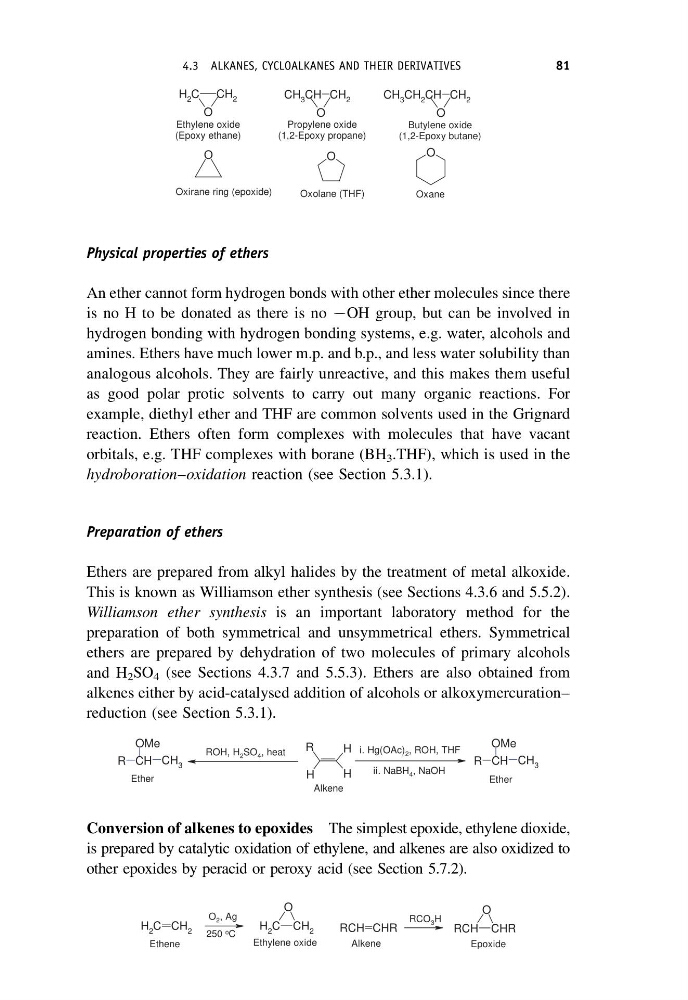
Conversion of alkenes to epoxides The simplest epoxide, ethylene dioxide,
is prepared by catalytic oxidation of ethylene, and alkenes are also oxidized to
other epoxides by peracid or peroxy acid (see Section 5.7.2).
C
H 2
CH 2
RCH CHR
RCH CHR
O
C
H 2
CH 2
O
Ethylene oxide
O 2 , Ag
250 o C
Alkene
RCO 3 H
Epoxide
Ethene
4.3 ALKANES, CYCLOALKANES AND THEIR DERIVATIVES
81
CH 3 CH CH 2
C
H 2
CH 2
O
O
CH 3 CH 2 CH CH 2
O
O
O
Propylene oxide
(1,2-Epoxy propane)
Butylene oxide
(1,2-Epoxy butane)
Ethylene oxide
(Epoxy ethane)
Oxolane (THF)
Oxane
Oxirane ring (epoxide)
Physical properties of ethers
An ether cannot form hydrogen bonds with other ether molecules since there
is no H to be donated as there is no À ÀOH group, but can be involved in
hydrogen bonding with hydrogen bonding systems, e.g. water, alcohols and
amines. Ethers have much lower m.p. and b.p., and less water solubility than
analogous alcohols. They are fairly unreactive, and this makes them useful
as good polar protic solvents to carry out many organic reactions. For
example, diethyl ether and THF are common solvents used in the Grignard
reaction. Ethers often form complexes with molecules that have vacant
orbitals, e.g. THF complexes with borane (BH 3 .THF), which is used in the
hydroboration–oxidation reaction (see Section 5.3.1).
Preparation of ethers
Ethers are prepared from alkyl halides by the treatment of metal alkoxide.
This is known as Williamson ether synthesis (see Sections 4.3.6 and 5.5.2).
Williamson ether synthesis is an important laboratory method for the
preparation of both symmetrical and unsymmetrical ethers. Symmetrical
ethers are prepared by dehydration of two molecules of primary alcohols
and H 2 SO 4 (see Sections 4.3.7 and 5.5.3). Ethers are also obtained from
alkenes either by acid-catalysed addition of alcohols or alkoxymercuration–
reduction (see Section 5.3.1).
R CH CH 3
OMe
R CH CH 3
OMe
H
H
R
H
ii. NaBH 4 , NaOH
ROH, H 2 SO 4 , heat
Alkene
Ether
i. Hg(OAc) 2 , ROH, THF
Ether
Conversion of alkenes to epoxides The simplest epoxide, ethylene dioxide,
is prepared by catalytic oxidation of ethylene, and alkenes are also oxidized to
other epoxides by peracid or peroxy acid (see Section 5.7.2).
C
H 2
CH 2
RCH CHR
RCH CHR
O
C
H 2
CH 2
O
Ethylene oxide
O 2 , Ag
250 o C
Alkene
RCO 3 H
Epoxide
Ethene
4.3 ALKANES, CYCLOALKANES AND THEIR DERIVATIVES
81