

4.3.9 Ethers
Ethers are also organic relatives of water, where alkyl groups replace both
hydrogen atoms. Thus, ethers have two hydrocarbons bonded to an oxygen
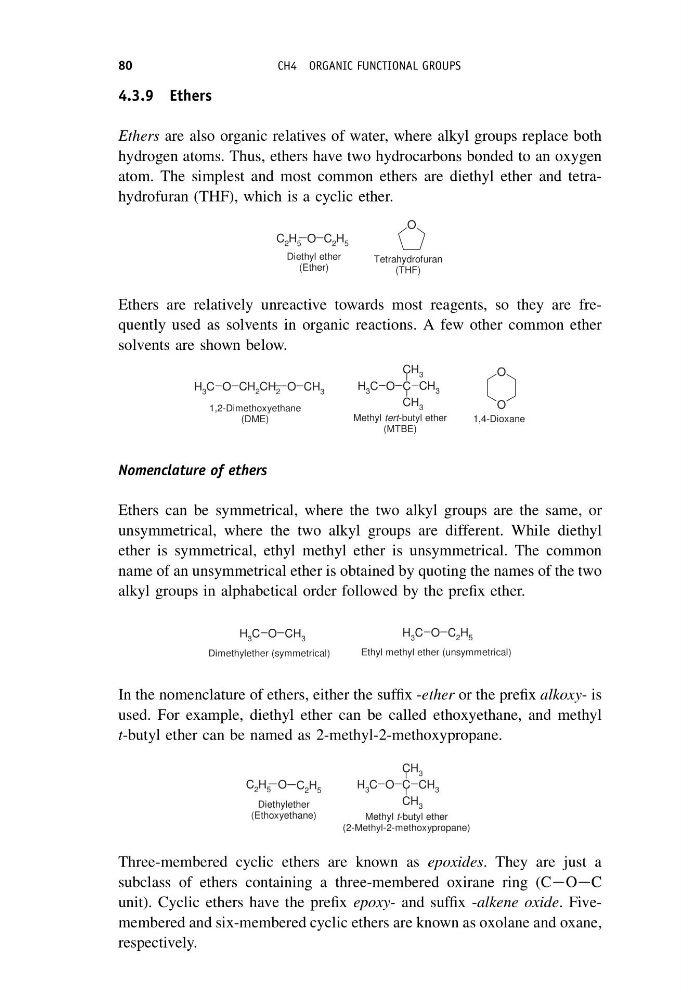
atom. The simplest and most common ethers are diethyl ether and tetrahydrofuran (THF), which is a cyclic ether.
C 2 H 5 O C 2 H 5
O
Diethyl ether
(Ether)
Tetrahydrofuran
(THF)
Ethers are relatively unreactive towards most reagents, so they are frequently used as solvents in organic reactions. A few other common ether
solvents are shown below.
O C
C
H 3
CH 3
CH 3
CH 3
O
O
C
H 3 O CH 2 CH 2 O CH 3
1,4-Dioxane
1,2-Dimethoxyethane
(DME)
Methyl tert-butyl ether
(MTBE)
Nomenclature of ethers
Ethers can be symmetrical, where the two alkyl groups are the same, or
unsymmetrical, where the two alkyl groups are different. While diethyl
ether is symmetrical, ethyl methyl ether is unsymmetrical. The common
name of an unsymmetrical ether is obtained by quoting the names of the two
alkyl groups in alphabetical order followed by the prefix ether.
C
H 3 O CH 3
C
H 3 O C 2 H 5
Dimethylether (symmetrical)
Ethyl methyl ether (unsymmetrical)
In the nomenclature of ethers, either the suffix -ether or the prefix alkoxy- is
used. For example, diethyl ether can be called ethoxyethane, and methyl
t-butyl ether can be named as 2-methyl-2-methoxypropane.
C 2 H 5 O C 2 H 5
C
H 3 O C CH 3
CH 3
CH 3
Diethylether
(Ethoxyethane)
Methyl t-butyl ether
(2-Methyl-2-methoxypropane)
Three-membered cyclic ethers are known as epoxides. They are just a
subclass of ethers containing a three-membered oxirane ring (CÀ ÀOÀ ÀC
unit). Cyclic ethers have the prefix epoxy- and suffix -alkene oxide. Fivemembered and six-membered cyclic ethers are known as oxolane and oxane,
respectively.
80
CH4 ORGANIC FUNCTIONAL GROUPS
Ethers are also organic relatives of water, where alkyl groups replace both
hydrogen atoms. Thus, ethers have two hydrocarbons bonded to an oxygen
atom. The simplest and most common ethers are diethyl ether and tetrahydrofuran (THF), which is a cyclic ether.
C 2 H 5 O C 2 H 5
O
Diethyl ether
(Ether)
Tetrahydrofuran
(THF)
Ethers are relatively unreactive towards most reagents, so they are frequently used as solvents in organic reactions. A few other common ether
solvents are shown below.
O C
C
H 3
CH 3
CH 3
CH 3
O
O
C
H 3 O CH 2 CH 2 O CH 3
1,4-Dioxane
1,2-Dimethoxyethane
(DME)
Methyl tert-butyl ether
(MTBE)
Nomenclature of ethers
Ethers can be symmetrical, where the two alkyl groups are the same, or
unsymmetrical, where the two alkyl groups are different. While diethyl
ether is symmetrical, ethyl methyl ether is unsymmetrical. The common
name of an unsymmetrical ether is obtained by quoting the names of the two
alkyl groups in alphabetical order followed by the prefix ether.
C
H 3 O CH 3
C
H 3 O C 2 H 5
Dimethylether (symmetrical)
Ethyl methyl ether (unsymmetrical)
In the nomenclature of ethers, either the suffix -ether or the prefix alkoxy- is
used. For example, diethyl ether can be called ethoxyethane, and methyl
t-butyl ether can be named as 2-methyl-2-methoxypropane.
C 2 H 5 O C 2 H 5
C
H 3 O C CH 3
CH 3
CH 3
Diethylether
(Ethoxyethane)
Methyl t-butyl ether
(2-Methyl-2-methoxypropane)
Three-membered cyclic ethers are known as epoxides. They are just a
subclass of ethers containing a three-membered oxirane ring (CÀ ÀOÀ ÀC
unit). Cyclic ethers have the prefix epoxy- and suffix -alkene oxide. Fivemembered and six-membered cyclic ethers are known as oxolane and oxane,
respectively.
80
CH4 ORGANIC FUNCTIONAL GROUPS