

Nomenclature of thiols
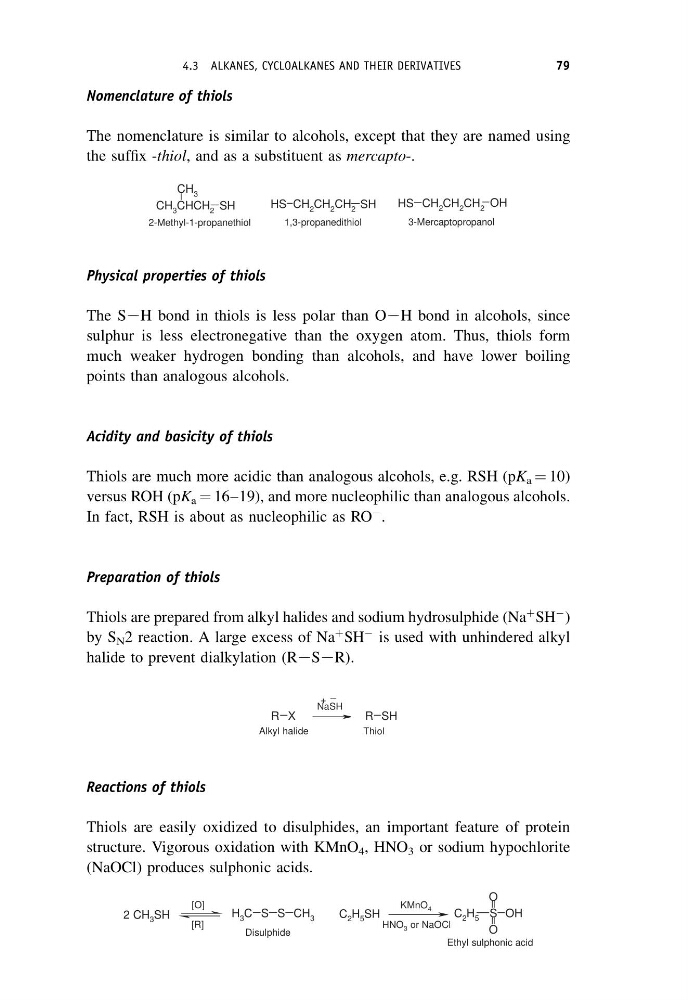
The nomenclature is similar to alcohols, except that they are named using
the suffix -thiol, and as a substituent as mercapto-.
CH 2 CH 2 CH 2
S
H
OH
CH 2 CH 2 CH 2
S
H
SH
CH 3 CHCH 2
CH 3
SH
2-Methyl-1-propanethiol
3-Mercaptopropanol
1,3-propanedithiol
Physical properties of thiols
The SÀ ÀH bond in thiols is less polar than OÀ ÀH bond in alcohols, since
sulphur is less electronegative than the oxygen atom. Thus, thiols form
much weaker hydrogen bonding than alcohols, and have lower boiling
points than analogous alcohols.
Acidity and basicity of thiols
Thiols are much more acidic than analogous alcohols, e.g. RSH (pK a ¼ 10)
versus ROH (pK a ¼ 16–19), and more nucleophilic than analogous alcohols.
In fact, RSH is about as nucleophilic as RO
À .
Preparation of thiols
Thiols are prepared from alkyl halides and sodium hydrosulphide (Na
þ SH
À )
by S N 2 reaction. A large excess of Na
þ SH
À is used with unhindered alkyl
halide to prevent dialkylation (RÀ ÀSÀ ÀR).
R X
R SH
_
NaSH
+
Thiol
Alkyl halide
Reactions of thiols
Thiols are easily oxidized to disulphides, an important feature of protein
structure. Vigorous oxidation with KMnO 4 , HNO 3 or sodium hypochlorite
(NaOCl) produces sulphonic acids.
C
H 3 S S CH 3
C 2 H 5 S OH
O
O
2 CH 3 SH
[O]
[R]
Disulphide
C 2 H 5 SH
KMnO 4
Ethyl sulphonic acid
HNO 3 or NaOCl
4.3 ALKANES, CYCLOALKANES AND THEIR DERIVATIVES
79
The nomenclature is similar to alcohols, except that they are named using
the suffix -thiol, and as a substituent as mercapto-.
CH 2 CH 2 CH 2
S
H
OH
CH 2 CH 2 CH 2
S
H
SH
CH 3 CHCH 2
CH 3
SH
2-Methyl-1-propanethiol
3-Mercaptopropanol
1,3-propanedithiol
Physical properties of thiols
The SÀ ÀH bond in thiols is less polar than OÀ ÀH bond in alcohols, since
sulphur is less electronegative than the oxygen atom. Thus, thiols form
much weaker hydrogen bonding than alcohols, and have lower boiling
points than analogous alcohols.
Acidity and basicity of thiols
Thiols are much more acidic than analogous alcohols, e.g. RSH (pK a ¼ 10)
versus ROH (pK a ¼ 16–19), and more nucleophilic than analogous alcohols.
In fact, RSH is about as nucleophilic as RO
À .
Preparation of thiols
Thiols are prepared from alkyl halides and sodium hydrosulphide (Na
þ SH
À )
by S N 2 reaction. A large excess of Na
þ SH
À is used with unhindered alkyl
halide to prevent dialkylation (RÀ ÀSÀ ÀR).
R X
R SH
_
NaSH
+
Thiol
Alkyl halide
Reactions of thiols
Thiols are easily oxidized to disulphides, an important feature of protein
structure. Vigorous oxidation with KMnO 4 , HNO 3 or sodium hypochlorite
(NaOCl) produces sulphonic acids.
C
H 3 S S CH 3
C 2 H 5 S OH
O
O
2 CH 3 SH
[O]
[R]
Disulphide
C 2 H 5 SH
KMnO 4
Ethyl sulphonic acid
HNO 3 or NaOCl
4.3 ALKANES, CYCLOALKANES AND THEIR DERIVATIVES
79