

would be protonated in the acidic solution, resulting in the total loss or
significant decrease of their nucleophilicity.
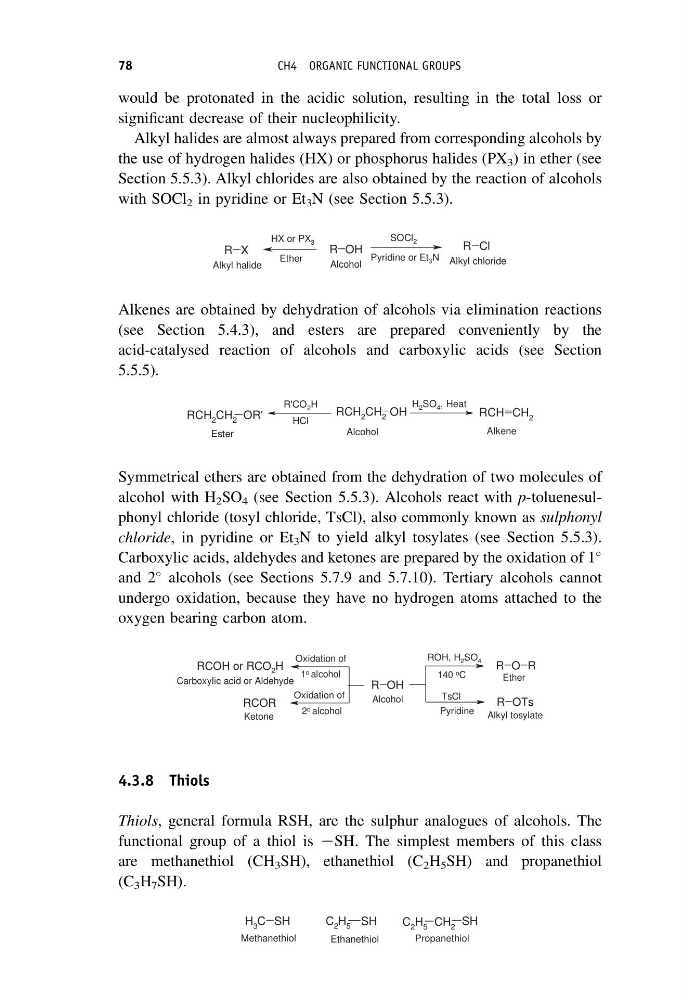
Alkyl halides are almost always prepared from corresponding alcohols by
the use of hydrogen halides (HX) or phosphorus halides (PX 3 ) in ether (see
Section 5.5.3). Alkyl chlorides are also obtained by the reaction of alcohols
with SOCl 2 in pyridine or Et 3 N (see Section 5.5.3).
R OH
R X
R Cl
HX or PX 3
Alcohol
Alkyl halide
SOCl 2
Pyridine or Et 3 N
Ether
Alkyl chloride
Alkenes are obtained by dehydration of alcohols via elimination reactions
(see Section 5.4.3), and esters are prepared conveniently by the
acid-catalysed reaction of alcohols and carboxylic acids (see Section
5.5.5).
RCH 2 CH 2 OR'
RCH CH 2
RCH 2 CH 2 OH
R'CO 2 H
Ester
HCl
Alcohol
H 2 SO 4 , Heat
Alkene
Symmetrical ethers are obtained from the dehydration of two molecules of
alcohol with H 2 SO 4 (see Section 5.5.3). Alcohols react with p-toluenesulphonyl chloride (tosyl chloride, TsCl), also commonly known as sulphonyl
chloride, in pyridine or Et 3 N to yield alkyl tosylates (see Section 5.5.3).
Carboxylic acids, aldehydes and ketones are prepared by the oxidation of 1
and 2
alcohols (see Sections 5.7.9 and 5.7.10). Tertiary alcohols cannot
undergo oxidation, because they have no hydrogen atoms attached to the
oxygen bearing carbon atom.
R OH
R OTs
R O R
Alcohol
Oxidation of
1 o alcohol
Carboxylic acid or Aldehyde
TsCl
Pyridine
RCOH or RCO 2 H
Ether
ROH, H 2 SO 4
140 o C
Alkyl tosylate
Oxidation of
2 o alcohol
RCOR
Ketone
4.3.8 Thiols
Thiols, general formula RSH, are the sulphur analogues of alcohols. The
functional group of a thiol is À ÀSH. The simplest members of this class
are methanethiol (CH 3 SH), ethanethiol (C 2 H 5 SH) and propanethiol
(C 3 H 7 SH).
C
H 3 SH
CH 2
C 2 H 5
SH
C 2 H 5 SH
Methanethiol
Propanethiol
Ethanethiol
78
CH4 ORGANIC FUNCTIONAL GROUPS
significant decrease of their nucleophilicity.
Alkyl halides are almost always prepared from corresponding alcohols by
the use of hydrogen halides (HX) or phosphorus halides (PX 3 ) in ether (see
Section 5.5.3). Alkyl chlorides are also obtained by the reaction of alcohols
with SOCl 2 in pyridine or Et 3 N (see Section 5.5.3).
R OH
R X
R Cl
HX or PX 3
Alcohol
Alkyl halide
SOCl 2
Pyridine or Et 3 N
Ether
Alkyl chloride
Alkenes are obtained by dehydration of alcohols via elimination reactions
(see Section 5.4.3), and esters are prepared conveniently by the
acid-catalysed reaction of alcohols and carboxylic acids (see Section
5.5.5).
RCH 2 CH 2 OR'
RCH CH 2
RCH 2 CH 2 OH
R'CO 2 H
Ester
HCl
Alcohol
H 2 SO 4 , Heat
Alkene
Symmetrical ethers are obtained from the dehydration of two molecules of
alcohol with H 2 SO 4 (see Section 5.5.3). Alcohols react with p-toluenesulphonyl chloride (tosyl chloride, TsCl), also commonly known as sulphonyl
chloride, in pyridine or Et 3 N to yield alkyl tosylates (see Section 5.5.3).
Carboxylic acids, aldehydes and ketones are prepared by the oxidation of 1
and 2
alcohols (see Sections 5.7.9 and 5.7.10). Tertiary alcohols cannot
undergo oxidation, because they have no hydrogen atoms attached to the
oxygen bearing carbon atom.
R OH
R OTs
R O R
Alcohol
Oxidation of
1 o alcohol
Carboxylic acid or Aldehyde
TsCl
Pyridine
RCOH or RCO 2 H
Ether
ROH, H 2 SO 4
140 o C
Alkyl tosylate
Oxidation of
2 o alcohol
RCOR
Ketone
4.3.8 Thiols
Thiols, general formula RSH, are the sulphur analogues of alcohols. The
functional group of a thiol is À ÀSH. The simplest members of this class
are methanethiol (CH 3 SH), ethanethiol (C 2 H 5 SH) and propanethiol
(C 3 H 7 SH).
C
H 3 SH
CH 2
C 2 H 5
SH
C 2 H 5 SH
Methanethiol
Propanethiol
Ethanethiol
78
CH4 ORGANIC FUNCTIONAL GROUPS