

R 2 C CHR
C
R
C H
R R
OH H
C
R
C H
R R
H OH
Alcohol
anti-Markovnikov addition
H 2 O, H 2 SO 4 or
i. Hg(OAc) 2 , THF, H 2 O
i. BH 3 .THF
ii. H 2 O 2 , NaOH
ii. NaBH 4 , NaOH
Alcohol
Markovnikov addition
Alkene
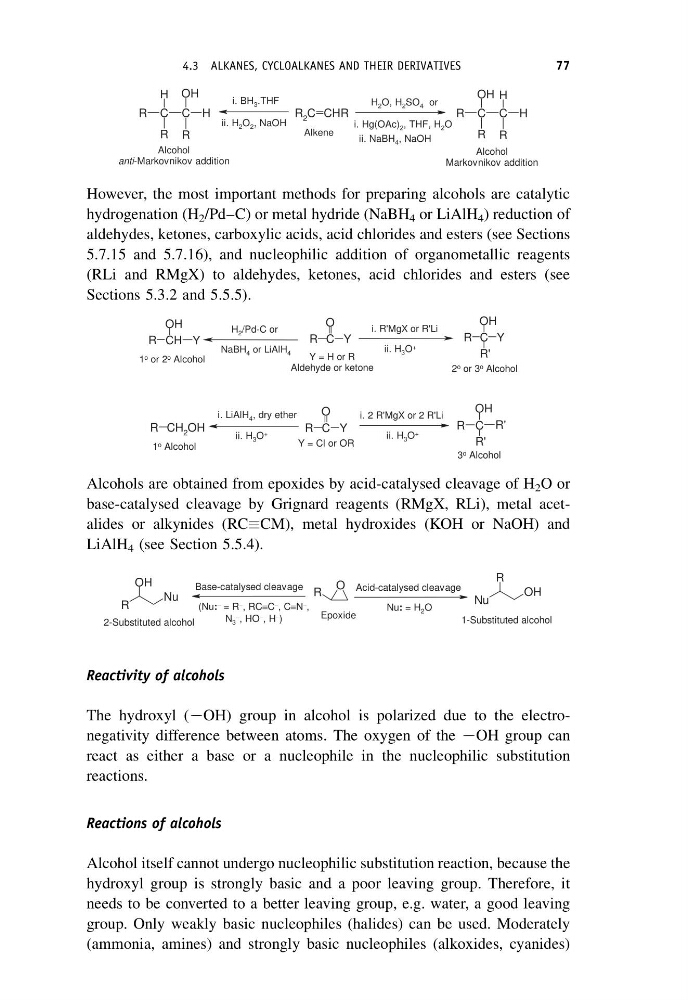
However, the most important methods for preparing alcohols are catalytic
hydrogenation (H 2 /Pd–C) or metal hydride (NaBH 4 or LiAlH 4 ) reduction of
aldehydes, ketones, carboxylic acids, acid chlorides and esters (see Sections
5.7.15 and 5.7.16), and nucleophilic addition of organometallic reagents
(RLi and RMgX) to aldehydes, ketones, acid chlorides and esters (see
Sections 5.3.2 and 5.5.5).
R C
O
Y
CH
OH
Y
C
OH
Y
R'
R
R
H 2 /Pd-C or
NaBH 4 or LiAlH 4
ii. H 3 O +
1 o or 2 o Alcohol
2 o or 3 o Alcohol
Y = H or R
Aldehyde or ketone
i. R'MgX or R'Li
R CH 2 OH
R C
OH
R'
R'
R C
O
Y
1 o Alcohol
3 o Alcohol
Y = Cl or OR
i. LiAlH 4 , dry ether
i. 2 R'MgX or 2 R'Li
ii. H 3 O +
ii. H 3 O +
Alcohols are obtained from epoxides by acid-catalysed cleavage of H 2 O or
base-catalysed cleavage by Grignard reagents (RMgX, RLi), metal acetalides or alkynides (RCCM), metal hydroxides (KOH or NaOH) and
LiAlH 4 (see Section 5.5.4).
O
R
R
Nu
OH
Nu
OH
R
Base-catalysed cleavage
Nu: = H 2 O
(Nu: − = R − , RC≡C − , C≡N − ,
N 3
− , HO − , H − )
2-Substituted alcohol
Epoxide
Acid-catalysed cleavage
1-Substituted alcohol
Reactivity of alcohols
The hydroxyl (À ÀOH) group in alcohol is polarized due to the electronegativity difference between atoms. The oxygen of the À ÀOH group can
react as either a base or a nucleophile in the nucleophilic substitution
reactions.
Reactions of alcohols
Alcohol itself cannot undergo nucleophilic substitution reaction, because the
hydroxyl group is strongly basic and a poor leaving group. Therefore, it
needs to be converted to a better leaving group, e.g. water, a good leaving
group. Only weakly basic nucleophiles (halides) can be used. Moderately
(ammonia, amines) and strongly basic nucleophiles (alkoxides, cyanides)
4.3 ALKANES, CYCLOALKANES AND THEIR DERIVATIVES
77
C
R
C H
R R
OH H
C
R
C H
R R
H OH
Alcohol
anti-Markovnikov addition
H 2 O, H 2 SO 4 or
i. Hg(OAc) 2 , THF, H 2 O
i. BH 3 .THF
ii. H 2 O 2 , NaOH
ii. NaBH 4 , NaOH
Alcohol
Markovnikov addition
Alkene
However, the most important methods for preparing alcohols are catalytic
hydrogenation (H 2 /Pd–C) or metal hydride (NaBH 4 or LiAlH 4 ) reduction of
aldehydes, ketones, carboxylic acids, acid chlorides and esters (see Sections
5.7.15 and 5.7.16), and nucleophilic addition of organometallic reagents
(RLi and RMgX) to aldehydes, ketones, acid chlorides and esters (see
Sections 5.3.2 and 5.5.5).
R C
O
Y
CH
OH
Y
C
OH
Y
R'
R
R
H 2 /Pd-C or
NaBH 4 or LiAlH 4
ii. H 3 O +
1 o or 2 o Alcohol
2 o or 3 o Alcohol
Y = H or R
Aldehyde or ketone
i. R'MgX or R'Li
R CH 2 OH
R C
OH
R'
R'
R C
O
Y
1 o Alcohol
3 o Alcohol
Y = Cl or OR
i. LiAlH 4 , dry ether
i. 2 R'MgX or 2 R'Li
ii. H 3 O +
ii. H 3 O +
Alcohols are obtained from epoxides by acid-catalysed cleavage of H 2 O or
base-catalysed cleavage by Grignard reagents (RMgX, RLi), metal acetalides or alkynides (RCCM), metal hydroxides (KOH or NaOH) and
LiAlH 4 (see Section 5.5.4).
O
R
R
Nu
OH
Nu
OH
R
Base-catalysed cleavage
Nu: = H 2 O
(Nu: − = R − , RC≡C − , C≡N − ,
N 3
− , HO − , H − )
2-Substituted alcohol
Epoxide
Acid-catalysed cleavage
1-Substituted alcohol
Reactivity of alcohols
The hydroxyl (À ÀOH) group in alcohol is polarized due to the electronegativity difference between atoms. The oxygen of the À ÀOH group can
react as either a base or a nucleophile in the nucleophilic substitution
reactions.
Reactions of alcohols
Alcohol itself cannot undergo nucleophilic substitution reaction, because the
hydroxyl group is strongly basic and a poor leaving group. Therefore, it
needs to be converted to a better leaving group, e.g. water, a good leaving
group. Only weakly basic nucleophiles (halides) can be used. Moderately
(ammonia, amines) and strongly basic nucleophiles (alkoxides, cyanides)
4.3 ALKANES, CYCLOALKANES AND THEIR DERIVATIVES
77