

Acidity and basicity of alcohols
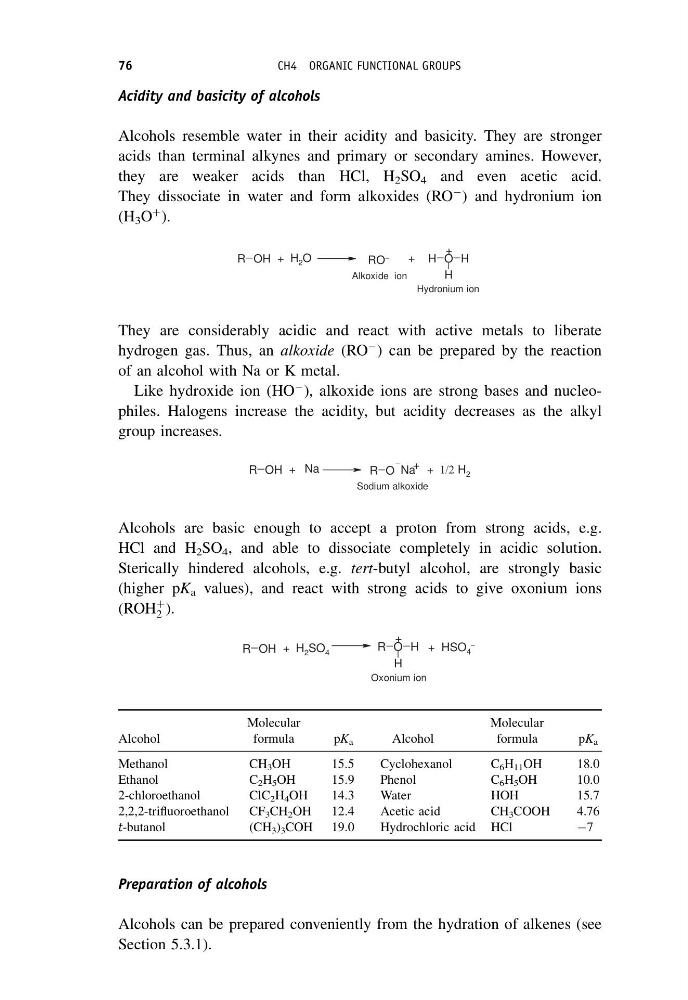
Alcohols resemble water in their acidity and basicity. They are stronger
acids than terminal alkynes and primary or secondary amines. However,
they are weaker acids than HCl, H 2 SO 4 and even acetic acid.
They dissociate in water and form alkoxides (RO
À ) and hydronium ion
(H 3 O
þ ).
H O H
H
R OH
RO −
+
Hydronium ion
H 2 O
+
+
Alkoxide ion
They are considerably acidic and react with active metals to liberate
hydrogen gas. Thus, an alkoxide (RO
À ) can be prepared by the reaction
of an alcohol with Na or K metal.
Like hydroxide ion (HO
À ), alkoxide ions are strong bases and nucleophiles. Halogens increase the acidity, but acidity decreases as the alkyl
group increases.
R OH
R O
+
Na + 1/2 H 2
Na
+
Sodium alkoxide
Alcohols are basic enough to accept a proton from strong acids, e.g.
HCl and H 2 SO 4 , and able to dissociate completely in acidic solution.
Sterically hindered alcohols, e.g. tert-butyl alcohol, are strongly basic
(higher pK a values), and react with strong acids to give oxonium ions
(ROH
þ
2 ).
R O H
H
R OH
+ HSO 4
−
H 2 SO 4
+
+
Oxonium ion
Molecular
Molecular
Alcohol
formula
pK a
Alcohol
formula
pK a
Methanol
CH 3 OH
15.5
Cyclohexanol
C 6 H 11 OH
18.0
Ethanol
C 2 H 5 OH
15.9
Phenol
C 6 H 5 OH
10.0
2-chloroethanol
ClC 2 H 4 OH
14.3
Water
HOH
15.7
2,2,2-trifluoroethanol
CF 3 CH 2 OH
12.4
Acetic acid
CH 3 COOH
4.76
t-butanol
(CH 3 ) 3 COH 19.0
Hydrochloric acid HCl
À7
Preparation of alcohols
Alcohols can be prepared conveniently from the hydration of alkenes (see
Section 5.3.1).
76
CH4 ORGANIC FUNCTIONAL GROUPS
Alcohols resemble water in their acidity and basicity. They are stronger
acids than terminal alkynes and primary or secondary amines. However,
they are weaker acids than HCl, H 2 SO 4 and even acetic acid.
They dissociate in water and form alkoxides (RO
À ) and hydronium ion
(H 3 O
þ ).
H O H
H
R OH
RO −
+
Hydronium ion
H 2 O
+
+
Alkoxide ion
They are considerably acidic and react with active metals to liberate
hydrogen gas. Thus, an alkoxide (RO
À ) can be prepared by the reaction
of an alcohol with Na or K metal.
Like hydroxide ion (HO
À ), alkoxide ions are strong bases and nucleophiles. Halogens increase the acidity, but acidity decreases as the alkyl
group increases.
R OH
R O
+
Na + 1/2 H 2
Na
+
Sodium alkoxide
Alcohols are basic enough to accept a proton from strong acids, e.g.
HCl and H 2 SO 4 , and able to dissociate completely in acidic solution.
Sterically hindered alcohols, e.g. tert-butyl alcohol, are strongly basic
(higher pK a values), and react with strong acids to give oxonium ions
(ROH
þ
2 ).
R O H
H
R OH
+ HSO 4
−
H 2 SO 4
+
+
Oxonium ion
Molecular
Molecular
Alcohol
formula
pK a
Alcohol
formula
pK a
Methanol
CH 3 OH
15.5
Cyclohexanol
C 6 H 11 OH
18.0
Ethanol
C 2 H 5 OH
15.9
Phenol
C 6 H 5 OH
10.0
2-chloroethanol
ClC 2 H 4 OH
14.3
Water
HOH
15.7
2,2,2-trifluoroethanol
CF 3 CH 2 OH
12.4
Acetic acid
CH 3 COOH
4.76
t-butanol
(CH 3 ) 3 COH 19.0
Hydrochloric acid HCl
À7
Preparation of alcohols
Alcohols can be prepared conveniently from the hydration of alkenes (see
Section 5.3.1).
76
CH4 ORGANIC FUNCTIONAL GROUPS