

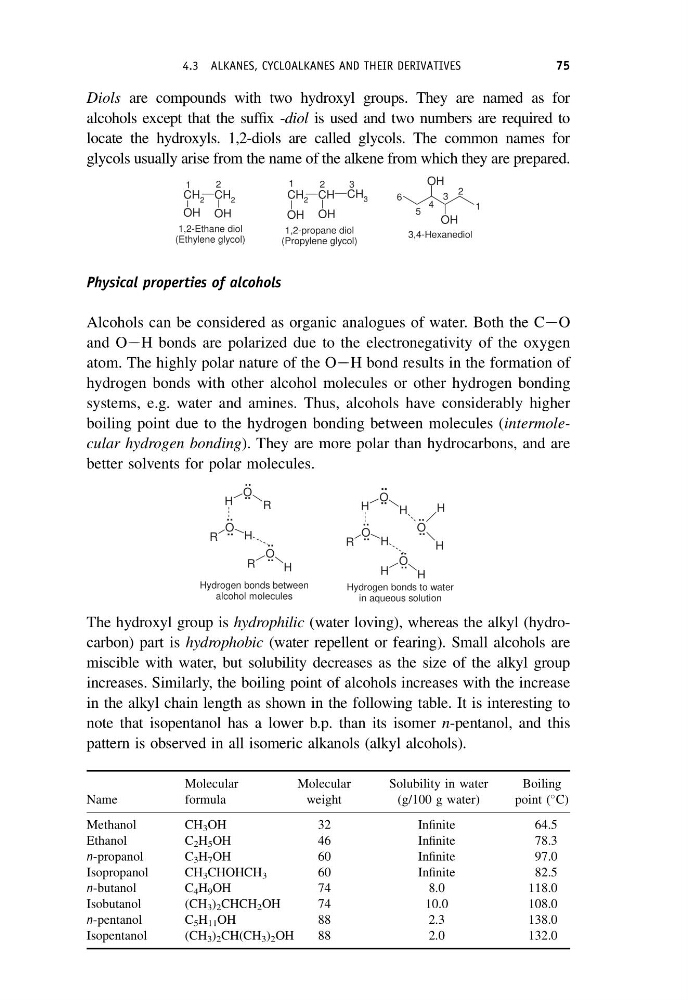
Diols are compounds with two hydroxyl groups. They are named as for
alcohols except that the suffix -diol is used and two numbers are required to
locate the hydroxyls. 1,2-diols are called glycols. The common names for
glycols usually arise from the name of the alkene from which they are prepared.
OH
OH
CH 2 CH 2
OH OH
CH 2 CH
OH OH
CH 3
3,4-Hexanediol
1
2
3
4
5
6
1
2
3
1,2-Ethane diol
(Ethylene glycol)
1
2
1,2-propane diol
(Propylene glycol)
Physical properties of alcohols
Alcohols can be considered as organic analogues of water. Both the CÀ ÀO
and OÀ ÀH bonds are polarized due to the electronegativity of the oxygen
atom. The highly polar nature of the OÀ ÀH bond results in the formation of
hydrogen bonds with other alcohol molecules or other hydrogen bonding
systems, e.g. water and amines. Thus, alcohols have considerably higher
boiling point due to the hydrogen bonding between molecules (intermolecular hydrogen bonding). They are more polar than hydrocarbons, and are
better solvents for polar molecules.
R
O
H
H
O
R
R
O H
H
O
H
R
O
H
H
O
H
H
H
O
..
..
..
..
..
Hydrogen bonds between
alcohol molecules
Hydrogen bonds to water
in aqueous solution
..
..
..
..
..
..
..
..
..
The hydroxyl group is hydrophilic (water loving), whereas the alkyl (hydrocarbon) part is hydrophobic (water repellent or fearing). Small alcohols are
miscible with water, but solubility decreases as the size of the alkyl group
increases. Similarly, the boiling point of alcohols increases with the increase
in the alkyl chain length as shown in the following table. It is interesting to
note that isopentanol has a lower b.p. than its isomer n-pentanol, and this
pattern is observed in all isomeric alkanols (alkyl alcohols).
Molecular
Molecular
Solubility in water
Boiling
Name
formula
weight
(g/100 g water)
point (
C)
Methanol
CH 3 OH
32
Infinite
64.5
Ethanol
C 2 H 5 OH
46
Infinite
78.3
n-propanol
C 3 H 7 OH
60
Infinite
97.0
Isopropanol
CH 3 CHOHCH 3
60
Infinite
82.5
n-butanol
C 4 H 9 OH
74
8.0
118.0
Isobutanol
(CH 3 ) 2 CHCH 2 OH
74
10.0
108.0
n-pentanol
C 5 H 11 OH
88
2.3
138.0
Isopentanol
(CH 3 ) 2 CH(CH 3 ) 2 OH
88
2.0
132.0
4.3 ALKANES, CYCLOALKANES AND THEIR DERIVATIVES
75
alcohols except that the suffix -diol is used and two numbers are required to
locate the hydroxyls. 1,2-diols are called glycols. The common names for
glycols usually arise from the name of the alkene from which they are prepared.
OH
OH
CH 2 CH 2
OH OH
CH 2 CH
OH OH
CH 3
3,4-Hexanediol
1
2
3
4
5
6
1
2
3
1,2-Ethane diol
(Ethylene glycol)
1
2
1,2-propane diol
(Propylene glycol)
Physical properties of alcohols
Alcohols can be considered as organic analogues of water. Both the CÀ ÀO
and OÀ ÀH bonds are polarized due to the electronegativity of the oxygen
atom. The highly polar nature of the OÀ ÀH bond results in the formation of
hydrogen bonds with other alcohol molecules or other hydrogen bonding
systems, e.g. water and amines. Thus, alcohols have considerably higher
boiling point due to the hydrogen bonding between molecules (intermolecular hydrogen bonding). They are more polar than hydrocarbons, and are
better solvents for polar molecules.
R
O
H
H
O
R
R
O H
H
O
H
R
O
H
H
O
H
H
H
O
..
..
..
..
..
Hydrogen bonds between
alcohol molecules
Hydrogen bonds to water
in aqueous solution
..
..
..
..
..
..
..
..
..
The hydroxyl group is hydrophilic (water loving), whereas the alkyl (hydrocarbon) part is hydrophobic (water repellent or fearing). Small alcohols are
miscible with water, but solubility decreases as the size of the alkyl group
increases. Similarly, the boiling point of alcohols increases with the increase
in the alkyl chain length as shown in the following table. It is interesting to
note that isopentanol has a lower b.p. than its isomer n-pentanol, and this
pattern is observed in all isomeric alkanols (alkyl alcohols).
Molecular
Molecular
Solubility in water
Boiling
Name
formula
weight
(g/100 g water)
point (
C)
Methanol
CH 3 OH
32
Infinite
64.5
Ethanol
C 2 H 5 OH
46
Infinite
78.3
n-propanol
C 3 H 7 OH
60
Infinite
97.0
Isopropanol
CH 3 CHOHCH 3
60
Infinite
82.5
n-butanol
C 4 H 9 OH
74
8.0
118.0
Isobutanol
(CH 3 ) 2 CHCH 2 OH
74
10.0
108.0
n-pentanol
C 5 H 11 OH
88
2.3
138.0
Isopentanol
(CH 3 ) 2 CH(CH 3 ) 2 OH
88
2.0
132.0
4.3 ALKANES, CYCLOALKANES AND THEIR DERIVATIVES
75