

Alkanes can be prepared from alkyl halides by reduction, directly with
Zn and acetic acid (AcOH) (see Sections 4.3.4 and 5.7.14) or via the
Grignard reagent formation followed by hydrolytic work-up (see Sections
4.3.4 and 5.7.15). The coupling reaction of alkyl halides with Gilman
reagent (R
0
2 CuLi, lithium organocuprates) also produces alkanes (see
Section 5.5.2). Base-catalysed dehydrohalogenation of alkyl halides is an
important reaction for the preparation of alkenes (see Section 5.4).
C
H
C X
C C
NaOH
Alkene
Heat
Alkyl halide
Alkyl halide reacts with triphenylphospine to give a phosphonium salt,
which is an important intermediate for the preparation of phosphorus ylide
(see Section 5.3.2).
P(Ph) 3 X
RCH 2
RCH 2 X
+
Phosphonium salt
+ (Ph) 3 P:
_
Alkyl halide
Triphenylphosphine
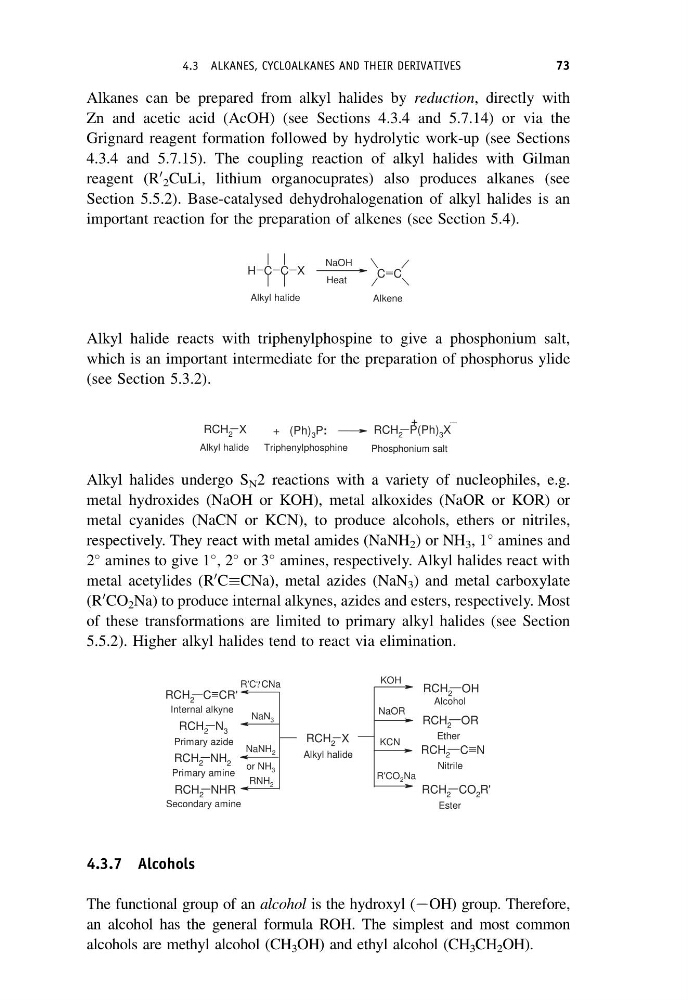
Alkyl halides undergo S N 2 reactions with a variety of nucleophiles, e.g.
metal hydroxides (NaOH or KOH), metal alkoxides (NaOR or KOR) or
metal cyanides (NaCN or KCN), to produce alcohols, ethers or nitriles,
respectively. They react with metal amides (NaNH 2 ) or NH 3 , 1
amines and
2
amines to give 1
, 2
or 3
amines, respectively. Alkyl halides react with
metal acetylides (R
0 CCNa), metal azides (NaN 3 ) and metal carboxylate
(R
0 CO 2 Na) to produce internal alkynes, azides and esters, respectively. Most
of these transformations are limited to primary alkyl halides (see Section
5.5.2). Higher alkyl halides tend to react via elimination.
RCH 2 OH
RCH 2 X
RCH 2 OR
RCH 2 C N
RCH 2 NH 2
RCH 2 CO 2 R'
RCH 2 C CR'
RCH 2 N 3
RCH 2 NHR
KOH
NaOR
KCN
Nitrile
Alcohol
Ether
Alkyl halide
NaNH 2
R'CO 2 Na
Internal alkyne
Primary amine
Ester
R'C? CNa
NaN 3
Primary azide
or NH 3
Secondary amine
RNH 2
4.3.7 Alcohols
The functional group of an alcohol is the hydroxyl (À ÀOH) group. Therefore,
an alcohol has the general formula ROH. The simplest and most common
alcohols are methyl alcohol (CH 3 OH) and ethyl alcohol (CH 3 CH 2 OH).
4.3 ALKANES, CYCLOALKANES AND THEIR DERIVATIVES
73
Zn and acetic acid (AcOH) (see Sections 4.3.4 and 5.7.14) or via the
Grignard reagent formation followed by hydrolytic work-up (see Sections
4.3.4 and 5.7.15). The coupling reaction of alkyl halides with Gilman
reagent (R
0
2 CuLi, lithium organocuprates) also produces alkanes (see
Section 5.5.2). Base-catalysed dehydrohalogenation of alkyl halides is an
important reaction for the preparation of alkenes (see Section 5.4).
C
H
C X
C C
NaOH
Alkene
Heat
Alkyl halide
Alkyl halide reacts with triphenylphospine to give a phosphonium salt,
which is an important intermediate for the preparation of phosphorus ylide
(see Section 5.3.2).
P(Ph) 3 X
RCH 2
RCH 2 X
+
Phosphonium salt
+ (Ph) 3 P:
_
Alkyl halide
Triphenylphosphine
Alkyl halides undergo S N 2 reactions with a variety of nucleophiles, e.g.
metal hydroxides (NaOH or KOH), metal alkoxides (NaOR or KOR) or
metal cyanides (NaCN or KCN), to produce alcohols, ethers or nitriles,
respectively. They react with metal amides (NaNH 2 ) or NH 3 , 1
amines and
2
amines to give 1
, 2
or 3
amines, respectively. Alkyl halides react with
metal acetylides (R
0 CCNa), metal azides (NaN 3 ) and metal carboxylate
(R
0 CO 2 Na) to produce internal alkynes, azides and esters, respectively. Most
of these transformations are limited to primary alkyl halides (see Section
5.5.2). Higher alkyl halides tend to react via elimination.
RCH 2 OH
RCH 2 X
RCH 2 OR
RCH 2 C N
RCH 2 NH 2
RCH 2 CO 2 R'
RCH 2 C CR'
RCH 2 N 3
RCH 2 NHR
KOH
NaOR
KCN
Nitrile
Alcohol
Ether
Alkyl halide
NaNH 2
R'CO 2 Na
Internal alkyne
Primary amine
Ester
R'C? CNa
NaN 3
Primary azide
or NH 3
Secondary amine
RNH 2
4.3.7 Alcohols
The functional group of an alcohol is the hydroxyl (À ÀOH) group. Therefore,
an alcohol has the general formula ROH. The simplest and most common
alcohols are methyl alcohol (CH 3 OH) and ethyl alcohol (CH 3 CH 2 OH).
4.3 ALKANES, CYCLOALKANES AND THEIR DERIVATIVES
73