

depending on the metal. The greater the ionic character of the bond, the
more reactive is the compound. The most common types of organometallic
compound are Grignard reagents, organolithium reagents and Gilman
reagents (lithium organocuprates, R 2 CuLi). A carbon–metal bond is polarized, with significant negative charge on the carbon, because metals are
electropositive. These compounds have nucleophilic carbon atoms, and
therefore are strong bases.
Organometallic reagents react readily with hydrogen atoms attached to
oxygen, nitrogen or sulphur, in addition to other acidic hydrogen atoms.
They react with terminal alkynes to form alkynides (alkynyl Grignard
reagent and alkynyllithium) by acid–base reactions (see Section 4.5.3).
Alkynides are useful nucleophiles for the synthesis of a variety of other
compounds (see Section 4.5.3). Organolithium reagents react similarly to
Grignard reagents, but they are more reactive than Grignard reagents.
Gilman reagents are weaker organometallic reagents. They react readily
with acid chlorides, but do not react with aldehydes, ketones, esters, amides,
acid anhydrides or nitriles. Gilman reagents also undergo coupling reactions
with alkyl halides.
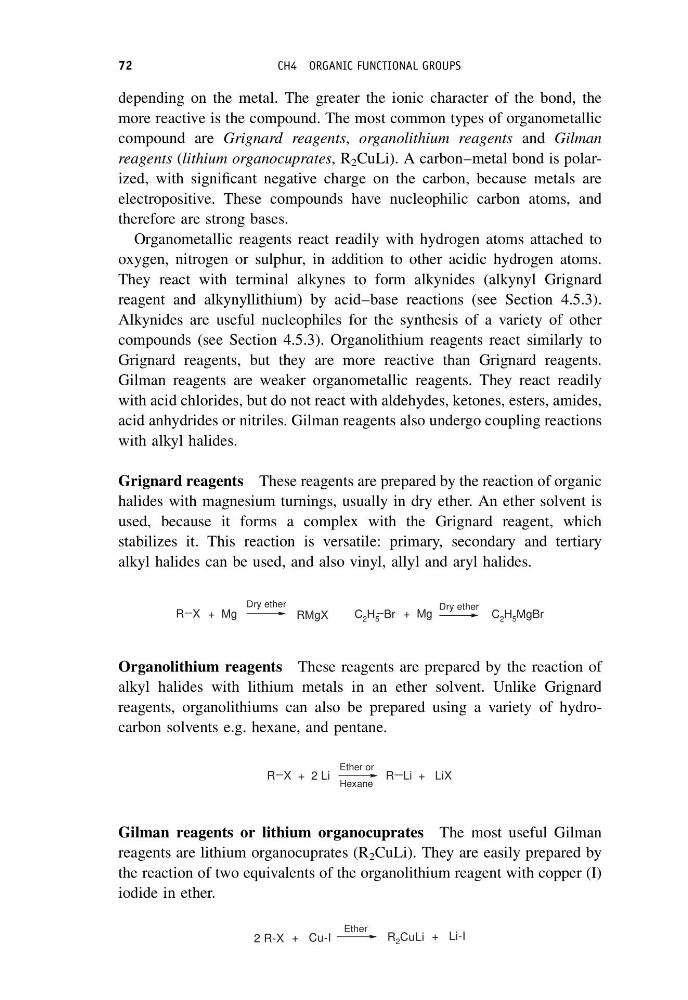
Grignard reagents These reagents are prepared by the reaction of organic
halides with magnesium turnings, usually in dry ether. An ether solvent is
used, because it forms a complex with the Grignard reagent, which
stabilizes it. This reaction is versatile: primary, secondary and tertiary
alkyl halides can be used, and also vinyl, allyl and aryl halides.
R X
C 2 H 5 Br
RMgX
C 2 H 5 MgBr
Dry ether
+ Mg
+ Mg
Dry ether
Organolithium reagents These reagents are prepared by the reaction of
alkyl halides with lithium metals in an ether solvent. Unlike Grignard
reagents, organolithiums can also be prepared using a variety of hydrocarbon solvents e.g. hexane, and pentane.
R X
R Li
+ 2 Li
+ LiX
Hexane
Ether or
Gilman reagents or lithium organocuprates The most useful Gilman
reagents are lithium organocuprates (R 2 CuLi). They are easily prepared by
the reaction of two equivalents of the organolithium reagent with copper (I)
iodide in ether.
+ Cu-I
+ Li-I
R 2 CuLi
2 R-X
Ether
72
CH4 ORGANIC FUNCTIONAL GROUPS
more reactive is the compound. The most common types of organometallic
compound are Grignard reagents, organolithium reagents and Gilman
reagents (lithium organocuprates, R 2 CuLi). A carbon–metal bond is polarized, with significant negative charge on the carbon, because metals are
electropositive. These compounds have nucleophilic carbon atoms, and
therefore are strong bases.
Organometallic reagents react readily with hydrogen atoms attached to
oxygen, nitrogen or sulphur, in addition to other acidic hydrogen atoms.
They react with terminal alkynes to form alkynides (alkynyl Grignard
reagent and alkynyllithium) by acid–base reactions (see Section 4.5.3).
Alkynides are useful nucleophiles for the synthesis of a variety of other
compounds (see Section 4.5.3). Organolithium reagents react similarly to
Grignard reagents, but they are more reactive than Grignard reagents.
Gilman reagents are weaker organometallic reagents. They react readily
with acid chlorides, but do not react with aldehydes, ketones, esters, amides,
acid anhydrides or nitriles. Gilman reagents also undergo coupling reactions
with alkyl halides.
Grignard reagents These reagents are prepared by the reaction of organic
halides with magnesium turnings, usually in dry ether. An ether solvent is
used, because it forms a complex with the Grignard reagent, which
stabilizes it. This reaction is versatile: primary, secondary and tertiary
alkyl halides can be used, and also vinyl, allyl and aryl halides.
R X
C 2 H 5 Br
RMgX
C 2 H 5 MgBr
Dry ether
+ Mg
+ Mg
Dry ether
Organolithium reagents These reagents are prepared by the reaction of
alkyl halides with lithium metals in an ether solvent. Unlike Grignard
reagents, organolithiums can also be prepared using a variety of hydrocarbon solvents e.g. hexane, and pentane.
R X
R Li
+ 2 Li
+ LiX
Hexane
Ether or
Gilman reagents or lithium organocuprates The most useful Gilman
reagents are lithium organocuprates (R 2 CuLi). They are easily prepared by
the reaction of two equivalents of the organolithium reagent with copper (I)
iodide in ether.
+ Cu-I
+ Li-I
R 2 CuLi
2 R-X
Ether
72
CH4 ORGANIC FUNCTIONAL GROUPS