

RHC CH 2
C
R
C H
H H
X H
HX
Alkyl halide
Markovnikov addition
Alkene
Reactivity of alkyl halides
The alkyl halide functional group consists of an sp
3
-hybridized carbon atom
bonded to a halogen atom via a strong s bond. The CÀ ÀX bonds in alkyl
halides are highly polar due to the higher electronegativity and polarizability of the halogen atoms. Halogens (Cl, Br and I) are good leaving groups
in the nucleophilic substitution reactions. The electronegativity of
halides decreases and the polarizability increases in the order of: F > Cl >
Br > I.
C Cl
H
H
H
µ
δ +
δ −
Chloromethane
Reactions of alkyl halides
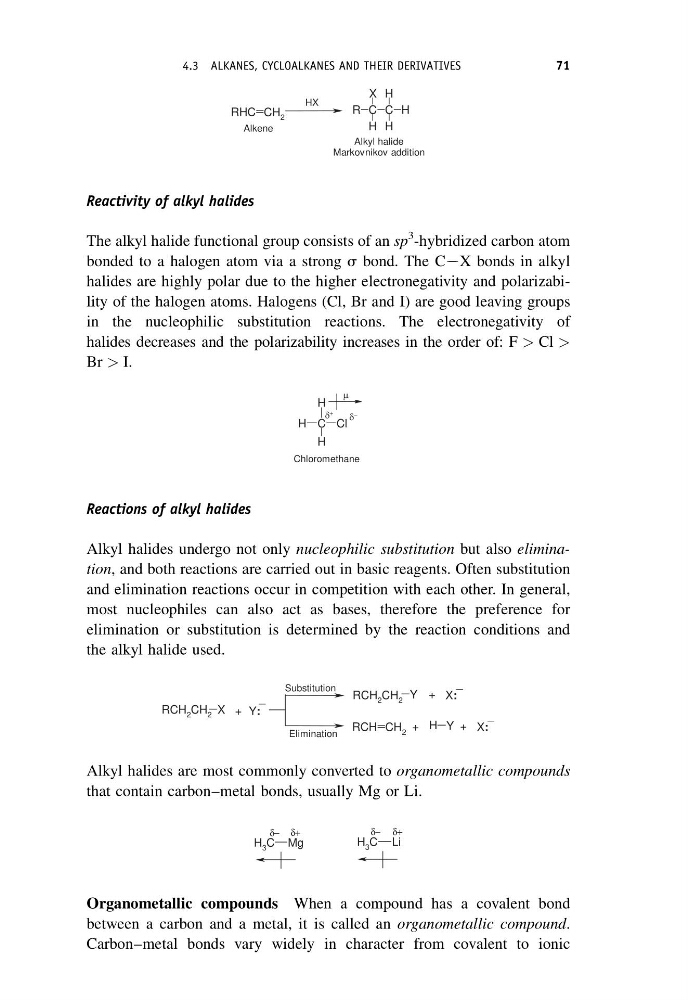
Alkyl halides undergo not only nucleophilic substitution but also elimination, and both reactions are carried out in basic reagents. Often substitution
and elimination reactions occur in competition with each other. In general,
most nucleophiles can also act as bases, therefore the preference for
elimination or substitution is determined by the reaction conditions and
the alkyl halide used.
RCH 2 CH 2 X
RCH 2 CH 2
RCH CH 2
Y
Y
Y:
_
X:
_
H
Substitution
Elimination
+
+
+
X:
_
+
Alkyl halides are most commonly converted to organometallic compounds
that contain carbon–metal bonds, usually Mg or Li.
C
H 3
Li
C
H 3
Mg
δ+
δ− δ+
δ−
Organometallic compounds When a compound has a covalent bond
between a carbon and a metal, it is called an organometallic compound.
Carbon–metal bonds vary widely in character from covalent to ionic
4.3 ALKANES, CYCLOALKANES AND THEIR DERIVATIVES
71
C
R
C H
H H
X H
HX
Alkyl halide
Markovnikov addition
Alkene
Reactivity of alkyl halides
The alkyl halide functional group consists of an sp
3
-hybridized carbon atom
bonded to a halogen atom via a strong s bond. The CÀ ÀX bonds in alkyl
halides are highly polar due to the higher electronegativity and polarizability of the halogen atoms. Halogens (Cl, Br and I) are good leaving groups
in the nucleophilic substitution reactions. The electronegativity of
halides decreases and the polarizability increases in the order of: F > Cl >
Br > I.
C Cl
H
H
H
µ
δ +
δ −
Chloromethane
Reactions of alkyl halides
Alkyl halides undergo not only nucleophilic substitution but also elimination, and both reactions are carried out in basic reagents. Often substitution
and elimination reactions occur in competition with each other. In general,
most nucleophiles can also act as bases, therefore the preference for
elimination or substitution is determined by the reaction conditions and
the alkyl halide used.
RCH 2 CH 2 X
RCH 2 CH 2
RCH CH 2
Y
Y
Y:
_
X:
_
H
Substitution
Elimination
+
+
+
X:
_
+
Alkyl halides are most commonly converted to organometallic compounds
that contain carbon–metal bonds, usually Mg or Li.
C
H 3
Li
C
H 3
Mg
δ+
δ− δ+
δ−
Organometallic compounds When a compound has a covalent bond
between a carbon and a metal, it is called an organometallic compound.
Carbon–metal bonds vary widely in character from covalent to ionic
4.3 ALKANES, CYCLOALKANES AND THEIR DERIVATIVES
71