

Nomenclature of alkyl halides
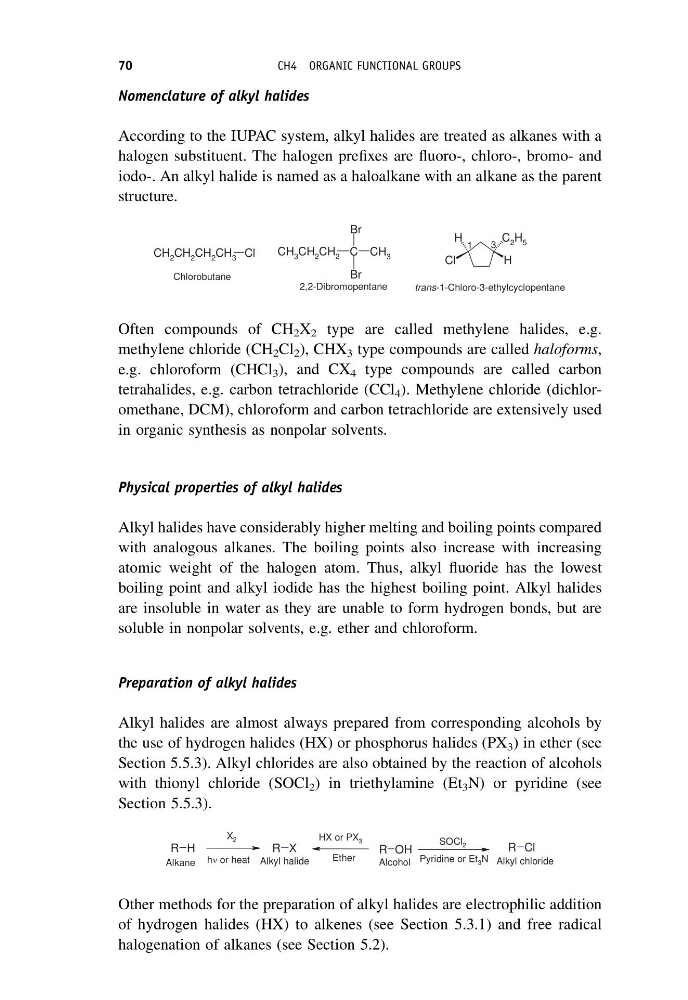
According to the IUPAC system, alkyl halides are treated as alkanes with a
halogen substituent. The halogen prefixes are fluoro-, chloro-, bromo- and
iodo-. An alkyl halide is named as a haloalkane with an alkane as the parent
structure.
Cl
CH 2 CH 2 CH 2 CH 3
H
Cl
H
C 2 H 5
C
Br
Br
CH 3
CH 3 CH 2 CH 2
Chlorobutane
trans-1-Chloro-3-ethylcyclopentane
1
3
2,2-Dibromopentane
Often compounds of CH 2 X 2 type are called methylene halides, e.g.
methylene chloride (CH 2 Cl 2 ), CHX 3 type compounds are called haloforms,
e.g. chloroform (CHCl 3 ), and CX 4 type compounds are called carbon
tetrahalides, e.g. carbon tetrachloride (CCl 4 ). Methylene chloride (dichloromethane, DCM), chloroform and carbon tetrachloride are extensively used
in organic synthesis as nonpolar solvents.
Physical properties of alkyl halides
Alkyl halides have considerably higher melting and boiling points compared
with analogous alkanes. The boiling points also increase with increasing
atomic weight of the halogen atom. Thus, alkyl fluoride has the lowest
boiling point and alkyl iodide has the highest boiling point. Alkyl halides
are insoluble in water as they are unable to form hydrogen bonds, but are
soluble in nonpolar solvents, e.g. ether and chloroform.
Preparation of alkyl halides
Alkyl halides are almost always prepared from corresponding alcohols by
the use of hydrogen halides (HX) or phosphorus halides (PX 3 ) in ether (see
Section 5.5.3). Alkyl chlorides are also obtained by the reaction of alcohols
with thionyl chloride (SOCl 2 ) in triethylamine (Et 3 N) or pyridine (see
Section 5.5.3).
R H
R OH
R X
R Cl
HX or PX 3
Alcohol
Alkane hν or heat Alkyl halide
SOCl 2
Pyridine or Et 3 N
Ether
Alkyl chloride
X 2
Other methods for the preparation of alkyl halides are electrophilic addition
of hydrogen halides (HX) to alkenes (see Section 5.3.1) and free radical
halogenation of alkanes (see Section 5.2).
70
CH4 ORGANIC FUNCTIONAL GROUPS
According to the IUPAC system, alkyl halides are treated as alkanes with a
halogen substituent. The halogen prefixes are fluoro-, chloro-, bromo- and
iodo-. An alkyl halide is named as a haloalkane with an alkane as the parent
structure.
Cl
CH 2 CH 2 CH 2 CH 3
H
Cl
H
C 2 H 5
C
Br
Br
CH 3
CH 3 CH 2 CH 2
Chlorobutane
trans-1-Chloro-3-ethylcyclopentane
1
3
2,2-Dibromopentane
Often compounds of CH 2 X 2 type are called methylene halides, e.g.
methylene chloride (CH 2 Cl 2 ), CHX 3 type compounds are called haloforms,
e.g. chloroform (CHCl 3 ), and CX 4 type compounds are called carbon
tetrahalides, e.g. carbon tetrachloride (CCl 4 ). Methylene chloride (dichloromethane, DCM), chloroform and carbon tetrachloride are extensively used
in organic synthesis as nonpolar solvents.
Physical properties of alkyl halides
Alkyl halides have considerably higher melting and boiling points compared
with analogous alkanes. The boiling points also increase with increasing
atomic weight of the halogen atom. Thus, alkyl fluoride has the lowest
boiling point and alkyl iodide has the highest boiling point. Alkyl halides
are insoluble in water as they are unable to form hydrogen bonds, but are
soluble in nonpolar solvents, e.g. ether and chloroform.
Preparation of alkyl halides
Alkyl halides are almost always prepared from corresponding alcohols by
the use of hydrogen halides (HX) or phosphorus halides (PX 3 ) in ether (see
Section 5.5.3). Alkyl chlorides are also obtained by the reaction of alcohols
with thionyl chloride (SOCl 2 ) in triethylamine (Et 3 N) or pyridine (see
Section 5.5.3).
R H
R OH
R X
R Cl
HX or PX 3
Alcohol
Alkane hν or heat Alkyl halide
SOCl 2
Pyridine or Et 3 N
Ether
Alkyl chloride
X 2
Other methods for the preparation of alkyl halides are electrophilic addition
of hydrogen halides (HX) to alkenes (see Section 5.3.1) and free radical
halogenation of alkanes (see Section 5.2).
70
CH4 ORGANIC FUNCTIONAL GROUPS