

CH 3 CH 2 CH 3
CH 4 + 2 O 2
+ 2 O 2
CO 2
3 CO 2
+ 2 H 2 O
+ 4 H 2 O
Methane
Propane
Reduction of smaller cycloalkanes
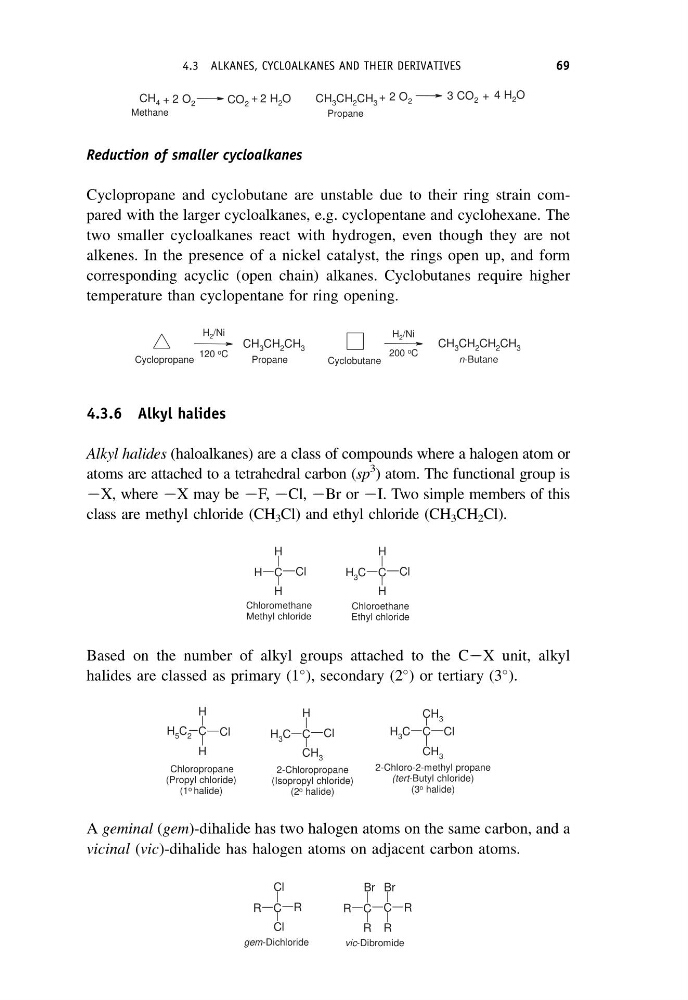
Cyclopropane and cyclobutane are unstable due to their ring strain compared with the larger cycloalkanes, e.g. cyclopentane and cyclohexane. The
two smaller cycloalkanes react with hydrogen, even though they are not
alkenes. In the presence of a nickel catalyst, the rings open up, and form
corresponding acyclic (open chain) alkanes. Cyclobutanes require higher
temperature than cyclopentane for ring opening.
CH 3 CH 2 CH 3
H 2 /Ni
120 o C
CH 3 CH 2 CH 2 CH 3
H 2 /Ni
200 o C
Cyclopropane
Propane
Cyclobutane
n-Butane
4.3.6 Alkyl halides
Alkyl halides (haloalkanes) are a class of compounds where a halogen atom or
atoms are attached to a tetrahedral carbon (sp
3
) atom. The functional group is
À ÀX, where À ÀX may be À ÀF, À ÀCl, À ÀBr or À ÀI. Two simple members of this
class are methyl chloride (CH 3 Cl) and ethyl chloride (CH 3 CH 2 Cl).
H C
H
H
Cl
C
H 3
C
H
H
Cl
Chloroethane
Ethyl chloride
Chloromethane
Methyl chloride
Based on the number of alkyl groups attached to the CÀ ÀX unit, alkyl
halides are classed as primary (1
), secondary (2
) or tertiary (3
).
C
H 3
C
H
CH 3
Cl
C
H 3
C
CH 3
CH 3
Cl
H 5 C 2 C
H
H
Cl
Chloropropane
(Propyl chloride)
(1 o halide)
2-Chloropropane
(Isopropyl chloride)
(2 o halide)
2-Chloro-2-methyl propane
(tert-Butyl chloride)
(3 o halide)
A geminal (gem)-dihalide has two halogen atoms on the same carbon, and a
vicinal (vic)-dihalide has halogen atoms on adjacent carbon atoms.
R C
Cl
Cl
R
R C
Br
C R
Br
R R
gem-Dichloride
vic-Dibromide
4.3 ALKANES, CYCLOALKANES AND THEIR DERIVATIVES
69
CH 4 + 2 O 2
+ 2 O 2
CO 2
3 CO 2
+ 2 H 2 O
+ 4 H 2 O
Methane
Propane
Reduction of smaller cycloalkanes
Cyclopropane and cyclobutane are unstable due to their ring strain compared with the larger cycloalkanes, e.g. cyclopentane and cyclohexane. The
two smaller cycloalkanes react with hydrogen, even though they are not
alkenes. In the presence of a nickel catalyst, the rings open up, and form
corresponding acyclic (open chain) alkanes. Cyclobutanes require higher
temperature than cyclopentane for ring opening.
CH 3 CH 2 CH 3
H 2 /Ni
120 o C
CH 3 CH 2 CH 2 CH 3
H 2 /Ni
200 o C
Cyclopropane
Propane
Cyclobutane
n-Butane
4.3.6 Alkyl halides
Alkyl halides (haloalkanes) are a class of compounds where a halogen atom or
atoms are attached to a tetrahedral carbon (sp
3
) atom. The functional group is
À ÀX, where À ÀX may be À ÀF, À ÀCl, À ÀBr or À ÀI. Two simple members of this
class are methyl chloride (CH 3 Cl) and ethyl chloride (CH 3 CH 2 Cl).
H C
H
H
Cl
C
H 3
C
H
H
Cl
Chloroethane
Ethyl chloride
Chloromethane
Methyl chloride
Based on the number of alkyl groups attached to the CÀ ÀX unit, alkyl
halides are classed as primary (1
), secondary (2
) or tertiary (3
).
C
H 3
C
H
CH 3
Cl
C
H 3
C
CH 3
CH 3
Cl
H 5 C 2 C
H
H
Cl
Chloropropane
(Propyl chloride)
(1 o halide)
2-Chloropropane
(Isopropyl chloride)
(2 o halide)
2-Chloro-2-methyl propane
(tert-Butyl chloride)
(3 o halide)
A geminal (gem)-dihalide has two halogen atoms on the same carbon, and a
vicinal (vic)-dihalide has halogen atoms on adjacent carbon atoms.
R C
Cl
Cl
R
R C
Br
C R
Br
R R
gem-Dichloride
vic-Dibromide
4.3 ALKANES, CYCLOALKANES AND THEIR DERIVATIVES
69