

C C R
R
RHC CHR
C
R
C R
H H
H H
Pt-C or Pd-C
H 2
Alkene
Alkyne
Pt-C or Pd-C
2 H 2
Alkane
Pt-C or Pd-C
H 2
Cyclohexene
Cyclohexane
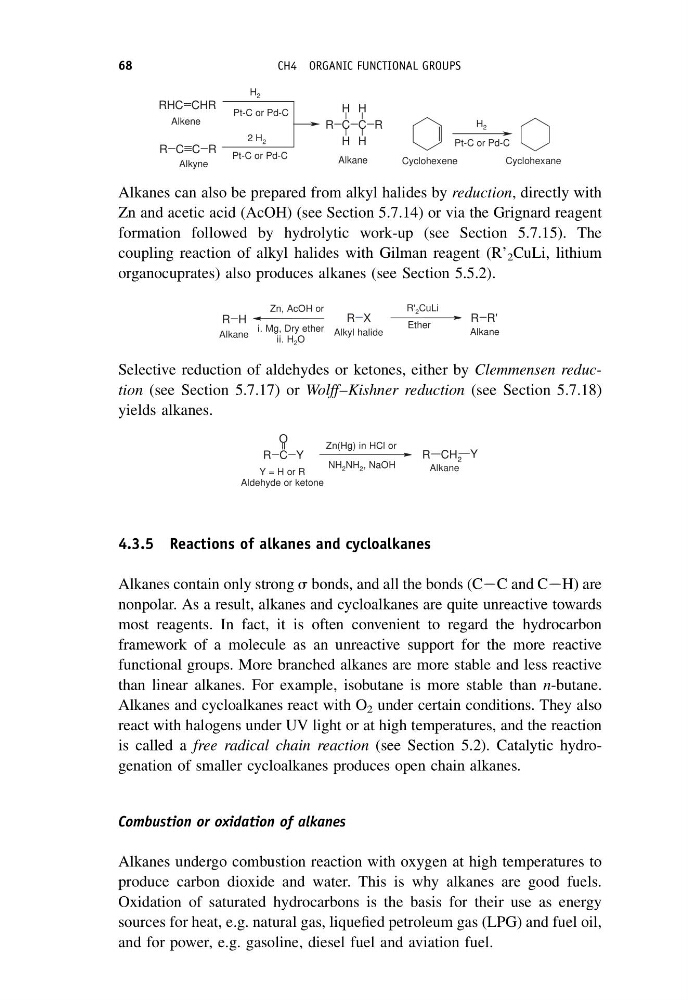
Alkanes can also be prepared from alkyl halides by reduction, directly with
Zn and acetic acid (AcOH) (see Section 5.7.14) or via the Grignard reagent
formation followed by hydrolytic work-up (see Section 5.7.15). The
coupling reaction of alkyl halides with Gilman reagent (R’ 2 CuLi, lithium
organocuprates) also produces alkanes (see Section 5.5.2).
R X
R H
R R'
i. Mg, Dry ether
ii. H 2 O
Zn, AcOH or
Alkyl halide
Alkane
R' 2 CuLi
Alkane
Ether
Selective reduction of aldehydes or ketones, either by Clemmensen reduction (see Section 5.7.17) or Wolff–Kishner reduction (see Section 5.7.18)
yields alkanes.
R C Y
O
R CH 2 Y
Zn(Hg) in HCl or
NH 2 NH 2 , NaOH
Y = H or R
Aldehyde or ketone
Alkane
4.3.5 Reactions of alkanes and cycloalkanes
Alkanes contain only strong s bonds, and all the bonds (CÀ ÀC and CÀ ÀH) are
nonpolar. As a result, alkanes and cycloalkanes are quite unreactive towards
most reagents. In fact, it is often convenient to regard the hydrocarbon
framework of a molecule as an unreactive support for the more reactive
functional groups. More branched alkanes are more stable and less reactive
than linear alkanes. For example, isobutane is more stable than n-butane.
Alkanes and cycloalkanes react with O 2 under certain conditions. They also
react with halogens under UV light or at high temperatures, and the reaction
is called a free radical chain reaction (see Section 5.2). Catalytic hydrogenation of smaller cycloalkanes produces open chain alkanes.
Combustion or oxidation of alkanes
Alkanes undergo combustion reaction with oxygen at high temperatures to
produce carbon dioxide and water. This is why alkanes are good fuels.
Oxidation of saturated hydrocarbons is the basis for their use as energy
sources for heat, e.g. natural gas, liquefied petroleum gas (LPG) and fuel oil,
and for power, e.g. gasoline, diesel fuel and aviation fuel.
68
CH4 ORGANIC FUNCTIONAL GROUPS
R
RHC CHR
C
R
C R
H H
H H
Pt-C or Pd-C
H 2
Alkene
Alkyne
Pt-C or Pd-C
2 H 2
Alkane
Pt-C or Pd-C
H 2
Cyclohexene
Cyclohexane
Alkanes can also be prepared from alkyl halides by reduction, directly with
Zn and acetic acid (AcOH) (see Section 5.7.14) or via the Grignard reagent
formation followed by hydrolytic work-up (see Section 5.7.15). The
coupling reaction of alkyl halides with Gilman reagent (R’ 2 CuLi, lithium
organocuprates) also produces alkanes (see Section 5.5.2).
R X
R H
R R'
i. Mg, Dry ether
ii. H 2 O
Zn, AcOH or
Alkyl halide
Alkane
R' 2 CuLi
Alkane
Ether
Selective reduction of aldehydes or ketones, either by Clemmensen reduction (see Section 5.7.17) or Wolff–Kishner reduction (see Section 5.7.18)
yields alkanes.
R C Y
O
R CH 2 Y
Zn(Hg) in HCl or
NH 2 NH 2 , NaOH
Y = H or R
Aldehyde or ketone
Alkane
4.3.5 Reactions of alkanes and cycloalkanes
Alkanes contain only strong s bonds, and all the bonds (CÀ ÀC and CÀ ÀH) are
nonpolar. As a result, alkanes and cycloalkanes are quite unreactive towards
most reagents. In fact, it is often convenient to regard the hydrocarbon
framework of a molecule as an unreactive support for the more reactive
functional groups. More branched alkanes are more stable and less reactive
than linear alkanes. For example, isobutane is more stable than n-butane.
Alkanes and cycloalkanes react with O 2 under certain conditions. They also
react with halogens under UV light or at high temperatures, and the reaction
is called a free radical chain reaction (see Section 5.2). Catalytic hydrogenation of smaller cycloalkanes produces open chain alkanes.
Combustion or oxidation of alkanes
Alkanes undergo combustion reaction with oxygen at high temperatures to
produce carbon dioxide and water. This is why alkanes are good fuels.
Oxidation of saturated hydrocarbons is the basis for their use as energy
sources for heat, e.g. natural gas, liquefied petroleum gas (LPG) and fuel oil,
and for power, e.g. gasoline, diesel fuel and aviation fuel.
68
CH4 ORGANIC FUNCTIONAL GROUPS