

CH 3
CH 3
CH 3
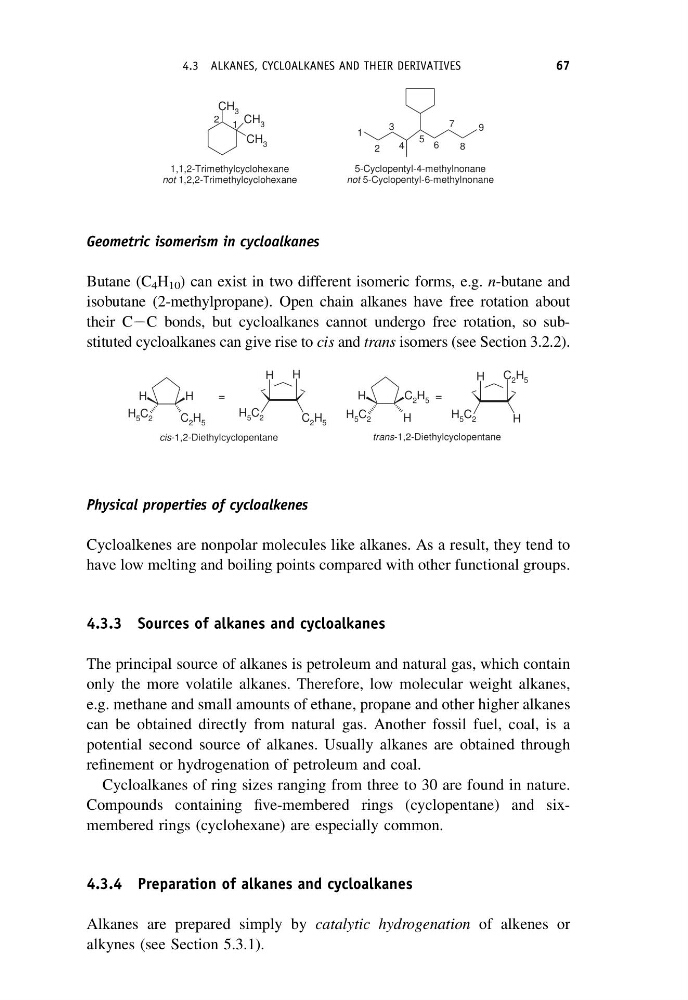
5-Cyclopentyl-4-methylnonane
not 5-Cyclopentyl-6-methylnonane
1
2
3
4
5 6
7
8
9
1,1,2-Trimethylcyclohexane
not 1,2,2-Trimethylcyclohexane
1
2
Geometric isomerism in cycloalkanes
Butane (C 4 H 10 ) can exist in two different isomeric forms, e.g. n-butane and
isobutane (2-methylpropane). Open chain alkanes have free rotation about
their CÀ ÀC bonds, but cycloalkanes cannot undergo free rotation, so substituted cycloalkanes can give rise to cis and trans isomers (see Section 3.2.2).
H
H 5 C 2
C 2 H 5
H
H
H
C 2 H 5
H 5 C 2
H
H 5 C 2
H
C 2 H 5
C 2 H 5
H
H 5 C 2
H
=
cis-1,2-Diethylcyclopentane
=
trans-1,2-Diethylcyclopentane
Physical properties of cycloalkenes
Cycloalkenes are nonpolar molecules like alkanes. As a result, they tend to
have low melting and boiling points compared with other functional groups.
4.3.3 Sources of alkanes and cycloalkanes
The principal source of alkanes is petroleum and natural gas, which contain
only the more volatile alkanes. Therefore, low molecular weight alkanes,
e.g. methane and small amounts of ethane, propane and other higher alkanes
can be obtained directly from natural gas. Another fossil fuel, coal, is a
potential second source of alkanes. Usually alkanes are obtained through
refinement or hydrogenation of petroleum and coal.
Cycloalkanes of ring sizes ranging from three to 30 are found in nature.
Compounds containing five-membered rings (cyclopentane) and sixmembered rings (cyclohexane) are especially common.
4.3.4 Preparation of alkanes and cycloalkanes
Alkanes are prepared simply by catalytic hydrogenation of alkenes or
alkynes (see Section 5.3.1).
4.3 ALKANES, CYCLOALKANES AND THEIR DERIVATIVES
67
CH 3
CH 3
5-Cyclopentyl-4-methylnonane
not 5-Cyclopentyl-6-methylnonane
1
2
3
4
5 6
7
8
9
1,1,2-Trimethylcyclohexane
not 1,2,2-Trimethylcyclohexane
1
2
Geometric isomerism in cycloalkanes
Butane (C 4 H 10 ) can exist in two different isomeric forms, e.g. n-butane and
isobutane (2-methylpropane). Open chain alkanes have free rotation about
their CÀ ÀC bonds, but cycloalkanes cannot undergo free rotation, so substituted cycloalkanes can give rise to cis and trans isomers (see Section 3.2.2).
H
H 5 C 2
C 2 H 5
H
H
H
C 2 H 5
H 5 C 2
H
H 5 C 2
H
C 2 H 5
C 2 H 5
H
H 5 C 2
H
=
cis-1,2-Diethylcyclopentane
=
trans-1,2-Diethylcyclopentane
Physical properties of cycloalkenes
Cycloalkenes are nonpolar molecules like alkanes. As a result, they tend to
have low melting and boiling points compared with other functional groups.
4.3.3 Sources of alkanes and cycloalkanes
The principal source of alkanes is petroleum and natural gas, which contain
only the more volatile alkanes. Therefore, low molecular weight alkanes,
e.g. methane and small amounts of ethane, propane and other higher alkanes
can be obtained directly from natural gas. Another fossil fuel, coal, is a
potential second source of alkanes. Usually alkanes are obtained through
refinement or hydrogenation of petroleum and coal.
Cycloalkanes of ring sizes ranging from three to 30 are found in nature.
Compounds containing five-membered rings (cyclopentane) and sixmembered rings (cyclohexane) are especially common.
4.3.4 Preparation of alkanes and cycloalkanes
Alkanes are prepared simply by catalytic hydrogenation of alkenes or
alkynes (see Section 5.3.1).
4.3 ALKANES, CYCLOALKANES AND THEIR DERIVATIVES
67