

4.3.2 Cycloalkanes
Cycloalkanes are alkanes that are cyclic with the general formula C n H 2n .
The simplest members of this class consist of a single, unsubstituted carbon
ring, and these form a homologous series similar to the unbranched alkanes.
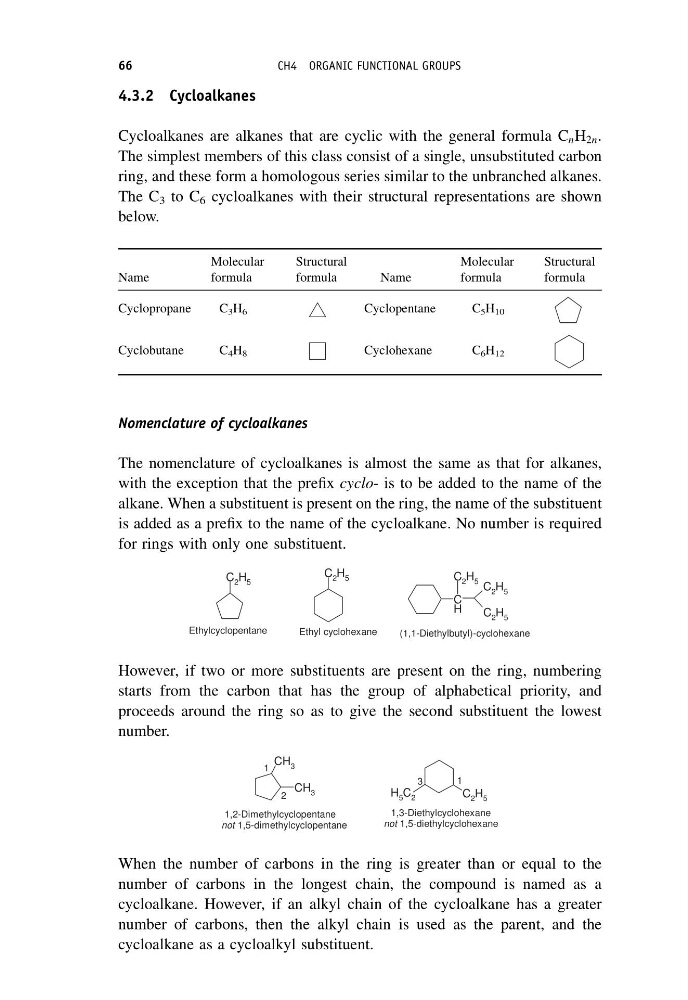
The C 3 to C 6 cycloalkanes with their structural representations are shown
below.
Molecular
Structural
Molecular
Structural
Name
formula
formula
Name
formula
formula
Cyclopropane
C 3 H 6
Cyclopentane
C 5 H 10
Cyclobutane
C 4 H 8
Cyclohexane
C 6 H 12
Nomenclature of cycloalkanes
The nomenclature of cycloalkanes is almost the same as that for alkanes,
with the exception that the prefix cyclo- is to be added to the name of the
alkane. When a substituent is present on the ring, the name of the substituent
is added as a prefix to the name of the cycloalkane. No number is required
for rings with only one substituent.
C 2 H 5
C 2 H 5
C
H
C 2 H 5 C 2 H 5
C 2 H 5
Ethyl cyclohexane
Ethylcyclopentane
(1,1-Diethylbutyl)-cyclohexane
However, if two or more substituents are present on the ring, numbering
starts from the carbon that has the group of alphabetical priority, and
proceeds around the ring so as to give the second substituent the lowest
number.
C 2 H 5
H 5 C 2
CH 3
CH 3
1,3-Diethylcyclohexane
not 1,5-diethylcyclohexane
1
3
1,2-Dimethylcyclopentane
not 1,5-dimethylcyclopentane
1
2
When the number of carbons in the ring is greater than or equal to the
number of carbons in the longest chain, the compound is named as a
cycloalkane. However, if an alkyl chain of the cycloalkane has a greater
number of carbons, then the alkyl chain is used as the parent, and the
cycloalkane as a cycloalkyl substituent.
66
CH4 ORGANIC FUNCTIONAL GROUPS
Cycloalkanes are alkanes that are cyclic with the general formula C n H 2n .
The simplest members of this class consist of a single, unsubstituted carbon
ring, and these form a homologous series similar to the unbranched alkanes.
The C 3 to C 6 cycloalkanes with their structural representations are shown
below.
Molecular
Structural
Molecular
Structural
Name
formula
formula
Name
formula
formula
Cyclopropane
C 3 H 6
Cyclopentane
C 5 H 10
Cyclobutane
C 4 H 8
Cyclohexane
C 6 H 12
Nomenclature of cycloalkanes
The nomenclature of cycloalkanes is almost the same as that for alkanes,
with the exception that the prefix cyclo- is to be added to the name of the
alkane. When a substituent is present on the ring, the name of the substituent
is added as a prefix to the name of the cycloalkane. No number is required
for rings with only one substituent.
C 2 H 5
C 2 H 5
C
H
C 2 H 5 C 2 H 5
C 2 H 5
Ethyl cyclohexane
Ethylcyclopentane
(1,1-Diethylbutyl)-cyclohexane
However, if two or more substituents are present on the ring, numbering
starts from the carbon that has the group of alphabetical priority, and
proceeds around the ring so as to give the second substituent the lowest
number.
C 2 H 5
H 5 C 2
CH 3
CH 3
1,3-Diethylcyclohexane
not 1,5-diethylcyclohexane
1
3
1,2-Dimethylcyclopentane
not 1,5-dimethylcyclopentane
1
2
When the number of carbons in the ring is greater than or equal to the
number of carbons in the longest chain, the compound is named as a
cycloalkane. However, if an alkyl chain of the cycloalkane has a greater
number of carbons, then the alkyl chain is used as the parent, and the
cycloalkane as a cycloalkyl substituent.
66
CH4 ORGANIC FUNCTIONAL GROUPS