

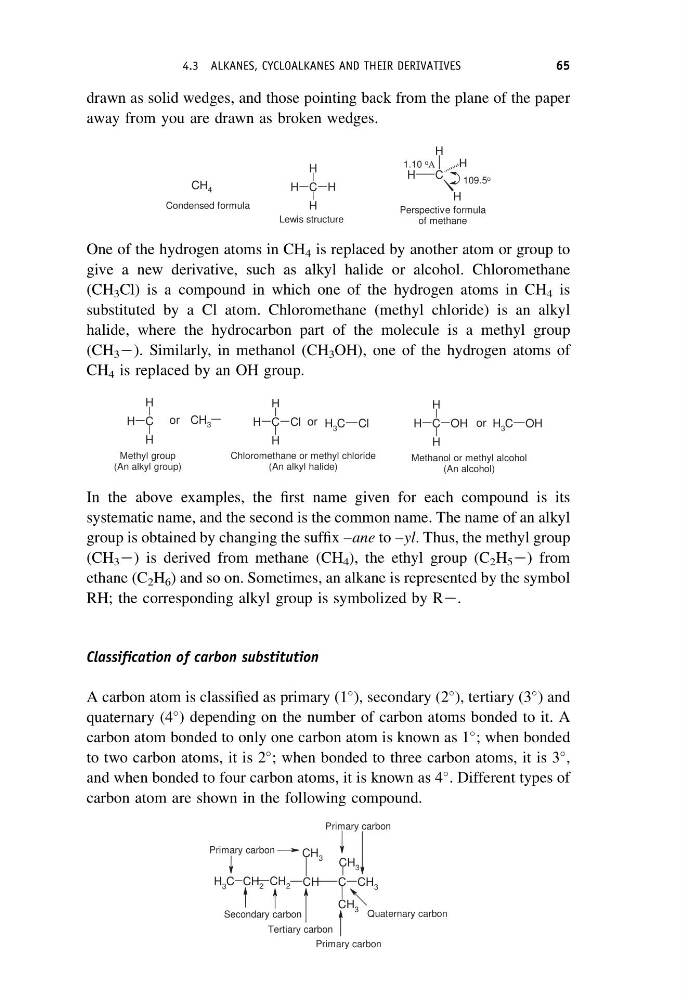
drawn as solid wedges, and those pointing back from the plane of the paper
away from you are drawn as broken wedges.
C
H
H
H
H
H C H
H
H
Perspective formula
of methane
109.5 o
1.10 o Α
Lewis structure
CH 4
Condensed formula
One of the hydrogen atoms in CH 4 is replaced by another atom or group to
give a new derivative, such as alkyl halide or alcohol. Chloromethane
(CH 3 Cl) is a compound in which one of the hydrogen atoms in CH 4 is
substituted by a Cl atom. Chloromethane (methyl chloride) is an alkyl
halide, where the hydrocarbon part of the molecule is a methyl group
(CH 3 À À). Similarly, in methanol (CH 3 OH), one of the hydrogen atoms of
CH 4 is replaced by an OH group.
C
H 3
OH
C
H
H
H
C
H 3
Cl
C
H
H
H
Cl
C
H
H
H
OH or
Methanol or methyl alcohol
(An alcohol)
CH 3
Methyl group
(An alkyl group)
or
or
Chloromethane or methyl chloride
(An alkyl halide)
In the above examples, the first name given for each compound is its
systematic name, and the second is the common name. The name of an alkyl
group is obtained by changing the suffix –ane to –yl. Thus, the methyl group
(CH 3 À À) is derived from methane (CH 4 ), the ethyl group (C 2 H 5 À À) from
ethane (C 2 H 6 ) and so on. Sometimes, an alkane is represented by the symbol
RH; the corresponding alkyl group is symbolized by RÀ À.
Classification of carbon substitution
A carbon atom is classified as primary (1
), secondary (2
), tertiary (3
) and
quaternary (4
) depending on the number of carbon atoms bonded to it. A
carbon atom bonded to only one carbon atom is known as 1
; when bonded
to two carbon atoms, it is 2
; when bonded to three carbon atoms, it is 3
,
and when bonded to four carbon atoms, it is known as 4
. Different types of
carbon atom are shown in the following compound.
C
H 3 CH 2 CH 2 CH
CH 3
C CH 3
CH 3
CH 3
Primary carbon
Secondary carbon
Tertiary carbon
Quaternary carbon
Primary carbon
Primary carbon
4.3 ALKANES, CYCLOALKANES AND THEIR DERIVATIVES
65
away from you are drawn as broken wedges.
C
H
H
H
H
H C H
H
H
Perspective formula
of methane
109.5 o
1.10 o Α
Lewis structure
CH 4
Condensed formula
One of the hydrogen atoms in CH 4 is replaced by another atom or group to
give a new derivative, such as alkyl halide or alcohol. Chloromethane
(CH 3 Cl) is a compound in which one of the hydrogen atoms in CH 4 is
substituted by a Cl atom. Chloromethane (methyl chloride) is an alkyl
halide, where the hydrocarbon part of the molecule is a methyl group
(CH 3 À À). Similarly, in methanol (CH 3 OH), one of the hydrogen atoms of
CH 4 is replaced by an OH group.
C
H 3
OH
C
H
H
H
C
H 3
Cl
C
H
H
H
Cl
C
H
H
H
OH or
Methanol or methyl alcohol
(An alcohol)
CH 3
Methyl group
(An alkyl group)
or
or
Chloromethane or methyl chloride
(An alkyl halide)
In the above examples, the first name given for each compound is its
systematic name, and the second is the common name. The name of an alkyl
group is obtained by changing the suffix –ane to –yl. Thus, the methyl group
(CH 3 À À) is derived from methane (CH 4 ), the ethyl group (C 2 H 5 À À) from
ethane (C 2 H 6 ) and so on. Sometimes, an alkane is represented by the symbol
RH; the corresponding alkyl group is symbolized by RÀ À.
Classification of carbon substitution
A carbon atom is classified as primary (1
), secondary (2
), tertiary (3
) and
quaternary (4
) depending on the number of carbon atoms bonded to it. A
carbon atom bonded to only one carbon atom is known as 1
; when bonded
to two carbon atoms, it is 2
; when bonded to three carbon atoms, it is 3
,
and when bonded to four carbon atoms, it is known as 4
. Different types of
carbon atom are shown in the following compound.
C
H 3 CH 2 CH 2 CH
CH 3
C CH 3
CH 3
CH 3
Primary carbon
Secondary carbon
Tertiary carbon
Quaternary carbon
Primary carbon
Primary carbon
4.3 ALKANES, CYCLOALKANES AND THEIR DERIVATIVES
65