

CH 2 OH
O
H
H
COOH
HOH 2 C
H
OH
COOH
(R)-2,3-Dihydroxypropanoic acid
Priority order 1 to 4 is in clockwise direction
(S)-2,3-Dihydroxypropanoic acid
Priority order 1 to 4 is in clockwise direction
1
2
3
4
1
2
3
4
When there is more than one stereocentre (chiral carbon) present in a
molecule, it is possible to have more than two stereoisomers. It is then
necessary to designate all these stereoisomers using the (R) and (S) system.
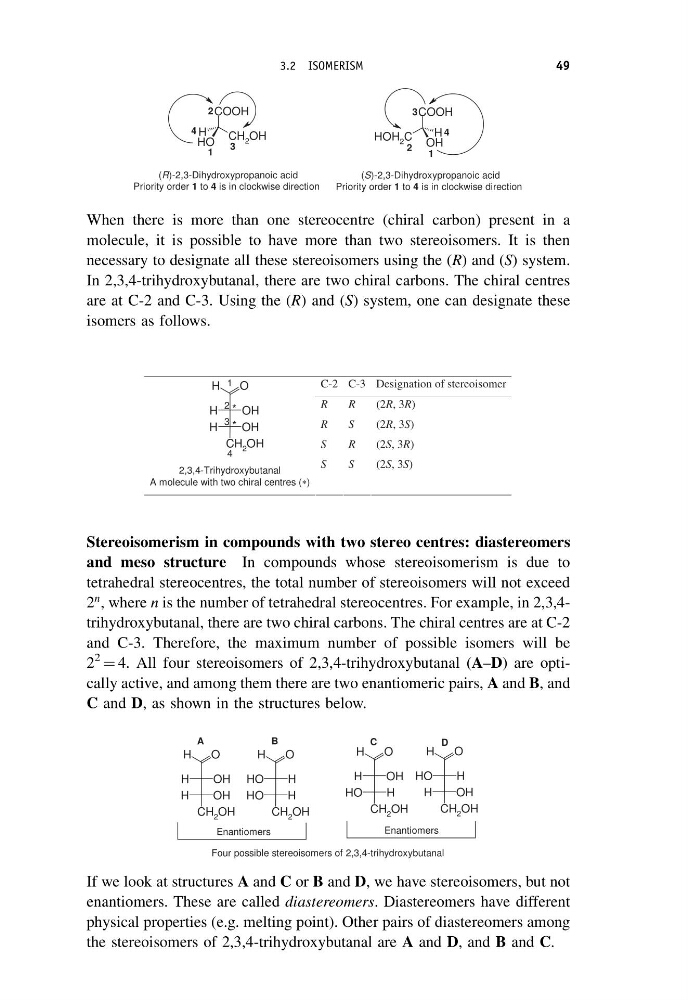
In 2,3,4-trihydroxybutanal, there are two chiral carbons. The chiral centres
are at C-2 and C-3. Using the (R) and (S) system, one can designate these
isomers as follows.
Stereoisomerism in compounds with two stereo centres: diastereomers
and meso structure In compounds whose stereoisomerism is due to
tetrahedral stereocentres, the total number of stereoisomers will not exceed
2
n , where n is the number of tetrahedral stereocentres. For example, in 2,3,4trihydroxybutanal, there are two chiral carbons. The chiral centres are at C-2
and C-3. Therefore, the maximum number of possible isomers will be
2
2 ¼ 4. All four stereoisomers of 2,3,4-trihydroxybutanal (A–D) are optically active, and among them there are two enantiomeric pairs, A and B, and
C and D, as shown in the structures below.
OH
H
OH
H
CH 2 OH
O
H
H
O
H
H
O
H
CH 2 OH
O
H
OH
H
H
O
H
CH 2 OH
O
H
H
O
H
OH
H
CH 2 OH
O
H
Enantiomers
Enantiomers
Four possible stereoisomers of 2,3,4-trihydroxybutanal
A
B
C
D
If we look at structures A and C or B and D, we have stereoisomers, but not
enantiomers. These are called diastereomers. Diastereomers have different
physical properties (e.g. melting point). Other pairs of diastereomers among
the stereoisomers of 2,3,4-trihydroxybutanal are A and D, and B and C.
C-2 C-3 Designation of stereoisomer
R
R
(2R, 3R)
R
S
(2R, 3S)
S
R
(2S, 3R)
OH
H
OH
H
CH 2 OH
O
H
*
*
1
2
3
4
2,3,4-Trihydroxybutanal
A molecule with two chiral centres (∗)
S
S
(2S, 3S)
3.2 ISOMERISM
49
O
H
H
COOH
HOH 2 C
H
OH
COOH
(R)-2,3-Dihydroxypropanoic acid
Priority order 1 to 4 is in clockwise direction
(S)-2,3-Dihydroxypropanoic acid
Priority order 1 to 4 is in clockwise direction
1
2
3
4
1
2
3
4
When there is more than one stereocentre (chiral carbon) present in a
molecule, it is possible to have more than two stereoisomers. It is then
necessary to designate all these stereoisomers using the (R) and (S) system.
In 2,3,4-trihydroxybutanal, there are two chiral carbons. The chiral centres
are at C-2 and C-3. Using the (R) and (S) system, one can designate these
isomers as follows.
Stereoisomerism in compounds with two stereo centres: diastereomers
and meso structure In compounds whose stereoisomerism is due to
tetrahedral stereocentres, the total number of stereoisomers will not exceed
2
n , where n is the number of tetrahedral stereocentres. For example, in 2,3,4trihydroxybutanal, there are two chiral carbons. The chiral centres are at C-2
and C-3. Therefore, the maximum number of possible isomers will be
2
2 ¼ 4. All four stereoisomers of 2,3,4-trihydroxybutanal (A–D) are optically active, and among them there are two enantiomeric pairs, A and B, and
C and D, as shown in the structures below.
OH
H
OH
H
CH 2 OH
O
H
H
O
H
H
O
H
CH 2 OH
O
H
OH
H
H
O
H
CH 2 OH
O
H
H
O
H
OH
H
CH 2 OH
O
H
Enantiomers
Enantiomers
Four possible stereoisomers of 2,3,4-trihydroxybutanal
A
B
C
D
If we look at structures A and C or B and D, we have stereoisomers, but not
enantiomers. These are called diastereomers. Diastereomers have different
physical properties (e.g. melting point). Other pairs of diastereomers among
the stereoisomers of 2,3,4-trihydroxybutanal are A and D, and B and C.
C-2 C-3 Designation of stereoisomer
R
R
(2R, 3R)
R
S
(2R, 3S)
S
R
(2S, 3R)
OH
H
OH
H
CH 2 OH
O
H
*
*
1
2
3
4
2,3,4-Trihydroxybutanal
A molecule with two chiral centres (∗)
S
S
(2S, 3S)
3.2 ISOMERISM
49