

group. In this case, on the basis of the atomic number of the carbon atom
alone, one cannot assign the priority of these two carbon atoms, and
must consider the next set of atoms attached to these carbon atoms.
When we examine the methyl group of the enantiomer, we find that the
next set of atoms consists of three H atoms. On the other hand, in the
propyl group, the next set of atoms consists of one C and two H atoms.
Carbon has a higher atomic number than H, so the CH 3 CH 2 CH 2 – group
receives priority over CH 3 .
(c) Groups containing double or triple bonds (p bonds) are assigned
priorities as if both atoms were duplicated or triplicated. For example
C O
C
O
O
C
as if it were
C N
C
N
N
C
C
N
as if it were
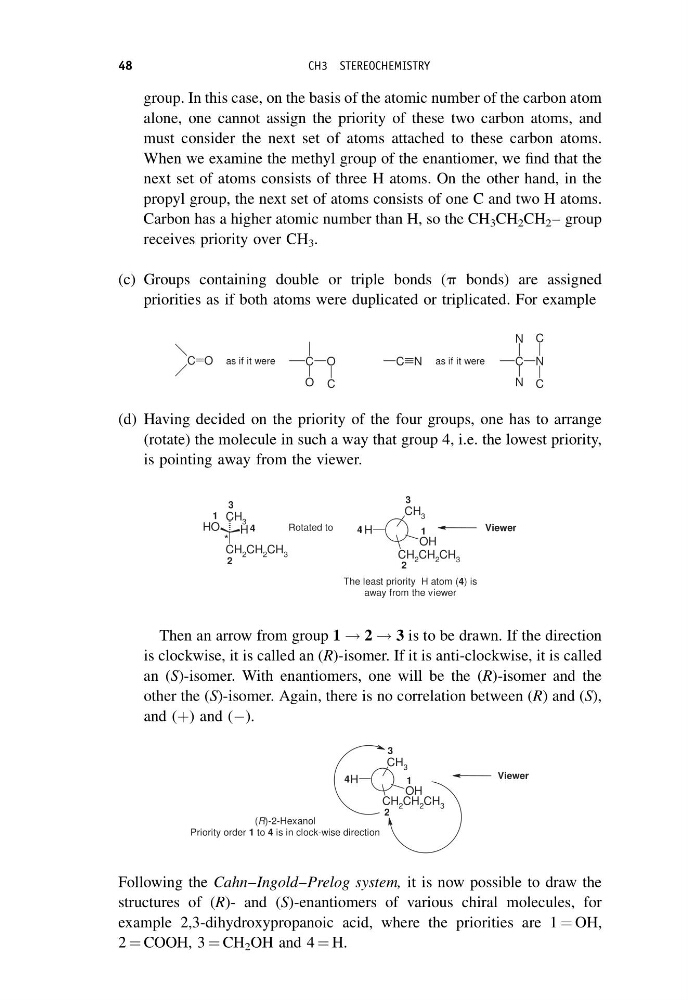
(d) Having decided on the priority of the four groups, one has to arrange
(rotate) the molecule in such a way that group 4, i.e. the lowest priority,
is pointing away from the viewer.
CH 3
H
O
H
CH 2 CH 2 CH 3
CH 3
CH 2 CH 2 CH 3
H
OH
*
1
2
3
4
Rotated to
Viewer
1
2
3
4
The least priority H atom (4) is
away from the viewer
Then an arrow from group 1 ! 2 ! 3 is to be drawn. If the direction
is clockwise, it is called an (R)-isomer. If it is anti-clockwise, it is called
an (S)-isomer. With enantiomers, one will be the (R)-isomer and the
other the (S)-isomer. Again, there is no correlation between (R) and (S),
and (þ) and (À).
CH 3
CH 2 CH 2 CH 3
H
OH
Viewer
1
2
3
4
(R)-2-Hexanol
Priority order 1 to 4 is in clock-wise direction
Following the Cahn–Ingold–Prelog system, it is now possible to draw the
structures of (R)- and (S)-enantiomers of various chiral molecules, for
example 2,3-dihydroxypropanoic acid, where the priorities are 1 ¼ OH,
2 ¼ COOH, 3 ¼ CH 2 OH and 4 ¼ H.
48
CH3 STEREOCHEMISTRY
alone, one cannot assign the priority of these two carbon atoms, and
must consider the next set of atoms attached to these carbon atoms.
When we examine the methyl group of the enantiomer, we find that the
next set of atoms consists of three H atoms. On the other hand, in the
propyl group, the next set of atoms consists of one C and two H atoms.
Carbon has a higher atomic number than H, so the CH 3 CH 2 CH 2 – group
receives priority over CH 3 .
(c) Groups containing double or triple bonds (p bonds) are assigned
priorities as if both atoms were duplicated or triplicated. For example
C O
C
O
O
C
as if it were
C N
C
N
N
C
C
N
as if it were
(d) Having decided on the priority of the four groups, one has to arrange
(rotate) the molecule in such a way that group 4, i.e. the lowest priority,
is pointing away from the viewer.
CH 3
H
O
H
CH 2 CH 2 CH 3
CH 3
CH 2 CH 2 CH 3
H
OH
*
1
2
3
4
Rotated to
Viewer
1
2
3
4
The least priority H atom (4) is
away from the viewer
Then an arrow from group 1 ! 2 ! 3 is to be drawn. If the direction
is clockwise, it is called an (R)-isomer. If it is anti-clockwise, it is called
an (S)-isomer. With enantiomers, one will be the (R)-isomer and the
other the (S)-isomer. Again, there is no correlation between (R) and (S),
and (þ) and (À).
CH 3
CH 2 CH 2 CH 3
H
OH
Viewer
1
2
3
4
(R)-2-Hexanol
Priority order 1 to 4 is in clock-wise direction
Following the Cahn–Ingold–Prelog system, it is now possible to draw the
structures of (R)- and (S)-enantiomers of various chiral molecules, for
example 2,3-dihydroxypropanoic acid, where the priorities are 1 ¼ OH,
2 ¼ COOH, 3 ¼ CH 2 OH and 4 ¼ H.
48
CH3 STEREOCHEMISTRY