

OH
H
OH
H
CH 2 OH
O
H
H
O
H
H
O
H
CH 2 OH
O
H
OH
H
H
O
H
CH 2 OH
O
H
H
O
H
OH
H
CH 2 OH
O
H
OH
H
H
O
H
CH 2 OH
O
H
OH
H
OH
H
CH 2 OH
O
H
H
O
H
OH
H
CH 2 OH
O
H
H
O
H
H
O
H
CH 2 OH
O
H
s
r
e
m
o
e
r
e
t
s
a
i
D
s
r
e
m
o
e
r
e
t
s
a
i
D
A
B
C
D
Diastereomers
Diastereomers
A
C
D
B
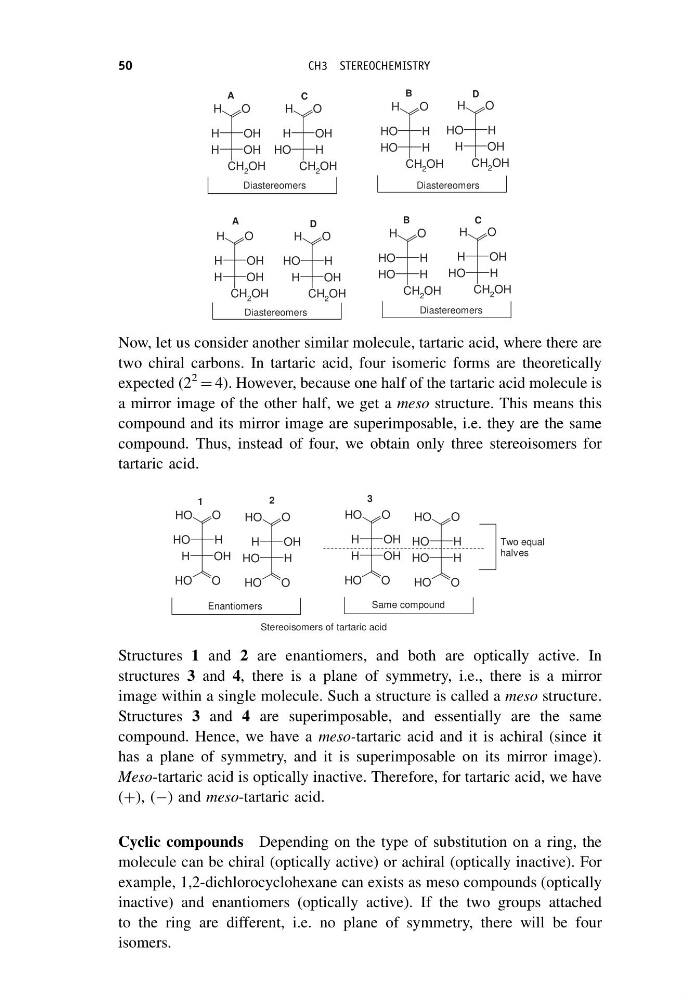
Now, let us consider another similar molecule, tartaric acid, where there are
two chiral carbons. In tartaric acid, four isomeric forms are theoretically
expected (2
2 ¼ 4). However, because one half of the tartaric acid molecule is
a mirror image of the other half, we get a meso structure. This means this
compound and its mirror image are superimposable, i.e. they are the same
compound. Thus, instead of four, we obtain only three stereoisomers for
tartaric acid.
H
O
H
OH
H
O
O
H
O
O
H
OH
H
H
O
H
O
O
H
O
O
H
OH
H
OH
H
O
O
H
O
O
H
H
O
H
H
O
H
O
O
H
O
O
H
Enantiomers
Same compound
1
2
3
Stereoisomers of tartaric acid
Two equal
halves
Structures 1 and 2 are enantiomers, and both are optically active. In
structures 3 and 4, there is a plane of symmetry, i.e., there is a mirror
image within a single molecule. Such a structure is called a meso structure.
Structures 3 and 4 are superimposable, and essentially are the same
compound. Hence, we have a meso-tartaric acid and it is achiral (since it
has a plane of symmetry, and it is superimposable on its mirror image).
Meso-tartaric acid is optically inactive. Therefore, for tartaric acid, we have
(þ), (À) and meso-tartaric acid.
Cyclic compounds Depending on the type of substitution on a ring, the
molecule can be chiral (optically active) or achiral (optically inactive). For
example, 1,2-dichlorocyclohexane can exists as meso compounds (optically
inactive) and enantiomers (optically active). If the two groups attached
to the ring are different, i.e. no plane of symmetry, there will be four
isomers.
50
CH3 STEREOCHEMISTRY
H
OH
H
CH 2 OH
O
H
H
O
H
H
O
H
CH 2 OH
O
H
OH
H
H
O
H
CH 2 OH
O
H
H
O
H
OH
H
CH 2 OH
O
H
OH
H
H
O
H
CH 2 OH
O
H
OH
H
OH
H
CH 2 OH
O
H
H
O
H
OH
H
CH 2 OH
O
H
H
O
H
H
O
H
CH 2 OH
O
H
s
r
e
m
o
e
r
e
t
s
a
i
D
s
r
e
m
o
e
r
e
t
s
a
i
D
A
B
C
D
Diastereomers
Diastereomers
A
C
D
B
Now, let us consider another similar molecule, tartaric acid, where there are
two chiral carbons. In tartaric acid, four isomeric forms are theoretically
expected (2
2 ¼ 4). However, because one half of the tartaric acid molecule is
a mirror image of the other half, we get a meso structure. This means this
compound and its mirror image are superimposable, i.e. they are the same
compound. Thus, instead of four, we obtain only three stereoisomers for
tartaric acid.
H
O
H
OH
H
O
O
H
O
O
H
OH
H
H
O
H
O
O
H
O
O
H
OH
H
OH
H
O
O
H
O
O
H
H
O
H
H
O
H
O
O
H
O
O
H
Enantiomers
Same compound
1
2
3
Stereoisomers of tartaric acid
Two equal
halves
Structures 1 and 2 are enantiomers, and both are optically active. In
structures 3 and 4, there is a plane of symmetry, i.e., there is a mirror
image within a single molecule. Such a structure is called a meso structure.
Structures 3 and 4 are superimposable, and essentially are the same
compound. Hence, we have a meso-tartaric acid and it is achiral (since it
has a plane of symmetry, and it is superimposable on its mirror image).
Meso-tartaric acid is optically inactive. Therefore, for tartaric acid, we have
(þ), (À) and meso-tartaric acid.
Cyclic compounds Depending on the type of substitution on a ring, the
molecule can be chiral (optically active) or achiral (optically inactive). For
example, 1,2-dichlorocyclohexane can exists as meso compounds (optically
inactive) and enantiomers (optically active). If the two groups attached
to the ring are different, i.e. no plane of symmetry, there will be four
isomers.
50
CH3 STEREOCHEMISTRY