

When we have a pair of enantiomers, each rotates the plane-polarized light
by the same amount, but in the opposite direction. A mixture of enantiomers
with the same amount of each is called a racemic mixture. Racemic mixtures
are optically inactive (i.e. they cancel each other out) and are denoted by (Æ).
Specific rotations The more molecules (optically active) the light beam
encounters, the greater the observed rotation. Thus, the amount of rotation
depends on both sample concentration and sample path length.
If we keep the concentration constant but double the length of the sample
tube, the observed rotation doubles. The amount of rotation also depends on
the temperature and the wavelength of the light used.
Therefore, to obtain a meaningful optical rotation data, we have to choose
standard conditions, and here the concept of specific rotation comes in.
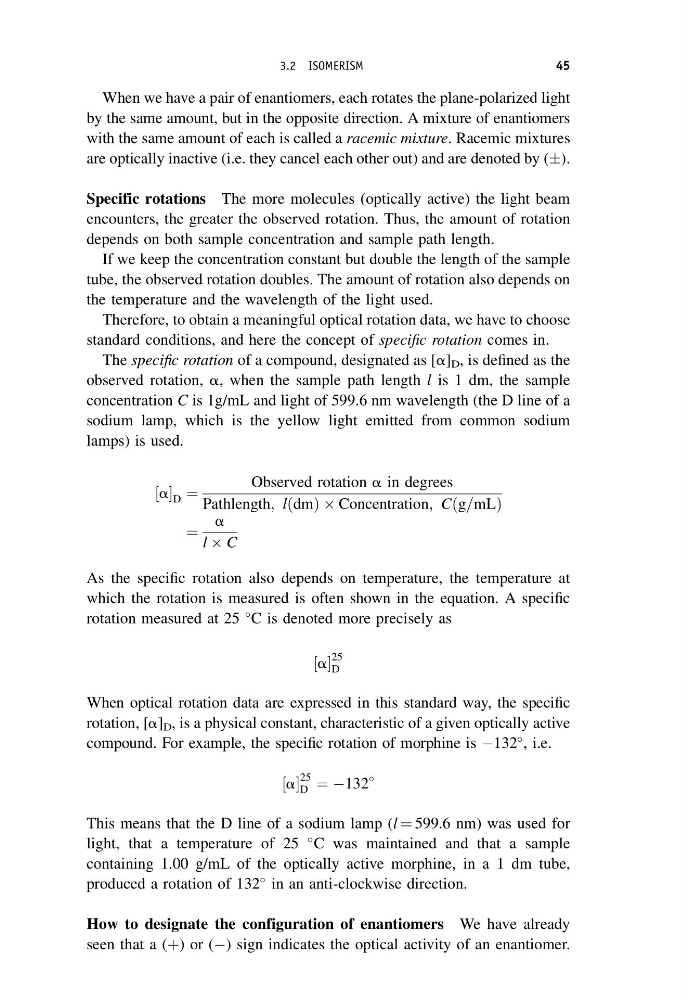
The specific rotation of a compound, designated as [a] D , is defined as the
observed rotation, a, when the sample path length l is 1 dm, the sample
concentration C is 1g/mL and light of 599.6 nm wavelength (the D line of a
sodium lamp, which is the yellow light emitted from common sodium
lamps) is used.
½a D ¼
Observed rotation a in degrees
Pathlength; lðdmÞ Â Concentration; Cðg=mLÞ
¼
a
l  C
As the specific rotation also depends on temperature, the temperature at
which the rotation is measured is often shown in the equation. A specific
rotation measured at 25
C is denoted more precisely as
½a
25
D
When optical rotation data are expressed in this standard way, the specific
rotation, [a] D , is a physical constant, characteristic of a given optically active
compound. For example, the specific rotation of morphine is À132
, i.e.
½a
25
D ¼ À132
This means that the D line of a sodium lamp (l ¼ 599.6 nm) was used for
light, that a temperature of 25
C was maintained and that a sample
containing 1.00 g/mL of the optically active morphine, in a 1 dm tube,
produced a rotation of 132
in an anti-clockwise direction.
How to designate the configuration of enantiomers We have already
seen that a (þ) or (À) sign indicates the optical activity of an enantiomer.
3.2 ISOMERISM
45
by the same amount, but in the opposite direction. A mixture of enantiomers
with the same amount of each is called a racemic mixture. Racemic mixtures
are optically inactive (i.e. they cancel each other out) and are denoted by (Æ).
Specific rotations The more molecules (optically active) the light beam
encounters, the greater the observed rotation. Thus, the amount of rotation
depends on both sample concentration and sample path length.
If we keep the concentration constant but double the length of the sample
tube, the observed rotation doubles. The amount of rotation also depends on
the temperature and the wavelength of the light used.
Therefore, to obtain a meaningful optical rotation data, we have to choose
standard conditions, and here the concept of specific rotation comes in.
The specific rotation of a compound, designated as [a] D , is defined as the
observed rotation, a, when the sample path length l is 1 dm, the sample
concentration C is 1g/mL and light of 599.6 nm wavelength (the D line of a
sodium lamp, which is the yellow light emitted from common sodium
lamps) is used.
½a D ¼
Observed rotation a in degrees
Pathlength; lðdmÞ Â Concentration; Cðg=mLÞ
¼
a
l  C
As the specific rotation also depends on temperature, the temperature at
which the rotation is measured is often shown in the equation. A specific
rotation measured at 25
C is denoted more precisely as
½a
25
D
When optical rotation data are expressed in this standard way, the specific
rotation, [a] D , is a physical constant, characteristic of a given optically active
compound. For example, the specific rotation of morphine is À132
, i.e.
½a
25
D ¼ À132
This means that the D line of a sodium lamp (l ¼ 599.6 nm) was used for
light, that a temperature of 25
C was maintained and that a sample
containing 1.00 g/mL of the optically active morphine, in a 1 dm tube,
produced a rotation of 132
in an anti-clockwise direction.
How to designate the configuration of enantiomers We have already
seen that a (þ) or (À) sign indicates the optical activity of an enantiomer.
3.2 ISOMERISM
45