

Optical isomers Light consists of waves that are composed of electrical
and magnetic vectors (at right angles). If we looked ‘end-on’ at light as it
travels, we would see it oscillates in all directions. When a beam of ordinary
light is passed through a polarizer, the polarizer interacts with the electrical
vector in such a way that the light emerging from it oscillates in one
direction or plane. This is called plane polarized light.
Light oscillates in all directions
The plane of oscillation in
plane-polarized light
When plane-polarized light passes through a solution of an enantiomer, the
plane of light rotates. Any compounds that rotate plane-polarized light are
called optically active. If the rotation is in a clockwise direction, the
enantiomer is said to be dextrorotatory and is given the (þ) sign in front
of its name. Anticlockwise rotation gives an enantiomer which is known as
levorotatory and is given the sign (À) in front of its name.
Before passing through a
solution of an enantiomer
Rotates clock-wise (right)
Dextrorotatory (+)
After passing through a solution of an enantiomer
or
Rotates anti-clock-wise (left)
Levorotatory (−)
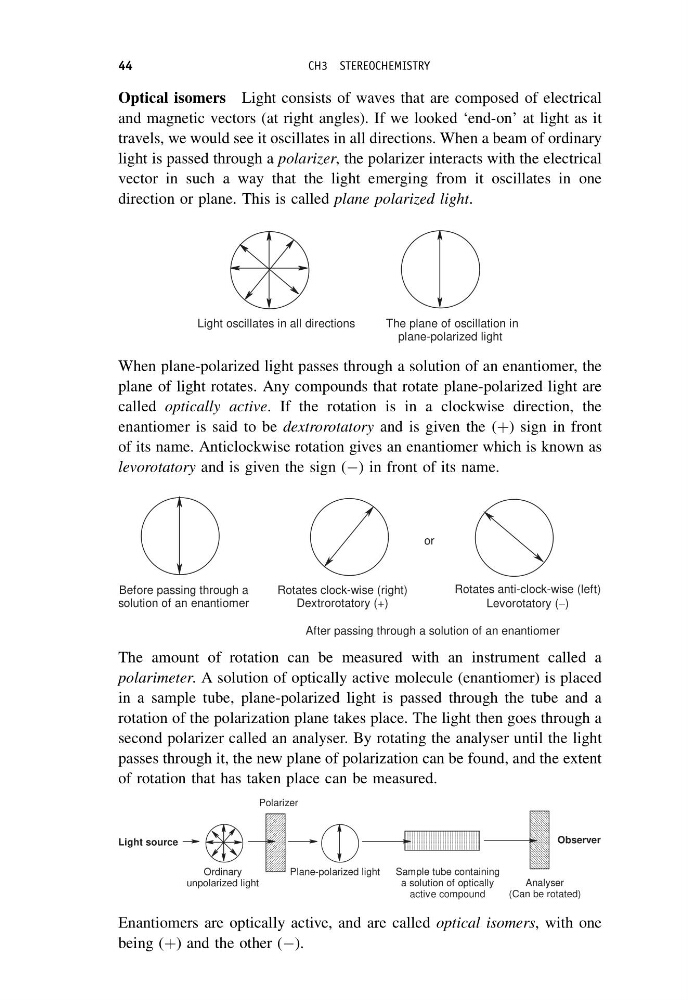
The amount of rotation can be measured with an instrument called a
polarimeter. A solution of optically active molecule (enantiomer) is placed
in a sample tube, plane-polarized light is passed through the tube and a
rotation of the polarization plane takes place. The light then goes through a
second polarizer called an analyser. By rotating the analyser until the light
passes through it, the new plane of polarization can be found, and the extent
of rotation that has taken place can be measured.
Light source
Polarizer
Plane-polarized light
Sample tube containing
a solution of optically
active compound
Analyser
(Can be rotated)
Observer
Ordinary
unpolarized light
Enantiomers are optically active, and are called optical isomers, with one
being (þ) and the other (À).
44
CH3 STEREOCHEMISTRY
and magnetic vectors (at right angles). If we looked ‘end-on’ at light as it
travels, we would see it oscillates in all directions. When a beam of ordinary
light is passed through a polarizer, the polarizer interacts with the electrical
vector in such a way that the light emerging from it oscillates in one
direction or plane. This is called plane polarized light.
Light oscillates in all directions
The plane of oscillation in
plane-polarized light
When plane-polarized light passes through a solution of an enantiomer, the
plane of light rotates. Any compounds that rotate plane-polarized light are
called optically active. If the rotation is in a clockwise direction, the
enantiomer is said to be dextrorotatory and is given the (þ) sign in front
of its name. Anticlockwise rotation gives an enantiomer which is known as
levorotatory and is given the sign (À) in front of its name.
Before passing through a
solution of an enantiomer
Rotates clock-wise (right)
Dextrorotatory (+)
After passing through a solution of an enantiomer
or
Rotates anti-clock-wise (left)
Levorotatory (−)
The amount of rotation can be measured with an instrument called a
polarimeter. A solution of optically active molecule (enantiomer) is placed
in a sample tube, plane-polarized light is passed through the tube and a
rotation of the polarization plane takes place. The light then goes through a
second polarizer called an analyser. By rotating the analyser until the light
passes through it, the new plane of polarization can be found, and the extent
of rotation that has taken place can be measured.
Light source
Polarizer
Plane-polarized light
Sample tube containing
a solution of optically
active compound
Analyser
(Can be rotated)
Observer
Ordinary
unpolarized light
Enantiomers are optically active, and are called optical isomers, with one
being (þ) and the other (À).
44
CH3 STEREOCHEMISTRY