

However, the optical activity does not tell us the actual configuration of an
enantiomer. It only gives us the information whether an enantiomer rotates
the plane-polarized light clockwise or anti-clockwise.
Let us look at the example of glyceraldehyde, an optically active
molecule. Glyceraldehyde can exist as enantiomers, i.e. (þ) and (À)
forms, but the sign does not describe the exact configuration.
O
H
OH
CH 2 OH
H
Glyceraldehyde
*
There are two systems to designate configuration of enantiomers: the D and
L system, and the (R) and (S) system (also known as the Cahn–Ingold–
Prelog system).
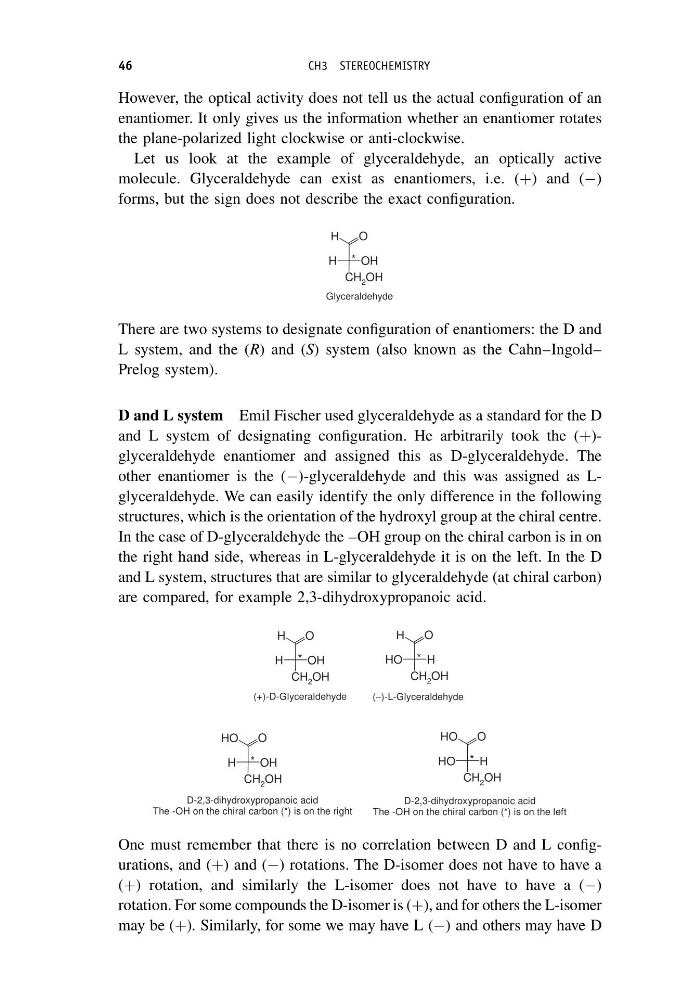
D and L system Emil Fischer used glyceraldehyde as a standard for the D
and L system of designating configuration. He arbitrarily took the (þ)glyceraldehyde enantiomer and assigned this as D-glyceraldehyde. The
other enantiomer is the (À)-glyceraldehyde and this was assigned as Lglyceraldehyde. We can easily identify the only difference in the following
structures, which is the orientation of the hydroxyl group at the chiral centre.
In the case of D-glyceraldehyde the –OH group on the chiral carbon is in on
the right hand side, whereas in L-glyceraldehyde it is on the left. In the D
and L system, structures that are similar to glyceraldehyde (at chiral carbon)
are compared, for example 2,3-dihydroxypropanoic acid.
O
H
OH
CH 2 OH
H
O
H
H
CH 2 OH
O
H
(+)-D-Glyceraldehyde
*
(−)-L-Glyceraldehyde
*
O
O
H
OH
CH 2 OH
H
O
O
H
H
CH 2 OH
O
H
D-2,3-dihydroxypropanoic acid
The -OH on the chiral carbon (*) is on the right
*
D-2,3-dihydroxypropanoic acid
The -OH on the chiral carbon (*) is on the left
*
One must remember that there is no correlation between D and L configurations, and (þ) and (À) rotations. The D-isomer does not have to have a
(þ) rotation, and similarly the L-isomer does not have to have a (À)
rotation. For some compounds the D-isomer is (þ), and for others the L-isomer
may be (þ). Similarly, for some we may have L (À) and others may have D
46
CH3 STEREOCHEMISTRY
enantiomer. It only gives us the information whether an enantiomer rotates
the plane-polarized light clockwise or anti-clockwise.
Let us look at the example of glyceraldehyde, an optically active
molecule. Glyceraldehyde can exist as enantiomers, i.e. (þ) and (À)
forms, but the sign does not describe the exact configuration.
O
H
OH
CH 2 OH
H
Glyceraldehyde
*
There are two systems to designate configuration of enantiomers: the D and
L system, and the (R) and (S) system (also known as the Cahn–Ingold–
Prelog system).
D and L system Emil Fischer used glyceraldehyde as a standard for the D
and L system of designating configuration. He arbitrarily took the (þ)glyceraldehyde enantiomer and assigned this as D-glyceraldehyde. The
other enantiomer is the (À)-glyceraldehyde and this was assigned as Lglyceraldehyde. We can easily identify the only difference in the following
structures, which is the orientation of the hydroxyl group at the chiral centre.
In the case of D-glyceraldehyde the –OH group on the chiral carbon is in on
the right hand side, whereas in L-glyceraldehyde it is on the left. In the D
and L system, structures that are similar to glyceraldehyde (at chiral carbon)
are compared, for example 2,3-dihydroxypropanoic acid.
O
H
OH
CH 2 OH
H
O
H
H
CH 2 OH
O
H
(+)-D-Glyceraldehyde
*
(−)-L-Glyceraldehyde
*
O
O
H
OH
CH 2 OH
H
O
O
H
H
CH 2 OH
O
H
D-2,3-dihydroxypropanoic acid
The -OH on the chiral carbon (*) is on the right
*
D-2,3-dihydroxypropanoic acid
The -OH on the chiral carbon (*) is on the left
*
One must remember that there is no correlation between D and L configurations, and (þ) and (À) rotations. The D-isomer does not have to have a
(þ) rotation, and similarly the L-isomer does not have to have a (À)
rotation. For some compounds the D-isomer is (þ), and for others the L-isomer
may be (þ). Similarly, for some we may have L (À) and others may have D
46
CH3 STEREOCHEMISTRY