

hydrogen. In general, the first ionization energies increase across a period
and decrease down the group. Adding more electrons is easier than
removing electrons. It requires a vast amount of energy to remove
electrons.
Ionic bonds
Ionic bonds result from the transfer of one or more electrons between
atoms. The more electronegative atom gains one or more valence
electrons and hence becomes an anion. The less electronegative atom
loses one or more valence electrons and becomes a cation. A singleheaded arrow indicates a single electron transfer from the less electronegative element to the more electronegative atom. Ionic compounds are
held together by the attraction of opposite charges. Thus, ionic bonds
consist of the electrostatic attraction between positively and negatively
charged ions. Ionic bonds are commonly formed between reactive metals,
electropositive elements (on the left hand side of the periodic table), and
nonmetals, electronegative elements (on the right hand side of the
periodic table). For example, Na (electronegativity 0.9) easily gives up
an electron, and Cl (electronegativity 3.0) readily accepts an electron to
form an ionic bond. In the formation of ionic compound Na
þ Cl
À , the
single 3s valence electron of Na is transferred to the partially filled
valence shell of chlorine.
Nað½Ne3s
1 ÞþClð½Ne3s
2 3p
5 Þ!Na
þ ð½Ne3s
0 ÞþCl
À ð½Ne3s
2 3p
6 Þ!Na
þ Cl
À
Covalent bonds
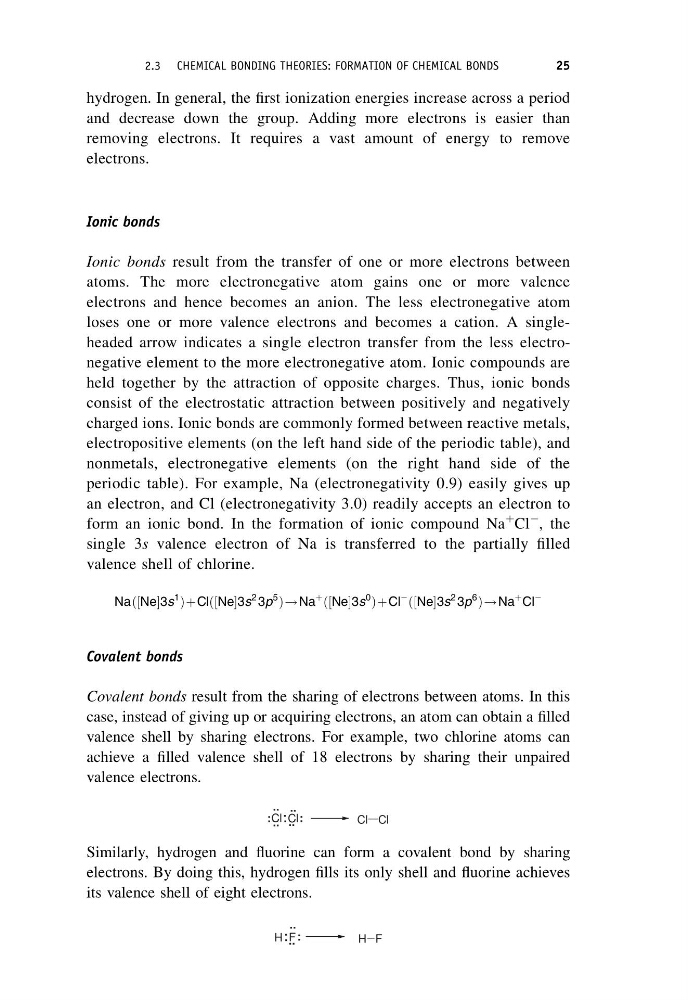
Covalent bonds result from the sharing of electrons between atoms. In this
case, instead of giving up or acquiring electrons, an atom can obtain a filled
valence shell by sharing electrons. For example, two chlorine atoms can
achieve a filled valence shell of 18 electrons by sharing their unpaired
valence electrons.
Cl Cl
Cl
: . Cl
. :
..
..
..
..
Similarly, hydrogen and fluorine can form a covalent bond by sharing
electrons. By doing this, hydrogen fills its only shell and fluorine achieves
its valence shell of eight electrons.
H F
:
F
..
..
H
. .
2.3 CHEMICAL BONDING THEORIES: FORMATION OF CHEMICAL BONDS
25
and decrease down the group. Adding more electrons is easier than
removing electrons. It requires a vast amount of energy to remove
electrons.
Ionic bonds
Ionic bonds result from the transfer of one or more electrons between
atoms. The more electronegative atom gains one or more valence
electrons and hence becomes an anion. The less electronegative atom
loses one or more valence electrons and becomes a cation. A singleheaded arrow indicates a single electron transfer from the less electronegative element to the more electronegative atom. Ionic compounds are
held together by the attraction of opposite charges. Thus, ionic bonds
consist of the electrostatic attraction between positively and negatively
charged ions. Ionic bonds are commonly formed between reactive metals,
electropositive elements (on the left hand side of the periodic table), and
nonmetals, electronegative elements (on the right hand side of the
periodic table). For example, Na (electronegativity 0.9) easily gives up
an electron, and Cl (electronegativity 3.0) readily accepts an electron to
form an ionic bond. In the formation of ionic compound Na
þ Cl
À , the
single 3s valence electron of Na is transferred to the partially filled
valence shell of chlorine.
Nað½Ne3s
1 ÞþClð½Ne3s
2 3p
5 Þ!Na
þ ð½Ne3s
0 ÞþCl
À ð½Ne3s
2 3p
6 Þ!Na
þ Cl
À
Covalent bonds
Covalent bonds result from the sharing of electrons between atoms. In this
case, instead of giving up or acquiring electrons, an atom can obtain a filled
valence shell by sharing electrons. For example, two chlorine atoms can
achieve a filled valence shell of 18 electrons by sharing their unpaired
valence electrons.
Cl Cl
Cl
: . Cl
. :
..
..
..
..
Similarly, hydrogen and fluorine can form a covalent bond by sharing
electrons. By doing this, hydrogen fills its only shell and fluorine achieves
its valence shell of eight electrons.
H F
:
F
..
..
H
. .
2.3 CHEMICAL BONDING THEORIES: FORMATION OF CHEMICAL BONDS
25