

If the structure is an ion, electrons are added or subtracted to give the proper
charge. Lewis structures are useful as they show what atoms are bonded
together, and whether any atoms possess lone pairs of electrons or have a
formal charge. A formal charge is the difference between the number of
valence electrons an atom actually has when it is not bonded to any other
atoms, and the number of nonbonding electrons and half of its bonding
electrons. Thus, a positive or negative charge assigned to an atom is called a
formal charge. The decision as to where to put the charge is made by
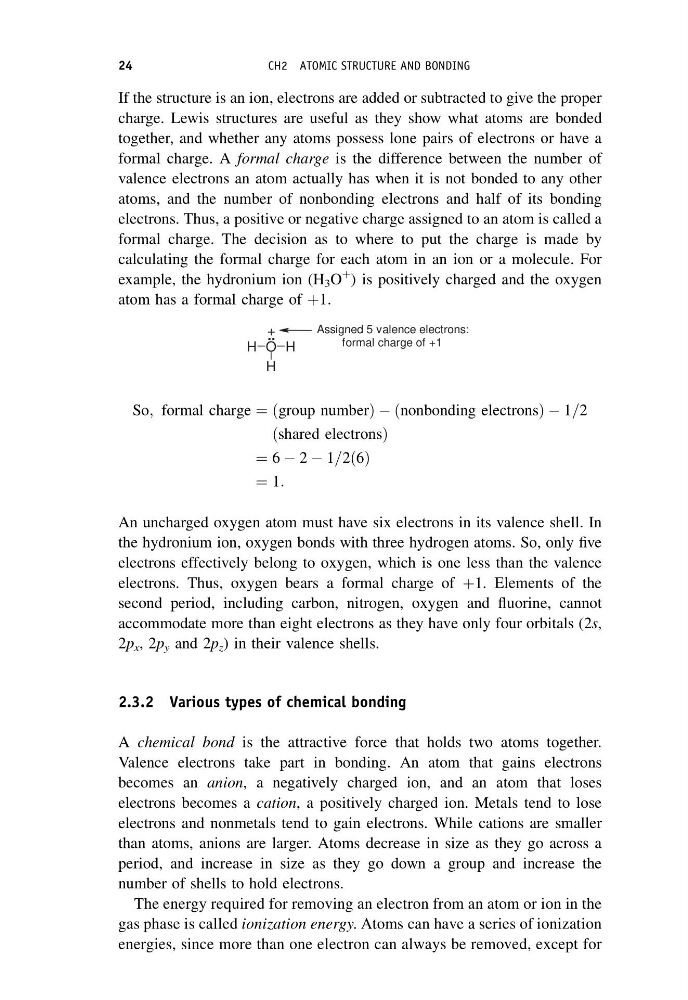
calculating the formal charge for each atom in an ion or a molecule. For
example, the hydronium ion (H 3 O
þ
) is positively charged and the oxygen
atom has a formal charge of þ1.
H O H
H
+ ..
Assigned 5 valence electrons:
formal charge of +1
So; formal charge ¼ ðgroup numberÞ À ðnonbonding electronsÞ À 1=2
ðshared electronsÞ
¼ 6 À 2 À 1=2ð6Þ
¼ 1:
An uncharged oxygen atom must have six electrons in its valence shell. In
the hydronium ion, oxygen bonds with three hydrogen atoms. So, only five
electrons effectively belong to oxygen, which is one less than the valence
electrons. Thus, oxygen bears a formal charge of þ1. Elements of the
second period, including carbon, nitrogen, oxygen and fluorine, cannot
accommodate more than eight electrons as they have only four orbitals (2s,
2p x , 2p y and 2p z ) in their valence shells.
2.3.2 Various types of chemical bonding
A chemical bond is the attractive force that holds two atoms together.
Valence electrons take part in bonding. An atom that gains electrons
becomes an anion, a negatively charged ion, and an atom that loses
electrons becomes a cation, a positively charged ion. Metals tend to lose
electrons and nonmetals tend to gain electrons. While cations are smaller
than atoms, anions are larger. Atoms decrease in size as they go across a
period, and increase in size as they go down a group and increase the
number of shells to hold electrons.
The energy required for removing an electron from an atom or ion in the
gas phase is called ionization energy. Atoms can have a series of ionization
energies, since more than one electron can always be removed, except for
24
CH2 ATOMIC STRUCTURE AND BONDING
charge. Lewis structures are useful as they show what atoms are bonded
together, and whether any atoms possess lone pairs of electrons or have a
formal charge. A formal charge is the difference between the number of
valence electrons an atom actually has when it is not bonded to any other
atoms, and the number of nonbonding electrons and half of its bonding
electrons. Thus, a positive or negative charge assigned to an atom is called a
formal charge. The decision as to where to put the charge is made by
calculating the formal charge for each atom in an ion or a molecule. For
example, the hydronium ion (H 3 O
þ
) is positively charged and the oxygen
atom has a formal charge of þ1.
H O H
H
+ ..
Assigned 5 valence electrons:
formal charge of +1
So; formal charge ¼ ðgroup numberÞ À ðnonbonding electronsÞ À 1=2
ðshared electronsÞ
¼ 6 À 2 À 1=2ð6Þ
¼ 1:
An uncharged oxygen atom must have six electrons in its valence shell. In
the hydronium ion, oxygen bonds with three hydrogen atoms. So, only five
electrons effectively belong to oxygen, which is one less than the valence
electrons. Thus, oxygen bears a formal charge of þ1. Elements of the
second period, including carbon, nitrogen, oxygen and fluorine, cannot
accommodate more than eight electrons as they have only four orbitals (2s,
2p x , 2p y and 2p z ) in their valence shells.
2.3.2 Various types of chemical bonding
A chemical bond is the attractive force that holds two atoms together.
Valence electrons take part in bonding. An atom that gains electrons
becomes an anion, a negatively charged ion, and an atom that loses
electrons becomes a cation, a positively charged ion. Metals tend to lose
electrons and nonmetals tend to gain electrons. While cations are smaller
than atoms, anions are larger. Atoms decrease in size as they go across a
period, and increase in size as they go down a group and increase the
number of shells to hold electrons.
The energy required for removing an electron from an atom or ion in the
gas phase is called ionization energy. Atoms can have a series of ionization
energies, since more than one electron can always be removed, except for
24
CH2 ATOMIC STRUCTURE AND BONDING