

Nonpolar and polar covalent bonds In general, most bonds within
organic molecules, including various drug molecules, are covalent. The
exceptions are compounds that possess metal atoms, where the metal atoms
should be treated as ions. If a bond is covalent, it is possible to identify
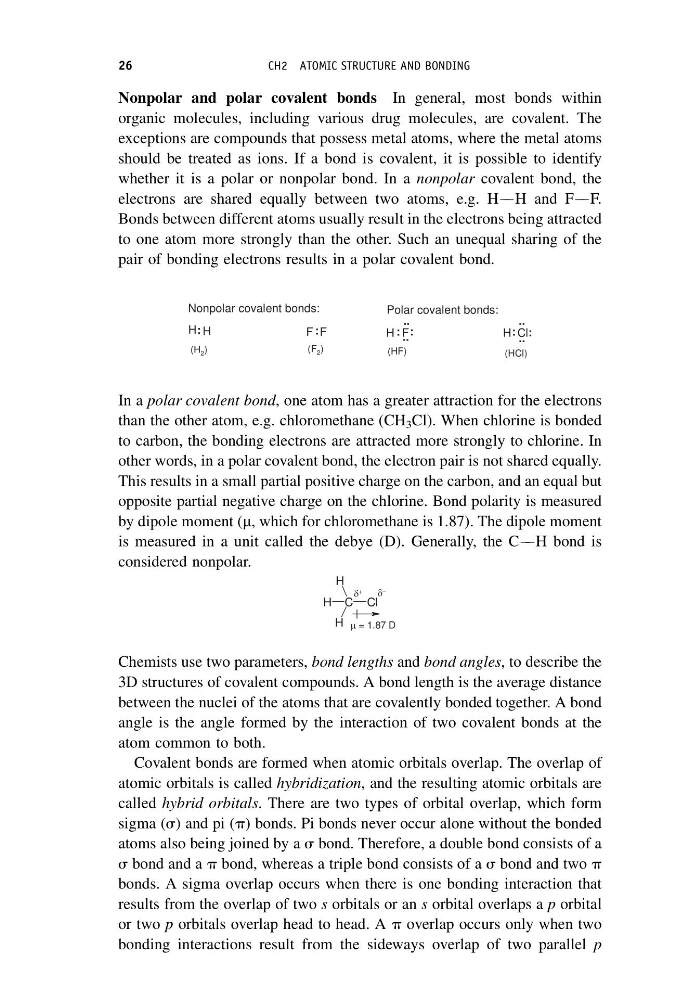
whether it is a polar or nonpolar bond. In a nonpolar covalent bond, the
electrons are shared equally between two atoms, e.g. HÀ ÀH and FÀ ÀF.
Bonds between different atoms usually result in the electrons being attracted
to one atom more strongly than the other. Such an unequal sharing of the
pair of bonding electrons results in a polar covalent bond.
In a polar covalent bond, one atom has a greater attraction for the electrons
than the other atom, e.g. chloromethane (CH 3 Cl). When chlorine is bonded
to carbon, the bonding electrons are attracted more strongly to chlorine. In
other words, in a polar covalent bond, the electron pair is not shared equally.
This results in a small partial positive charge on the carbon, and an equal but
opposite partial negative charge on the chlorine. Bond polarity is measured
by dipole moment (m, which for chloromethane is 1.87). The dipole moment
is measured in a unit called the debye (D). Generally, the CÀ ÀH bond is
considered nonpolar.
C
H
H
Cl
H
δ +
δ −
µ = 1.87 D
Chemists use two parameters, bond lengths and bond angles, to describe the
3D structures of covalent compounds. A bond length is the average distance
between the nuclei of the atoms that are covalently bonded together. A bond
angle is the angle formed by the interaction of two covalent bonds at the
atom common to both.
Covalent bonds are formed when atomic orbitals overlap. The overlap of
atomic orbitals is called hybridization, and the resulting atomic orbitals are
called hybrid orbitals. There are two types of orbital overlap, which form
sigma (s) and pi (p) bonds. Pi bonds never occur alone without the bonded
atoms also being joined by a s bond. Therefore, a double bond consists of a
s bond and a p bond, whereas a triple bond consists of a s bond and two p
bonds. A sigma overlap occurs when there is one bonding interaction that
results from the overlap of two s orbitals or an s orbital overlaps a p orbital
or two p orbitals overlap head to head. A p overlap occurs only when two
bonding interactions result from the sideways overlap of two parallel p
H: H
:F
(H 2 )
F
(F 2 )
Nonpolar covalent bonds:
Polar covalent bonds:
H : F:
..
..
H: Cl:
..
..
(HF)
(HCl)
26
CH2 ATOMIC STRUCTURE AND BONDING
organic molecules, including various drug molecules, are covalent. The
exceptions are compounds that possess metal atoms, where the metal atoms
should be treated as ions. If a bond is covalent, it is possible to identify
whether it is a polar or nonpolar bond. In a nonpolar covalent bond, the
electrons are shared equally between two atoms, e.g. HÀ ÀH and FÀ ÀF.
Bonds between different atoms usually result in the electrons being attracted
to one atom more strongly than the other. Such an unequal sharing of the
pair of bonding electrons results in a polar covalent bond.
In a polar covalent bond, one atom has a greater attraction for the electrons
than the other atom, e.g. chloromethane (CH 3 Cl). When chlorine is bonded
to carbon, the bonding electrons are attracted more strongly to chlorine. In
other words, in a polar covalent bond, the electron pair is not shared equally.
This results in a small partial positive charge on the carbon, and an equal but
opposite partial negative charge on the chlorine. Bond polarity is measured
by dipole moment (m, which for chloromethane is 1.87). The dipole moment
is measured in a unit called the debye (D). Generally, the CÀ ÀH bond is
considered nonpolar.
C
H
H
Cl
H
δ +
δ −
µ = 1.87 D
Chemists use two parameters, bond lengths and bond angles, to describe the
3D structures of covalent compounds. A bond length is the average distance
between the nuclei of the atoms that are covalently bonded together. A bond
angle is the angle formed by the interaction of two covalent bonds at the
atom common to both.
Covalent bonds are formed when atomic orbitals overlap. The overlap of
atomic orbitals is called hybridization, and the resulting atomic orbitals are
called hybrid orbitals. There are two types of orbital overlap, which form
sigma (s) and pi (p) bonds. Pi bonds never occur alone without the bonded
atoms also being joined by a s bond. Therefore, a double bond consists of a
s bond and a p bond, whereas a triple bond consists of a s bond and two p
bonds. A sigma overlap occurs when there is one bonding interaction that
results from the overlap of two s orbitals or an s orbital overlaps a p orbital
or two p orbitals overlap head to head. A p overlap occurs only when two
bonding interactions result from the sideways overlap of two parallel p
H: H
:F
(H 2 )
F
(F 2 )
Nonpolar covalent bonds:
Polar covalent bonds:
H : F:
..
..
H: Cl:
..
..
(HF)
(HCl)
26
CH2 ATOMIC STRUCTURE AND BONDING