

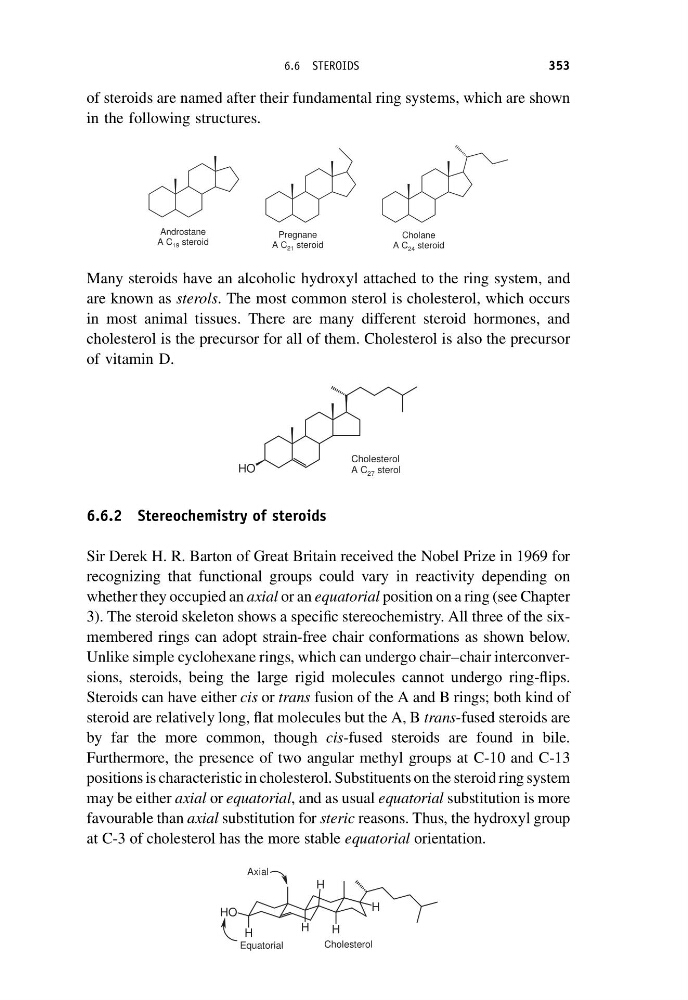
of steroids are named after their fundamental ring systems, which are shown
in the following structures.
Androstane
A C 19 steroid
Pregnane
A C 21 steroid
Cholane
A C 24 steroid
Many steroids have an alcoholic hydroxyl attached to the ring system, and
are known as sterols. The most common sterol is cholesterol, which occurs
in most animal tissues. There are many different steroid hormones, and
cholesterol is the precursor for all of them. Cholesterol is also the precursor
of vitamin D.
O
H
Cholesterol
A C 27 sterol
6.6.2 Stereochemistry of steroids
Sir Derek H. R. Barton of Great Britain received the Nobel Prize in 1969 for
recognizing that functional groups could vary in reactivity depending on
whether they occupied an axial or an equatorial position on a ring (see Chapter
3). The steroid skeleton shows a specific stereochemistry. All three of the sixmembered rings can adopt strain-free chair conformations as shown below.
Unlike simple cyclohexane rings, which can undergo chair–chair interconversions, steroids, being the large rigid molecules cannot undergo ring-flips.
Steroids can have either cis or trans fusion of the A and B rings; both kind of
steroid are relatively long, flat molecules but the A, B trans-fused steroids are
by far the more common, though cis-fused steroids are found in bile.
Furthermore, the presence of two angular methyl groups at C-10 and C-13
positions is characteristic in cholesterol. Substituents on the steroid ring system
may be either axial or equatorial, and as usual equatorial substitution is more
favourable than axial substitution for steric reasons. Thus, the hydroxyl group
at C-3 of cholesterol has the more stable equatorial orientation.
H
H
H
O
H
H
H
Equatorial
Axial
Cholesterol
6.6 STEROIDS
353
in the following structures.
Androstane
A C 19 steroid
Pregnane
A C 21 steroid
Cholane
A C 24 steroid
Many steroids have an alcoholic hydroxyl attached to the ring system, and
are known as sterols. The most common sterol is cholesterol, which occurs
in most animal tissues. There are many different steroid hormones, and
cholesterol is the precursor for all of them. Cholesterol is also the precursor
of vitamin D.
O
H
Cholesterol
A C 27 sterol
6.6.2 Stereochemistry of steroids
Sir Derek H. R. Barton of Great Britain received the Nobel Prize in 1969 for
recognizing that functional groups could vary in reactivity depending on
whether they occupied an axial or an equatorial position on a ring (see Chapter
3). The steroid skeleton shows a specific stereochemistry. All three of the sixmembered rings can adopt strain-free chair conformations as shown below.
Unlike simple cyclohexane rings, which can undergo chair–chair interconversions, steroids, being the large rigid molecules cannot undergo ring-flips.
Steroids can have either cis or trans fusion of the A and B rings; both kind of
steroid are relatively long, flat molecules but the A, B trans-fused steroids are
by far the more common, though cis-fused steroids are found in bile.
Furthermore, the presence of two angular methyl groups at C-10 and C-13
positions is characteristic in cholesterol. Substituents on the steroid ring system
may be either axial or equatorial, and as usual equatorial substitution is more
favourable than axial substitution for steric reasons. Thus, the hydroxyl group
at C-3 of cholesterol has the more stable equatorial orientation.
H
H
H
O
H
H
H
Equatorial
Axial
Cholesterol
6.6 STEROIDS
353