

intake of vitamin, however, can lead to adverse effects, e.g. pathological
changes in the skin, hair loss, blurred vision and headaches.
6.6 Steroids
You have surely come across the items of news that appear quite frequently
in the media, related to world-class athletes and sports personalities abusing
anabolic steroids, e.g. nandrolone, to enhance performance and also to
improve physical appearance. What are these substances? Well, all these
drugs and many other important drugs belong to the class of compounds
called steroids.
Steroids are chemical messengers, also known as hormones. They are
synthesized in glands and delivered by the bloodstream to target tissues to
stimulate or inhibit some process. Steroids are nonpolar and therefore lipids.
Their nonpolar character allows them to cross cell membranes, so they can
leave the cells in which they are synthesized and enter their target cells.
6.6.1 Structure
Structurally, a steroid is a lipid characterized by a carbon skeleton with four
fused rings. All steroids are derived from the acetyl CoA biosynthetic
pathway. Hundreds of distinct steroids have been identified in plants,
animals and fungi, and most of them have interesting biological activity.
They have a common basic ring structures, three-fused cyclohexane rings,
together the phenanthrene part, fused to a cyclopentane ring system, known
as cyclopentaphenanthrene.
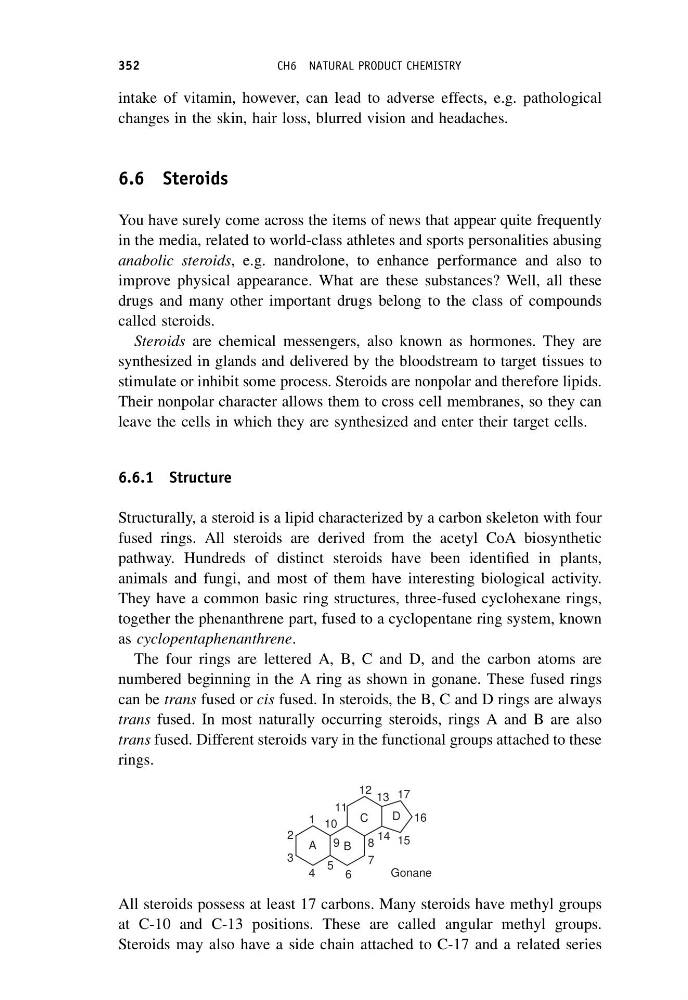
The four rings are lettered A, B, C and D, and the carbon atoms are
numbered beginning in the A ring as shown in gonane. These fused rings
can be trans fused or cis fused. In steroids, the B, C and D rings are always
trans fused. In most naturally occurring steroids, rings A and B are also
trans fused. Different steroids vary in the functional groups attached to these
rings.
Gonane
A
B
C
D
1
2
3
4
5
6
7
8
9
10
11
12 13
14 15
16
17
All steroids possess at least 17 carbons. Many steroids have methyl groups
at C-10 and C-13 positions. These are called angular methyl groups.
Steroids may also have a side chain attached to C-17 and a related series
352
CH6 NATURAL PRODUCT CHEMISTRY
changes in the skin, hair loss, blurred vision and headaches.
6.6 Steroids
You have surely come across the items of news that appear quite frequently
in the media, related to world-class athletes and sports personalities abusing
anabolic steroids, e.g. nandrolone, to enhance performance and also to
improve physical appearance. What are these substances? Well, all these
drugs and many other important drugs belong to the class of compounds
called steroids.
Steroids are chemical messengers, also known as hormones. They are
synthesized in glands and delivered by the bloodstream to target tissues to
stimulate or inhibit some process. Steroids are nonpolar and therefore lipids.
Their nonpolar character allows them to cross cell membranes, so they can
leave the cells in which they are synthesized and enter their target cells.
6.6.1 Structure
Structurally, a steroid is a lipid characterized by a carbon skeleton with four
fused rings. All steroids are derived from the acetyl CoA biosynthetic
pathway. Hundreds of distinct steroids have been identified in plants,
animals and fungi, and most of them have interesting biological activity.
They have a common basic ring structures, three-fused cyclohexane rings,
together the phenanthrene part, fused to a cyclopentane ring system, known
as cyclopentaphenanthrene.
The four rings are lettered A, B, C and D, and the carbon atoms are
numbered beginning in the A ring as shown in gonane. These fused rings
can be trans fused or cis fused. In steroids, the B, C and D rings are always
trans fused. In most naturally occurring steroids, rings A and B are also
trans fused. Different steroids vary in the functional groups attached to these
rings.
Gonane
A
B
C
D
1
2
3
4
5
6
7
8
9
10
11
12 13
14 15
16
17
All steroids possess at least 17 carbons. Many steroids have methyl groups
at C-10 and C-13 positions. These are called angular methyl groups.
Steroids may also have a side chain attached to C-17 and a related series
352
CH6 NATURAL PRODUCT CHEMISTRY