

compounds are important metabolites of carotenoids, e.g. vitamin A 1
(retinol).
Chemistry of vision: role of vitamin A
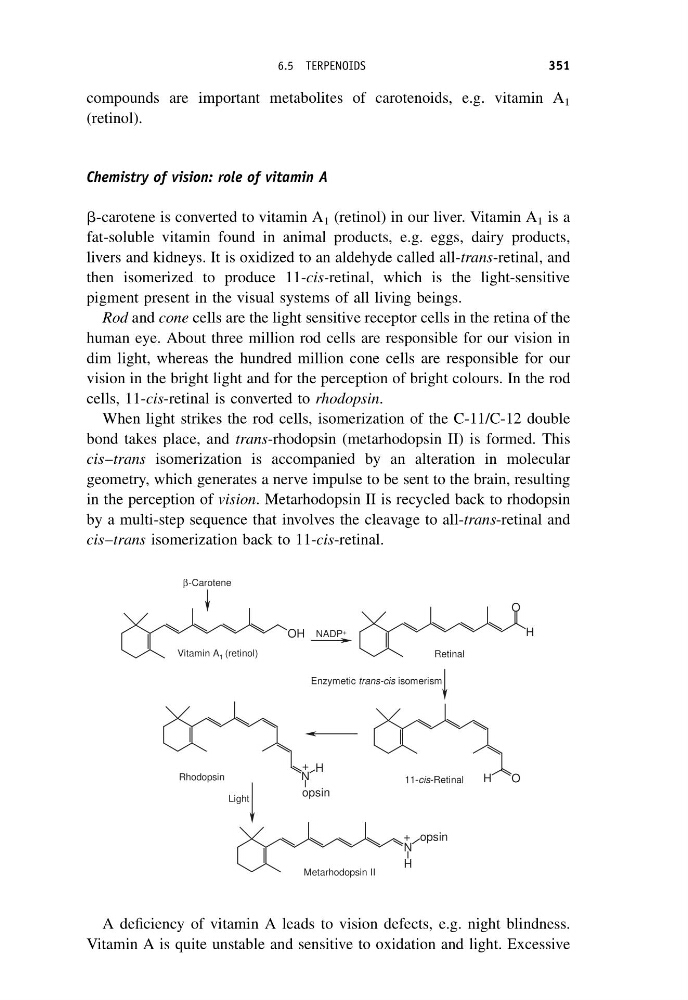
b-carotene is converted to vitamin A 1 (retinol) in our liver. Vitamin A 1 is a
fat-soluble vitamin found in animal products, e.g. eggs, dairy products,
livers and kidneys. It is oxidized to an aldehyde called all-trans-retinal, and
then isomerized to produce 11-cis-retinal, which is the light-sensitive
pigment present in the visual systems of all living beings.
Rod and cone cells are the light sensitive receptor cells in the retina of the
human eye. About three million rod cells are responsible for our vision in
dim light, whereas the hundred million cone cells are responsible for our
vision in the bright light and for the perception of bright colours. In the rod
cells, 11-cis-retinal is converted to rhodopsin.
When light strikes the rod cells, isomerization of the C-11/C-12 double
bond takes place, and trans-rhodopsin (metarhodopsin II) is formed. This
cis–trans isomerization is accompanied by an alteration in molecular
geometry, which generates a nerve impulse to be sent to the brain, resulting
in the perception of vision. Metarhodopsin II is recycled back to rhodopsin
by a multi-step sequence that involves the cleavage to all-trans-retinal and
cis–trans isomerization back to 11-cis-retinal.
OH
H
O
O
H
N
opsin
H
N
opsin
H
β-Carotene
Vitamin A 1 (retinol)
Retinal
NADP +
Enzymetic trans-cis isomerism
11-cis-Retinal
Rhodopsin
+
Light
+
Metarhodopsin II
A deficiency of vitamin A leads to vision defects, e.g. night blindness.
Vitamin A is quite unstable and sensitive to oxidation and light. Excessive
6.5 TERPENOIDS
351
(retinol).
Chemistry of vision: role of vitamin A
b-carotene is converted to vitamin A 1 (retinol) in our liver. Vitamin A 1 is a
fat-soluble vitamin found in animal products, e.g. eggs, dairy products,
livers and kidneys. It is oxidized to an aldehyde called all-trans-retinal, and
then isomerized to produce 11-cis-retinal, which is the light-sensitive
pigment present in the visual systems of all living beings.
Rod and cone cells are the light sensitive receptor cells in the retina of the
human eye. About three million rod cells are responsible for our vision in
dim light, whereas the hundred million cone cells are responsible for our
vision in the bright light and for the perception of bright colours. In the rod
cells, 11-cis-retinal is converted to rhodopsin.
When light strikes the rod cells, isomerization of the C-11/C-12 double
bond takes place, and trans-rhodopsin (metarhodopsin II) is formed. This
cis–trans isomerization is accompanied by an alteration in molecular
geometry, which generates a nerve impulse to be sent to the brain, resulting
in the perception of vision. Metarhodopsin II is recycled back to rhodopsin
by a multi-step sequence that involves the cleavage to all-trans-retinal and
cis–trans isomerization back to 11-cis-retinal.
OH
H
O
O
H
N
opsin
H
N
opsin
H
β-Carotene
Vitamin A 1 (retinol)
Retinal
NADP +
Enzymetic trans-cis isomerism
11-cis-Retinal
Rhodopsin
+
Light
+
Metarhodopsin II
A deficiency of vitamin A leads to vision defects, e.g. night blindness.
Vitamin A is quite unstable and sensitive to oxidation and light. Excessive
6.5 TERPENOIDS
351