

Botanical sources
Plants are the main sources of natural triterpenes. However, they are also
found in other natural sources, e.g. fungus. The following table presents just
a few of these sources, and their major triterpenoidal components.
Source
Major diterpenes
Common name
Botanical name (Family)
Fusidium
Fusidium coccineum
Fusidic acid
Ganoderma
Ganoderma lucidum
Lanosterol
Dammar resin
Balanocarpus heimii
Dammarenediols
(Dipterocarpaceae)
Ginseng
Panax ginseng (Araliaceae)
Dammarenediols
Lupin
Lupinus luteus (Fabaceae)
Lupeol
Quillaia
Quillaja saponaria (Rosaceae)
Quillaic acid
6.5.7 Tetraterpenes
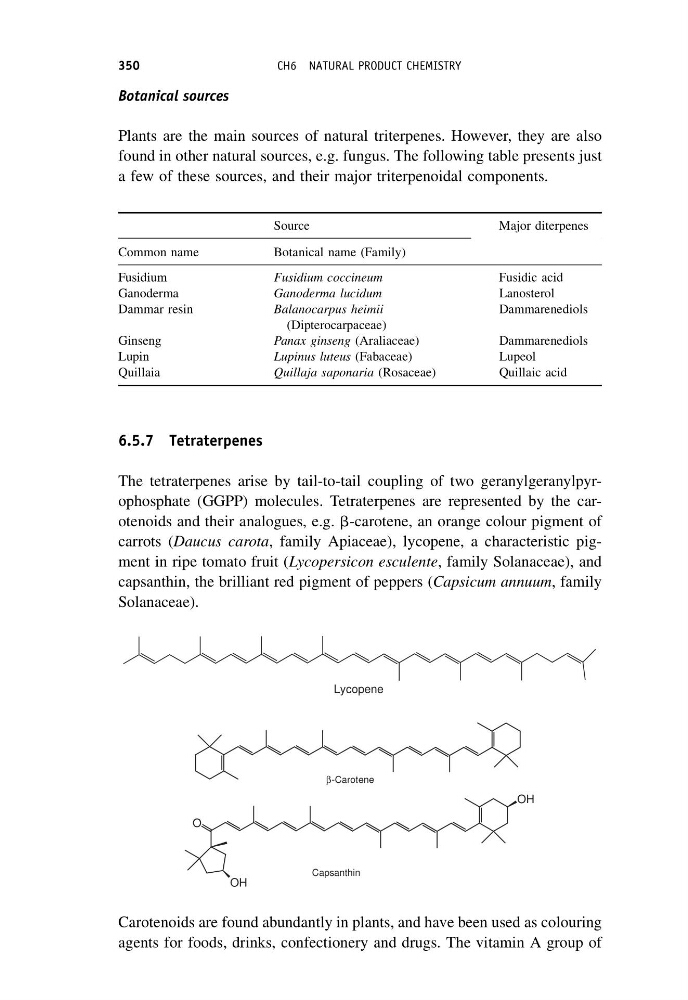
The tetraterpenes arise by tail-to-tail coupling of two geranylgeranylpyrophosphate (GGPP) molecules. Tetraterpenes are represented by the carotenoids and their analogues, e.g. b-carotene, an orange colour pigment of
carrots (Daucus carota, family Apiaceae), lycopene, a characteristic pigment in ripe tomato fruit (Lycopersicon esculente, family Solanaceae), and
capsanthin, the brilliant red pigment of peppers (Capsicum annuum, family
Solanaceae).
Lycopene
β-Carotene
OH
O
OH
Capsanthin
Carotenoids are found abundantly in plants, and have been used as colouring
agents for foods, drinks, confectionery and drugs. The vitamin A group of
350
CH6 NATURAL PRODUCT CHEMISTRY
Plants are the main sources of natural triterpenes. However, they are also
found in other natural sources, e.g. fungus. The following table presents just
a few of these sources, and their major triterpenoidal components.
Source
Major diterpenes
Common name
Botanical name (Family)
Fusidium
Fusidium coccineum
Fusidic acid
Ganoderma
Ganoderma lucidum
Lanosterol
Dammar resin
Balanocarpus heimii
Dammarenediols
(Dipterocarpaceae)
Ginseng
Panax ginseng (Araliaceae)
Dammarenediols
Lupin
Lupinus luteus (Fabaceae)
Lupeol
Quillaia
Quillaja saponaria (Rosaceae)
Quillaic acid
6.5.7 Tetraterpenes
The tetraterpenes arise by tail-to-tail coupling of two geranylgeranylpyrophosphate (GGPP) molecules. Tetraterpenes are represented by the carotenoids and their analogues, e.g. b-carotene, an orange colour pigment of
carrots (Daucus carota, family Apiaceae), lycopene, a characteristic pigment in ripe tomato fruit (Lycopersicon esculente, family Solanaceae), and
capsanthin, the brilliant red pigment of peppers (Capsicum annuum, family
Solanaceae).
Lycopene
β-Carotene
OH
O
OH
Capsanthin
Carotenoids are found abundantly in plants, and have been used as colouring
agents for foods, drinks, confectionery and drugs. The vitamin A group of
350
CH6 NATURAL PRODUCT CHEMISTRY