

In most steroids the B–C and C–D rings are fused, usually in a trans
manner. The lower side of the steroid is denoted a, the upper side of the
steroid is denoted b, usually drawn as projected below the plane of the
paper, which is shown as broken lines, and above the plane of the paper,
which is drawn as solid lines. Thus, substituents attached to the steroid are
also characterized as a and b. Cholesterol has eight chiral centres, therefore
256 stereoisomers are theoretically possible, but only one exists in nature!
Stereogenic centres in steroid side chains are denoted preferentially with the
R and S nomenclature.
6.6.3 Physical properties of steroids
The main feature, as in all lipids, is the presence of a large number of
carbon–hydrogens that makes steroids nonpolar. The solubility of steroids in
nonpolar organic solvents, e.g. ether, chloroform, acetone and benzene, and
general insolubility in water, results from their significant hydrocarbon
components. However, with the increase in number of hydroxyl or other
polar functional groups on the steroid skeleton, the solubility in polar
solvents increases.
6.6.4 Types of steroid
On the basis of the physiological functions, steroids can be categorized as
follows.
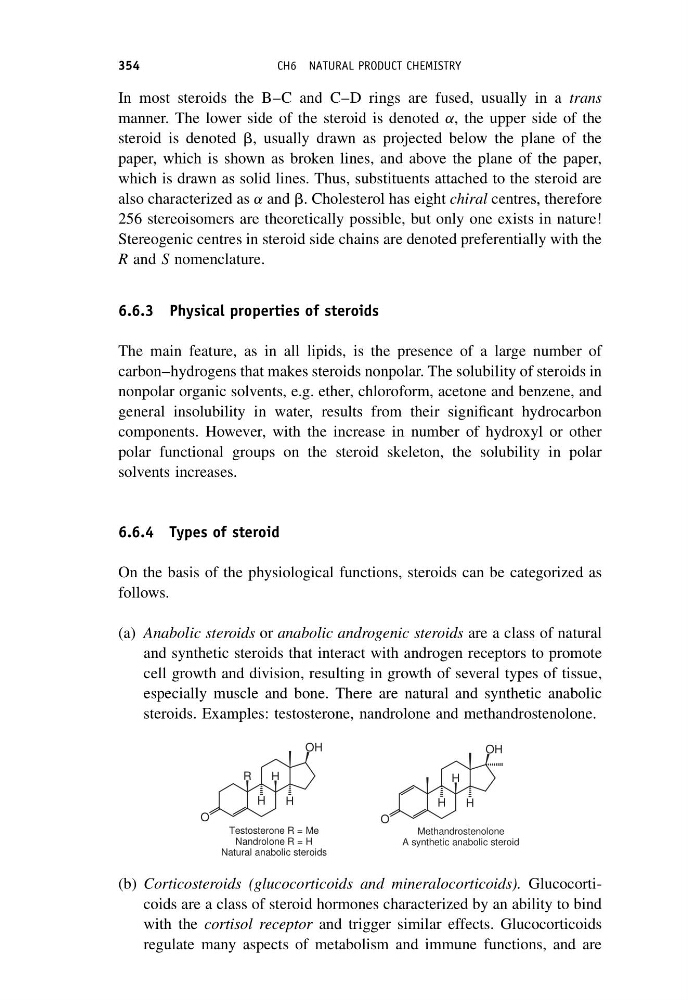
(a) Anabolic steroids or anabolic androgenic steroids are a class of natural
and synthetic steroids that interact with androgen receptors to promote
cell growth and division, resulting in growth of several types of tissue,
especially muscle and bone. There are natural and synthetic anabolic
steroids. Examples: testosterone, nandrolone and methandrostenolone.
O
R
OH
H
H
H
O
OH
H
H
H
Testosterone R = Me
Nandrolone R = H
Natural anabolic steroids
Methandrostenolone
A synthetic anabolic steroid
(b) Corticosteroids (glucocorticoids and mineralocorticoids). Glucocorticoids are a class of steroid hormones characterized by an ability to bind
with the cortisol receptor and trigger similar effects. Glucocorticoids
regulate many aspects of metabolism and immune functions, and are
354
CH6 NATURAL PRODUCT CHEMISTRY
manner. The lower side of the steroid is denoted a, the upper side of the
steroid is denoted b, usually drawn as projected below the plane of the
paper, which is shown as broken lines, and above the plane of the paper,
which is drawn as solid lines. Thus, substituents attached to the steroid are
also characterized as a and b. Cholesterol has eight chiral centres, therefore
256 stereoisomers are theoretically possible, but only one exists in nature!
Stereogenic centres in steroid side chains are denoted preferentially with the
R and S nomenclature.
6.6.3 Physical properties of steroids
The main feature, as in all lipids, is the presence of a large number of
carbon–hydrogens that makes steroids nonpolar. The solubility of steroids in
nonpolar organic solvents, e.g. ether, chloroform, acetone and benzene, and
general insolubility in water, results from their significant hydrocarbon
components. However, with the increase in number of hydroxyl or other
polar functional groups on the steroid skeleton, the solubility in polar
solvents increases.
6.6.4 Types of steroid
On the basis of the physiological functions, steroids can be categorized as
follows.
(a) Anabolic steroids or anabolic androgenic steroids are a class of natural
and synthetic steroids that interact with androgen receptors to promote
cell growth and division, resulting in growth of several types of tissue,
especially muscle and bone. There are natural and synthetic anabolic
steroids. Examples: testosterone, nandrolone and methandrostenolone.
O
R
OH
H
H
H
O
OH
H
H
H
Testosterone R = Me
Nandrolone R = H
Natural anabolic steroids
Methandrostenolone
A synthetic anabolic steroid
(b) Corticosteroids (glucocorticoids and mineralocorticoids). Glucocorticoids are a class of steroid hormones characterized by an ability to bind
with the cortisol receptor and trigger similar effects. Glucocorticoids
regulate many aspects of metabolism and immune functions, and are
354
CH6 NATURAL PRODUCT CHEMISTRY