

Each atom has an infinite number of possible electronic configurations. We
are here only concerned with the ground-state electronic configuration,
which has the lowest energy. The ground-state electronic configuration of an
atom can be determined by the following three principles.
The Aufbau principle states that the orbitals fill in order of increasing
energy, from lowest to highest. Because a 1s orbital is closer to the
nucleus it is lower in energy than a 2s orbital, which is lower in energy
than a 3s orbital.
The Pauli exclusion principle states that no more than two electrons can
occupy each orbital, and if two electrons are present, their spins must be
paired. For example, the two electrons of a helium atom must occupy the
1s orbital in opposite spins.
Hund’s rule explains that when degenerate orbitals (orbitals that have
same energy) are present but not enough electrons are available to fill all
the shell completely, then a single electron will occupy an empty orbital
first before it will pair up with another electron. This is understandable, as
it takes energy to pair up electrons. Therefore, the six electrons in the
carbon atom are filled as follows: the first four electrons will go to the 1s
and 2s orbitals, a fifth electron goes to the 2p x , the sixth electron to the
2p y orbital and the 2p z orbital will remain empty.
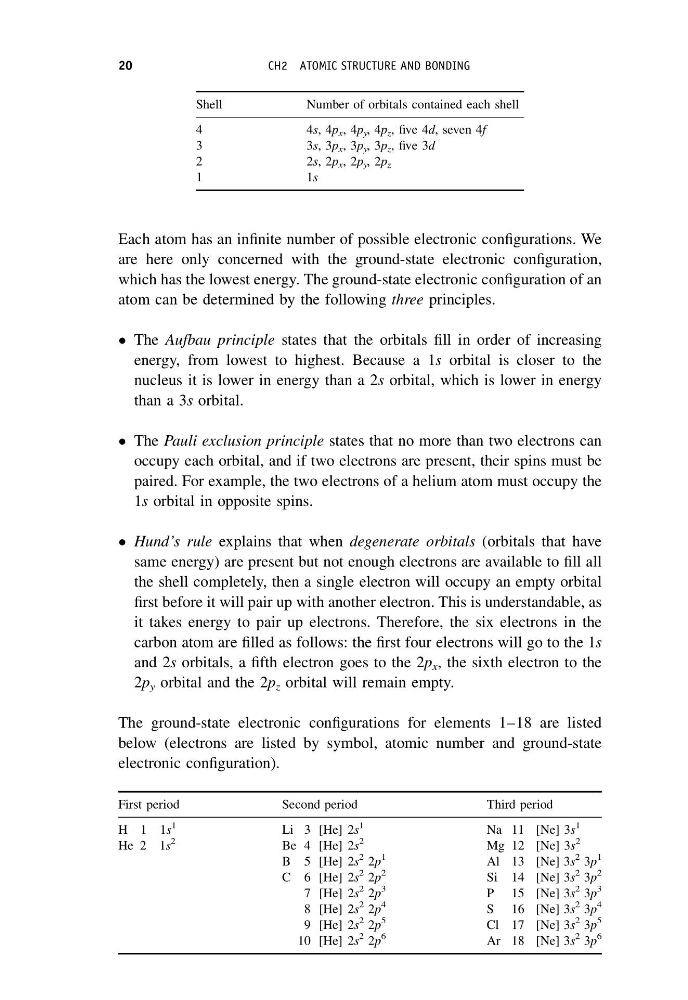
The ground-state electronic configurations for elements 1–18 are listed
below (electrons are listed by symbol, atomic number and ground-state
electronic configuration).
Shell
Number of orbitals contained each shell
4
4 s, 4p x , 4p y , 4p z , five 4d, seven 4f
3
3 s, 3p x , 3p y , 3p z , five 3d
2
2 s, 2p x , 2p y , 2p z
1
1 s
First period
Second period
Third period
H 1 1s
1
Li 3 [He] 2s
1
Na 11 [Ne] 3s
1
He 2 1s
2
Be 4 [He] 2s
2
Mg 12 [Ne] 3s
2
B 5 [He] 2s
2 2p
1
Al 13 [Ne] 3s
2 3p
1
C 6 [He] 2s
2 2p
2
Si 14 [Ne] 3s
2 3p
2
7 [He] 2s
2 2p
3
P 15 [Ne] 3s
2 3p
3
8 [He] 2s
2 2p
4
S 16 [Ne] 3s
2 3p
4
9 [He] 2s
2 2p
5
Cl 17 [Ne] 3s
2 3p
5
10 [He] 2s
2 2p
6
Ar 18 [Ne] 3s
2 3p
6
20
CH2 ATOMIC STRUCTURE AND BONDING
are here only concerned with the ground-state electronic configuration,
which has the lowest energy. The ground-state electronic configuration of an
atom can be determined by the following three principles.
The Aufbau principle states that the orbitals fill in order of increasing
energy, from lowest to highest. Because a 1s orbital is closer to the
nucleus it is lower in energy than a 2s orbital, which is lower in energy
than a 3s orbital.
The Pauli exclusion principle states that no more than two electrons can
occupy each orbital, and if two electrons are present, their spins must be
paired. For example, the two electrons of a helium atom must occupy the
1s orbital in opposite spins.
Hund’s rule explains that when degenerate orbitals (orbitals that have
same energy) are present but not enough electrons are available to fill all
the shell completely, then a single electron will occupy an empty orbital
first before it will pair up with another electron. This is understandable, as
it takes energy to pair up electrons. Therefore, the six electrons in the
carbon atom are filled as follows: the first four electrons will go to the 1s
and 2s orbitals, a fifth electron goes to the 2p x , the sixth electron to the
2p y orbital and the 2p z orbital will remain empty.
The ground-state electronic configurations for elements 1–18 are listed
below (electrons are listed by symbol, atomic number and ground-state
electronic configuration).
Shell
Number of orbitals contained each shell
4
4 s, 4p x , 4p y , 4p z , five 4d, seven 4f
3
3 s, 3p x , 3p y , 3p z , five 3d
2
2 s, 2p x , 2p y , 2p z
1
1 s
First period
Second period
Third period
H 1 1s
1
Li 3 [He] 2s
1
Na 11 [Ne] 3s
1
He 2 1s
2
Be 4 [He] 2s
2
Mg 12 [Ne] 3s
2
B 5 [He] 2s
2 2p
1
Al 13 [Ne] 3s
2 3p
1
C 6 [He] 2s
2 2p
2
Si 14 [Ne] 3s
2 3p
2
7 [He] 2s
2 2p
3
P 15 [Ne] 3s
2 3p
3
8 [He] 2s
2 2p
4
S 16 [Ne] 3s
2 3p
4
9 [He] 2s
2 2p
5
Cl 17 [Ne] 3s
2 3p
5
10 [He] 2s
2 2p
6
Ar 18 [Ne] 3s
2 3p
6
20
CH2 ATOMIC STRUCTURE AND BONDING