

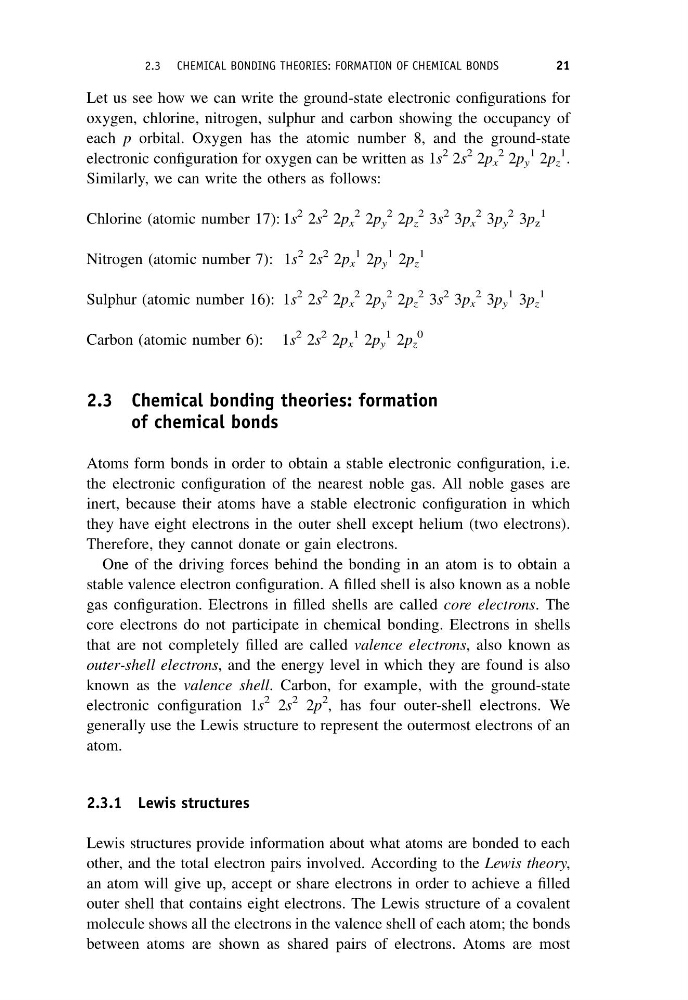
Let us see how we can write the ground-state electronic configurations for
oxygen, chlorine, nitrogen, sulphur and carbon showing the occupancy of
each p orbital. Oxygen has the atomic number 8, and the ground-state
electronic configuration for oxygen can be written as 1s
2 2s
2 2p x
2 2p y
1 2p z
1 .
Similarly, we can write the others as follows:
Chlorine (atomic number 17): 1s
2 2s
2 2p x
2 2p y
2 2p z
2 3s
2 3p x
2 3p y
2 3p z
1
Nitrogen (atomic number 7): 1s
2 2s
2 2p x
1 2p y
1 2p z
1
Sulphur (atomic number 16): 1s
2 2s
2 2p x
2 2p y
2 2p z
2 3s
2 3p x
2 3p y
1 3p z
1
Carbon (atomic number 6): 1s
2 2s
2 2p x
1 2p y
1 2p z
0
2.3 Chemical bonding theories: formation
of chemical bonds
Atoms form bonds in order to obtain a stable electronic configuration, i.e.
the electronic configuration of the nearest noble gas. All noble gases are
inert, because their atoms have a stable electronic configuration in which
they have eight electrons in the outer shell except helium (two electrons).
Therefore, they cannot donate or gain electrons.
One of the driving forces behind the bonding in an atom is to obtain a
stable valence electron configuration. A filled shell is also known as a noble
gas configuration. Electrons in filled shells are called core electrons. The
core electrons do not participate in chemical bonding. Electrons in shells
that are not completely filled are called valence electrons, also known as
outer-shell electrons, and the energy level in which they are found is also
known as the valence shell. Carbon, for example, with the ground-state
electronic configuration 1s
2 2s
2 2p
2
, has four outer-shell electrons. We
generally use the Lewis structure to represent the outermost electrons of an
atom.
2.3.1 Lewis structures
Lewis structures provide information about what atoms are bonded to each
other, and the total electron pairs involved. According to the Lewis theory,
an atom will give up, accept or share electrons in order to achieve a filled
outer shell that contains eight electrons. The Lewis structure of a covalent
molecule shows all the electrons in the valence shell of each atom; the bonds
between atoms are shown as shared pairs of electrons. Atoms are most
2.3 CHEMICAL BONDING THEORIES: FORMATION OF CHEMICAL BONDS
21
oxygen, chlorine, nitrogen, sulphur and carbon showing the occupancy of
each p orbital. Oxygen has the atomic number 8, and the ground-state
electronic configuration for oxygen can be written as 1s
2 2s
2 2p x
2 2p y
1 2p z
1 .
Similarly, we can write the others as follows:
Chlorine (atomic number 17): 1s
2 2s
2 2p x
2 2p y
2 2p z
2 3s
2 3p x
2 3p y
2 3p z
1
Nitrogen (atomic number 7): 1s
2 2s
2 2p x
1 2p y
1 2p z
1
Sulphur (atomic number 16): 1s
2 2s
2 2p x
2 2p y
2 2p z
2 3s
2 3p x
2 3p y
1 3p z
1
Carbon (atomic number 6): 1s
2 2s
2 2p x
1 2p y
1 2p z
0
2.3 Chemical bonding theories: formation
of chemical bonds
Atoms form bonds in order to obtain a stable electronic configuration, i.e.
the electronic configuration of the nearest noble gas. All noble gases are
inert, because their atoms have a stable electronic configuration in which
they have eight electrons in the outer shell except helium (two electrons).
Therefore, they cannot donate or gain electrons.
One of the driving forces behind the bonding in an atom is to obtain a
stable valence electron configuration. A filled shell is also known as a noble
gas configuration. Electrons in filled shells are called core electrons. The
core electrons do not participate in chemical bonding. Electrons in shells
that are not completely filled are called valence electrons, also known as
outer-shell electrons, and the energy level in which they are found is also
known as the valence shell. Carbon, for example, with the ground-state
electronic configuration 1s
2 2s
2 2p
2
, has four outer-shell electrons. We
generally use the Lewis structure to represent the outermost electrons of an
atom.
2.3.1 Lewis structures
Lewis structures provide information about what atoms are bonded to each
other, and the total electron pairs involved. According to the Lewis theory,
an atom will give up, accept or share electrons in order to achieve a filled
outer shell that contains eight electrons. The Lewis structure of a covalent
molecule shows all the electrons in the valence shell of each atom; the bonds
between atoms are shown as shared pairs of electrons. Atoms are most
2.3 CHEMICAL BONDING THEORIES: FORMATION OF CHEMICAL BONDS
21