

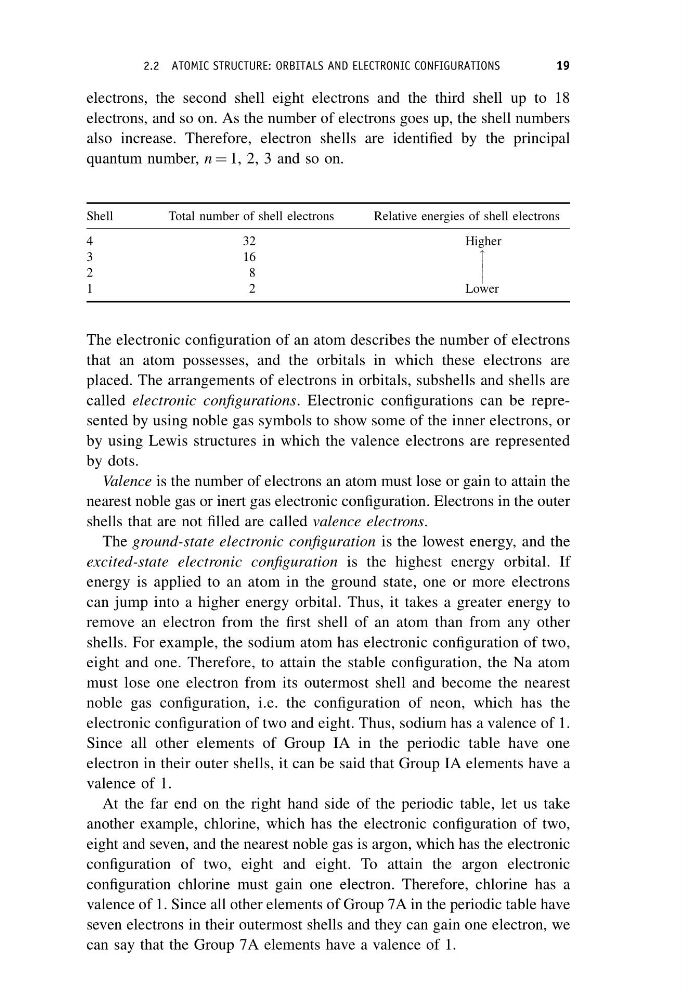
electrons, the second shell eight electrons and the third shell up to 18
electrons, and so on. As the number of electrons goes up, the shell numbers
also increase. Therefore, electron shells are identified by the principal
quantum number, n ¼ 1, 2, 3 and so on.
The electronic configuration of an atom describes the number of electrons
that an atom possesses, and the orbitals in which these electrons are
placed. The arrangements of electrons in orbitals, subshells and shells are
called electronic configurations. Electronic configurations can be represented by using noble gas symbols to show some of the inner electrons, or
by using Lewis structures in which the valence electrons are represented
by dots.
Valence is the number of electrons an atom must lose or gain to attain the
nearest noble gas or inert gas electronic configuration. Electrons in the outer
shells that are not filled are called valence electrons.
The ground-state electronic configuration is the lowest energy, and the
excited-state electronic configuration is the highest energy orbital. If
energy is applied to an atom in the ground state, one or more electrons
can jump into a higher energy orbital. Thus, it takes a greater energy to
remove an electron from the first shell of an atom than from any other
shells. For example, the sodium atom has electronic configuration of two,
eight and one. Therefore, to attain the stable configuration, the Na atom
must lose one electron from its outermost shell and become the nearest
noble gas configuration, i.e. the configuration of neon, which has the
electronic configuration of two and eight. Thus, sodium has a valence of 1.
Since all other elements of Group IA in the periodic table have one
electron in their outer shells, it can be said that Group IA elements have a
valence of 1.
At the far end on the right hand side of the periodic table, let us take
another example, chlorine, which has the electronic configuration of two,
eight and seven, and the nearest noble gas is argon, which has the electronic
configuration of two, eight and eight. To attain the argon electronic
configuration chlorine must gain one electron. Therefore, chlorine has a
valence of 1. Since all other elements of Group 7A in the periodic table have
seven electrons in their outermost shells and they can gain one electron, we
can say that the Group 7A elements have a valence of 1.
Shell
Total number of shell electrons
Relative energies of shell electrons
4
32
Higher
3
1 6
ÀÀÀ À!
2
8
1
2
Lower
2.2 ATOMIC STRUCTURE: ORBITALS AND ELECTRONIC CONFIGURATIONS
19
electrons, and so on. As the number of electrons goes up, the shell numbers
also increase. Therefore, electron shells are identified by the principal
quantum number, n ¼ 1, 2, 3 and so on.
The electronic configuration of an atom describes the number of electrons
that an atom possesses, and the orbitals in which these electrons are
placed. The arrangements of electrons in orbitals, subshells and shells are
called electronic configurations. Electronic configurations can be represented by using noble gas symbols to show some of the inner electrons, or
by using Lewis structures in which the valence electrons are represented
by dots.
Valence is the number of electrons an atom must lose or gain to attain the
nearest noble gas or inert gas electronic configuration. Electrons in the outer
shells that are not filled are called valence electrons.
The ground-state electronic configuration is the lowest energy, and the
excited-state electronic configuration is the highest energy orbital. If
energy is applied to an atom in the ground state, one or more electrons
can jump into a higher energy orbital. Thus, it takes a greater energy to
remove an electron from the first shell of an atom than from any other
shells. For example, the sodium atom has electronic configuration of two,
eight and one. Therefore, to attain the stable configuration, the Na atom
must lose one electron from its outermost shell and become the nearest
noble gas configuration, i.e. the configuration of neon, which has the
electronic configuration of two and eight. Thus, sodium has a valence of 1.
Since all other elements of Group IA in the periodic table have one
electron in their outer shells, it can be said that Group IA elements have a
valence of 1.
At the far end on the right hand side of the periodic table, let us take
another example, chlorine, which has the electronic configuration of two,
eight and seven, and the nearest noble gas is argon, which has the electronic
configuration of two, eight and eight. To attain the argon electronic
configuration chlorine must gain one electron. Therefore, chlorine has a
valence of 1. Since all other elements of Group 7A in the periodic table have
seven electrons in their outermost shells and they can gain one electron, we
can say that the Group 7A elements have a valence of 1.
Shell
Total number of shell electrons
Relative energies of shell electrons
4
32
Higher
3
1 6
ÀÀÀ À!
2
8
1
2
Lower
2.2 ATOMIC STRUCTURE: ORBITALS AND ELECTRONIC CONFIGURATIONS
19