

Nucleus contains
protons & neutrons
Electron cloud
Electrons outside of nucleus
Nucleus is tiny relative to the
size of the electron cloud
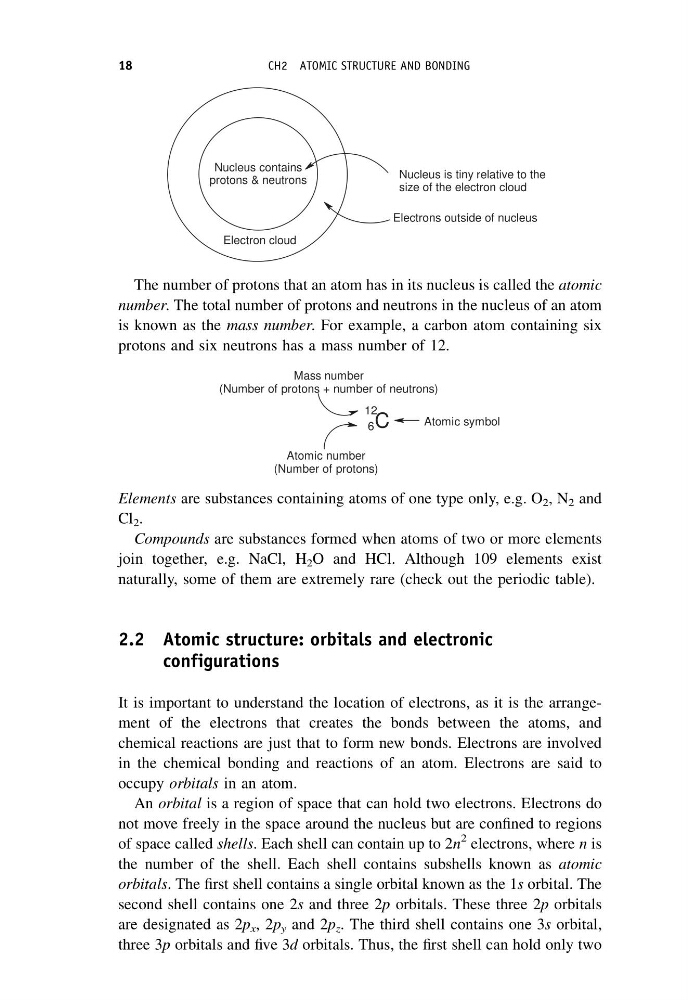
The number of protons that an atom has in its nucleus is called the atomic
number. The total number of protons and neutrons in the nucleus of an atom
is known as the mass number. For example, a carbon atom containing six
protons and six neutrons has a mass number of 12.
C
12
6
Atomic number
(Number of protons)
Atomic symbol
Mass number
(Number of protons + number of neutrons)
Elements are substances containing atoms of one type only, e.g. O 2 , N 2 and
Cl 2 .
Compounds are substances formed when atoms of two or more elements
join together, e.g. NaCl, H 2 O and HCl. Although 109 elements exist
naturally, some of them are extremely rare (check out the periodic table).
2.2 Atomic structure: orbitals and electronic
configurations
It is important to understand the location of electrons, as it is the arrangement of the electrons that creates the bonds between the atoms, and
chemical reactions are just that to form new bonds. Electrons are involved
in the chemical bonding and reactions of an atom. Electrons are said to
occupy orbitals in an atom.
An orbital is a region of space that can hold two electrons. Electrons do
not move freely in the space around the nucleus but are confined to regions
of space called shells. Each shell can contain up to 2n
2 electrons, where n is
the number of the shell. Each shell contains subshells known as atomic
orbitals. The first shell contains a single orbital known as the 1s orbital. The
second shell contains one 2s and three 2p orbitals. These three 2p orbitals
are designated as 2p x , 2p y and 2p z . The third shell contains one 3s orbital,
three 3p orbitals and five 3d orbitals. Thus, the first shell can hold only two
18
CH2 ATOMIC STRUCTURE AND BONDING
protons & neutrons
Electron cloud
Electrons outside of nucleus
Nucleus is tiny relative to the
size of the electron cloud
The number of protons that an atom has in its nucleus is called the atomic
number. The total number of protons and neutrons in the nucleus of an atom
is known as the mass number. For example, a carbon atom containing six
protons and six neutrons has a mass number of 12.
C
12
6
Atomic number
(Number of protons)
Atomic symbol
Mass number
(Number of protons + number of neutrons)
Elements are substances containing atoms of one type only, e.g. O 2 , N 2 and
Cl 2 .
Compounds are substances formed when atoms of two or more elements
join together, e.g. NaCl, H 2 O and HCl. Although 109 elements exist
naturally, some of them are extremely rare (check out the periodic table).
2.2 Atomic structure: orbitals and electronic
configurations
It is important to understand the location of electrons, as it is the arrangement of the electrons that creates the bonds between the atoms, and
chemical reactions are just that to form new bonds. Electrons are involved
in the chemical bonding and reactions of an atom. Electrons are said to
occupy orbitals in an atom.
An orbital is a region of space that can hold two electrons. Electrons do
not move freely in the space around the nucleus but are confined to regions
of space called shells. Each shell can contain up to 2n
2 electrons, where n is
the number of the shell. Each shell contains subshells known as atomic
orbitals. The first shell contains a single orbital known as the 1s orbital. The
second shell contains one 2s and three 2p orbitals. These three 2p orbitals
are designated as 2p x , 2p y and 2p z . The third shell contains one 3s orbital,
three 3p orbitals and five 3d orbitals. Thus, the first shell can hold only two
18
CH2 ATOMIC STRUCTURE AND BONDING