

O
O
1
3
4
5
6
7
8
9
10
11
1
3
4
5
8 9
10
11
6
7
Iridoid
Secoiridoid
O
O
O
H
O
H
O
H
OH
O
OH
H
O
H
O
O
Harpagoside
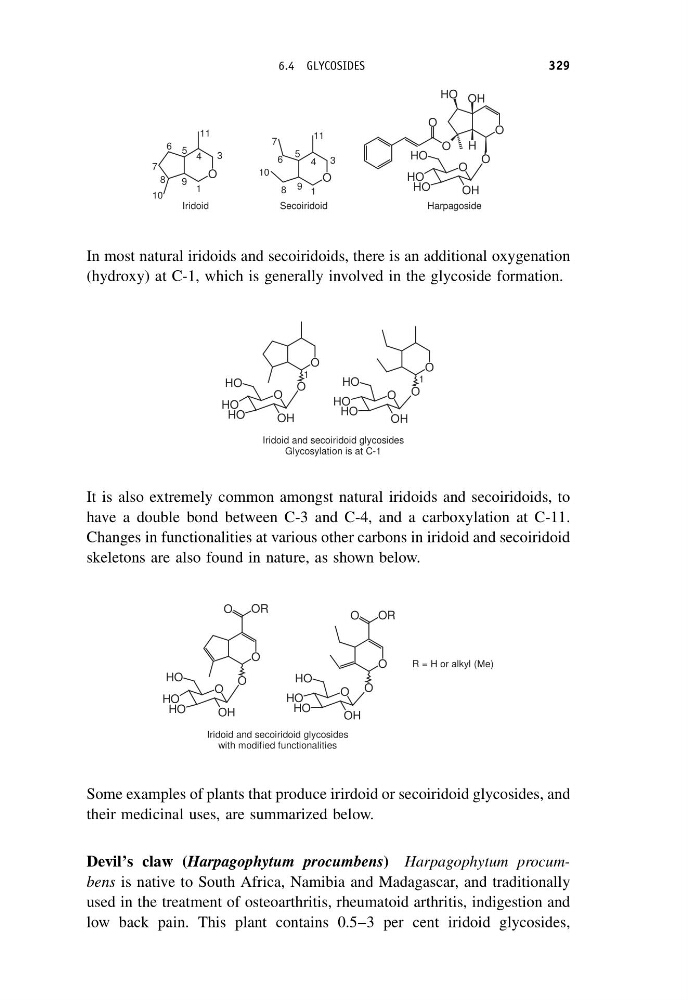
In most natural iridoids and secoiridoids, there is an additional oxygenation
(hydroxy) at C-1, which is generally involved in the glycoside formation.
O
O
O
O
H
O
H
O
H
OH
O
O
O
O
H
OH
O
H
O
H
1
1
Iridoid and secoiridoid glycosides
Glycosylation is at C-1
It is also extremely common amongst natural iridoids and secoiridoids, to
have a double bond between C-3 and C-4, and a carboxylation at C-11.
Changes in functionalities at various other carbons in iridoid and secoiridoid
skeletons are also found in nature, as shown below.
O
O
O
O
H
O
H
O
H
OH
O
OR
O
O
O
O
H
OH
O
H
O
H
O
OR
Iridoid and secoiridoid glycosides
with modified functionalities
R = H or alkyl (Me)
Some examples of plants that produce irirdoid or secoiridoid glycosides, and
their medicinal uses, are summarized below.
Devil’s claw (Harpagophytum procumbens) Harpagophytum procumbens is native to South Africa, Namibia and Madagascar, and traditionally
used in the treatment of osteoarthritis, rheumatoid arthritis, indigestion and
low back pain. This plant contains 0.5–3 per cent iridoid glycosides,
6.4 GLYCOSIDES
329
O
1
3
4
5
6
7
8
9
10
11
1
3
4
5
8 9
10
11
6
7
Iridoid
Secoiridoid
O
O
O
H
O
H
O
H
OH
O
OH
H
O
H
O
O
Harpagoside
In most natural iridoids and secoiridoids, there is an additional oxygenation
(hydroxy) at C-1, which is generally involved in the glycoside formation.
O
O
O
O
H
O
H
O
H
OH
O
O
O
O
H
OH
O
H
O
H
1
1
Iridoid and secoiridoid glycosides
Glycosylation is at C-1
It is also extremely common amongst natural iridoids and secoiridoids, to
have a double bond between C-3 and C-4, and a carboxylation at C-11.
Changes in functionalities at various other carbons in iridoid and secoiridoid
skeletons are also found in nature, as shown below.
O
O
O
O
H
O
H
O
H
OH
O
OR
O
O
O
O
H
OH
O
H
O
H
O
OR
Iridoid and secoiridoid glycosides
with modified functionalities
R = H or alkyl (Me)
Some examples of plants that produce irirdoid or secoiridoid glycosides, and
their medicinal uses, are summarized below.
Devil’s claw (Harpagophytum procumbens) Harpagophytum procumbens is native to South Africa, Namibia and Madagascar, and traditionally
used in the treatment of osteoarthritis, rheumatoid arthritis, indigestion and
low back pain. This plant contains 0.5–3 per cent iridoid glycosides,
6.4 GLYCOSIDES
329