

harpagoside, harpagide and procumbine being the major active iridoid
glycosides present.
O
O
O
H
O
H
O
H
OH
O
OH
H
O
H
O
H
O
O
O
H
O
H
O
H
OH
O
OH
H
O
O
H
Harpagide
Procumbine
The toxicity of H. procumbens is considered extremely low. To date, there
have been no reported side-effects following its use. However, this plant is
said to have oxytocic properties and should be avoided in pregnancy. In
addition, due to its reflex effect on the digestive system, it should be avoided
in patients with gastric or duodenal ulcers.
Picrorhiza (Picrorhiza kurroa) Picrorhiza kurroa is a small perennial
herb that grows in hilly parts of India, particularly in the Himalayas between
3000 and 5000 m. The bitter rhizomes of this plant have been used for
thousands of years in Ayurvedic traditional medicine to treat indigestion,
dyspepsia, constipation, liver dysfunction, bronchial problems and fever. It
is, in combination with various metals, useful in the treatment of acute viral
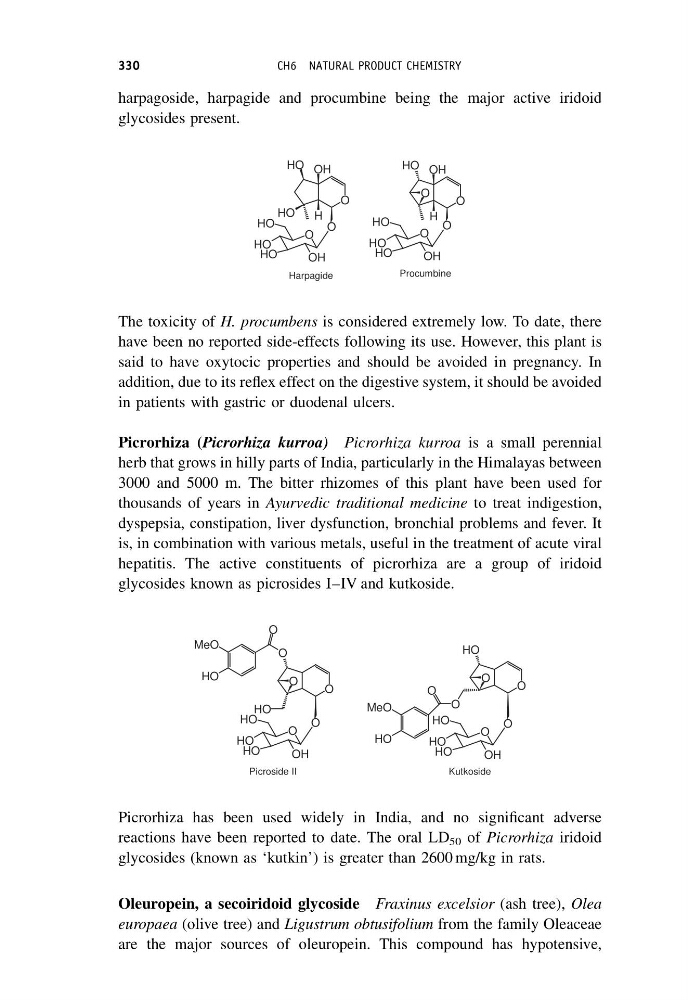
hepatitis. The active constituents of picrorhiza are a group of iridoid
glycosides known as picrosides I–IV and kutkoside.
O
O
O
H
O
H
O
H
OH
O
O
O
O
O
H
MeO
O
H
Picroside II
O
O
O
H
O
H
O
H
OH
O
O
O
H
O
O
O
H
MeO
Kutkoside
Picrorhiza has been used widely in India, and no significant adverse
reactions have been reported to date. The oral LD 50 of Picrorhiza iridoid
glycosides (known as ‘kutkin’) is greater than 2600 mg/kg in rats.
Oleuropein, a secoiridoid glycoside Fraxinus excelsior (ash tree), Olea
europaea (olive tree) and Ligustrum obtusifolium from the family Oleaceae
are the major sources of oleuropein. This compound has hypotensive,
330
CH6 NATURAL PRODUCT CHEMISTRY
glycosides present.
O
O
O
H
O
H
O
H
OH
O
OH
H
O
H
O
H
O
O
O
H
O
H
O
H
OH
O
OH
H
O
O
H
Harpagide
Procumbine
The toxicity of H. procumbens is considered extremely low. To date, there
have been no reported side-effects following its use. However, this plant is
said to have oxytocic properties and should be avoided in pregnancy. In
addition, due to its reflex effect on the digestive system, it should be avoided
in patients with gastric or duodenal ulcers.
Picrorhiza (Picrorhiza kurroa) Picrorhiza kurroa is a small perennial
herb that grows in hilly parts of India, particularly in the Himalayas between
3000 and 5000 m. The bitter rhizomes of this plant have been used for
thousands of years in Ayurvedic traditional medicine to treat indigestion,
dyspepsia, constipation, liver dysfunction, bronchial problems and fever. It
is, in combination with various metals, useful in the treatment of acute viral
hepatitis. The active constituents of picrorhiza are a group of iridoid
glycosides known as picrosides I–IV and kutkoside.
O
O
O
H
O
H
O
H
OH
O
O
O
O
O
H
MeO
O
H
Picroside II
O
O
O
H
O
H
O
H
OH
O
O
O
H
O
O
O
H
MeO
Kutkoside
Picrorhiza has been used widely in India, and no significant adverse
reactions have been reported to date. The oral LD 50 of Picrorhiza iridoid
glycosides (known as ‘kutkin’) is greater than 2600 mg/kg in rats.
Oleuropein, a secoiridoid glycoside Fraxinus excelsior (ash tree), Olea
europaea (olive tree) and Ligustrum obtusifolium from the family Oleaceae
are the major sources of oleuropein. This compound has hypotensive,
330
CH6 NATURAL PRODUCT CHEMISTRY