

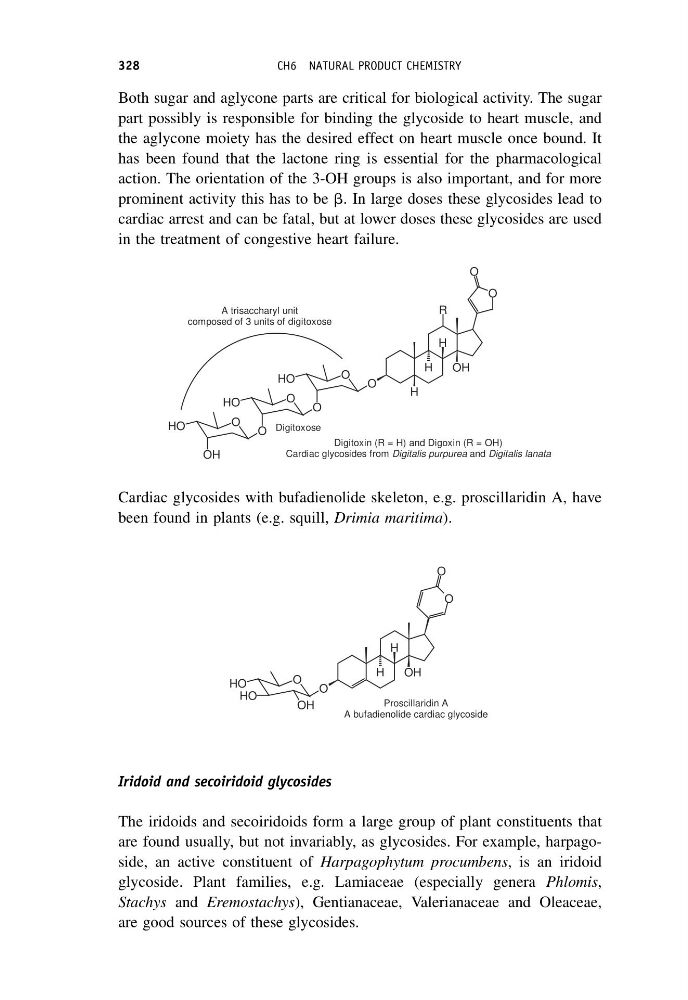
Both sugar and aglycone parts are critical for biological activity. The sugar
part possibly is responsible for binding the glycoside to heart muscle, and
the aglycone moiety has the desired effect on heart muscle once bound. It
has been found that the lactone ring is essential for the pharmacological
action. The orientation of the 3-OH groups is also important, and for more
prominent activity this has to be b. In large doses these glycosides lead to
cardiac arrest and can be fatal, but at lower doses these glycosides are used
in the treatment of congestive heart failure.
O
O
O
H
OH
O
O
O
H
O
O
O
H
O
O
OH
R
H
H
H
Digitoxose
A trisaccharyl unit
composed of 3 units of digitoxose
Digitoxin (R = H) and Digoxin (R = OH)
Cardiac glycosides from Digitalis purpurea and Digitalis lanata
Cardiac glycosides with bufadienolide skeleton, e.g. proscillaridin A, have
been found in plants (e.g. squill, Drimia maritima).
O
O
O
H
OH
O
O
H
OH
H
O
H
Proscillaridin A
A bufadienolide cardiac glycoside
Iridoid and secoiridoid glycosides
The iridoids and secoiridoids form a large group of plant constituents that
are found usually, but not invariably, as glycosides. For example, harpagoside, an active constituent of Harpagophytum procumbens, is an iridoid
glycoside. Plant families, e.g. Lamiaceae (especially genera Phlomis,
Stachys and Eremostachys), Gentianaceae, Valerianaceae and Oleaceae,
are good sources of these glycosides.
328
CH6 NATURAL PRODUCT CHEMISTRY
part possibly is responsible for binding the glycoside to heart muscle, and
the aglycone moiety has the desired effect on heart muscle once bound. It
has been found that the lactone ring is essential for the pharmacological
action. The orientation of the 3-OH groups is also important, and for more
prominent activity this has to be b. In large doses these glycosides lead to
cardiac arrest and can be fatal, but at lower doses these glycosides are used
in the treatment of congestive heart failure.
O
O
O
H
OH
O
O
O
H
O
O
O
H
O
O
OH
R
H
H
H
Digitoxose
A trisaccharyl unit
composed of 3 units of digitoxose
Digitoxin (R = H) and Digoxin (R = OH)
Cardiac glycosides from Digitalis purpurea and Digitalis lanata
Cardiac glycosides with bufadienolide skeleton, e.g. proscillaridin A, have
been found in plants (e.g. squill, Drimia maritima).
O
O
O
H
OH
O
O
H
OH
H
O
H
Proscillaridin A
A bufadienolide cardiac glycoside
Iridoid and secoiridoid glycosides
The iridoids and secoiridoids form a large group of plant constituents that
are found usually, but not invariably, as glycosides. For example, harpagoside, an active constituent of Harpagophytum procumbens, is an iridoid
glycoside. Plant families, e.g. Lamiaceae (especially genera Phlomis,
Stachys and Eremostachys), Gentianaceae, Valerianaceae and Oleaceae,
are good sources of these glycosides.
328
CH6 NATURAL PRODUCT CHEMISTRY