

should be restricted to short term treatment of constipation only, as frequent
or long term use may cause intestinal tumours.
Anthraquinones are found extensively in various plant species, especially
from the families Liliaceae, Polygonaceae, Rhamnaceae, Rubiaceae and
Fabaceae. They are also biosynthesized in micro-organisms, e.g. Penicillium
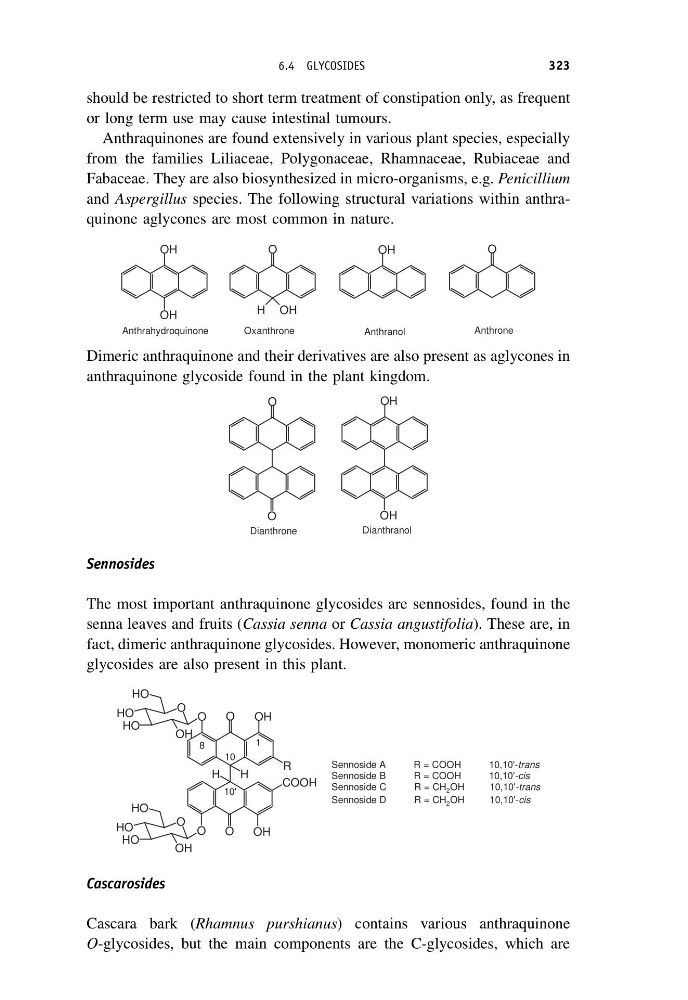
and Aspergillus species. The following structural variations within anthraquinone aglycones are most common in nature.
OH
OH
O
H OH
OH
O
Anthrahydroquinone
Oxanthrone
Anthranol
Anthrone
Dimeric anthraquinone and their derivatives are also present as aglycones in
anthraquinone glycoside found in the plant kingdom.
O
O
OH
OH
Dianthrone
Dianthranol
Sennosides
The most important anthraquinone glycosides are sennosides, found in the
senna leaves and fruits (Cassia senna or Cassia angustifolia). These are, in
fact, dimeric anthraquinone glycosides. However, monomeric anthraquinone
glycosides are also present in this plant.
O
OH
O
H
O
H
O
H
O
O
OH
O
H
O
H
O
H
O
O
OH
R
H
H
COOH
OH
O
1
8
10
10'
Sennoside A
R = COOH
10,10'-trans
Sennoside B
R = COOH
10,10'-cis
Sennoside C
R = CH 2 OH
10,10'-trans
Sennoside D
R = CH 2 OH
10,10'-cis
Cascarosides
Cascara bark (Rhamnus purshianus) contains various anthraquinone
O-glycosides, but the main components are the C-glycosides, which are
6.4 GLYCOSIDES
323
or long term use may cause intestinal tumours.
Anthraquinones are found extensively in various plant species, especially
from the families Liliaceae, Polygonaceae, Rhamnaceae, Rubiaceae and
Fabaceae. They are also biosynthesized in micro-organisms, e.g. Penicillium
and Aspergillus species. The following structural variations within anthraquinone aglycones are most common in nature.
OH
OH
O
H OH
OH
O
Anthrahydroquinone
Oxanthrone
Anthranol
Anthrone
Dimeric anthraquinone and their derivatives are also present as aglycones in
anthraquinone glycoside found in the plant kingdom.
O
O
OH
OH
Dianthrone
Dianthranol
Sennosides
The most important anthraquinone glycosides are sennosides, found in the
senna leaves and fruits (Cassia senna or Cassia angustifolia). These are, in
fact, dimeric anthraquinone glycosides. However, monomeric anthraquinone
glycosides are also present in this plant.
O
OH
O
H
O
H
O
H
O
O
OH
O
H
O
H
O
H
O
O
OH
R
H
H
COOH
OH
O
1
8
10
10'
Sennoside A
R = COOH
10,10'-trans
Sennoside B
R = COOH
10,10'-cis
Sennoside C
R = CH 2 OH
10,10'-trans
Sennoside D
R = CH 2 OH
10,10'-cis
Cascarosides
Cascara bark (Rhamnus purshianus) contains various anthraquinone
O-glycosides, but the main components are the C-glycosides, which are
6.4 GLYCOSIDES
323