

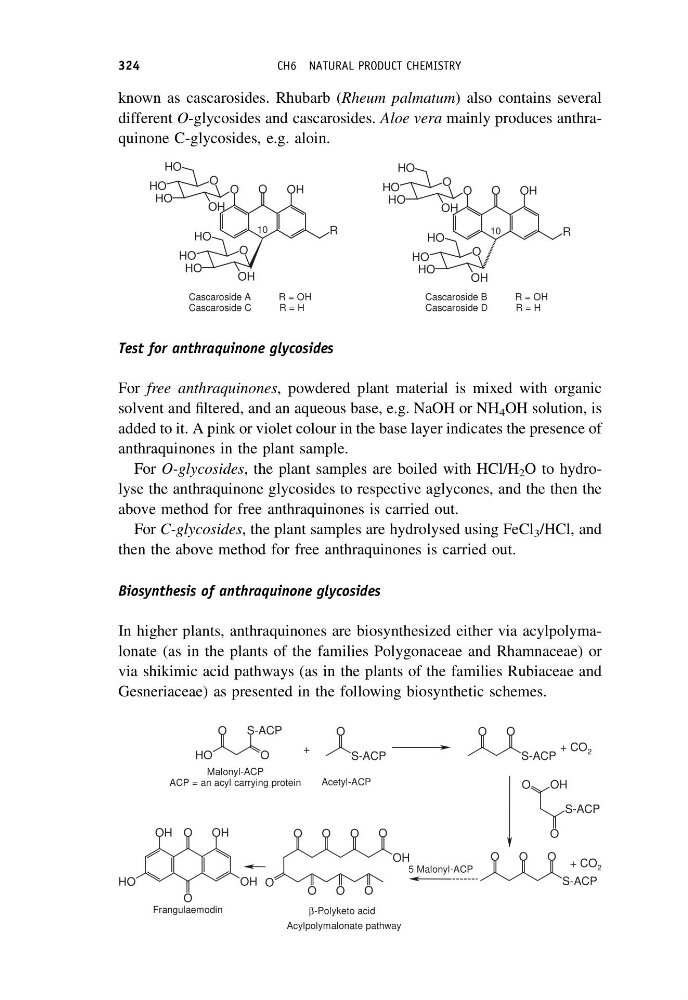
known as cascarosides. Rhubarb (Rheum palmatum) also contains several
different O-glycosides and cascarosides. Aloe vera mainly produces anthraquinone C-glycosides, e.g. aloin.
O
OH
O
H
O
H
O
H
O
O
OH
R
O
OH
O
H
O
H
O
H
O
OH
O
H
O
H
O
H
O
O
OH
R
O
OH
O
H
O
H
O
H
10
Cascaroside A
R = OH
Cascaroside C
R = H
10
Cascaroside B
R = OH
Cascaroside D
R = H
Test for anthraquinone glycosides
For free anthraquinones, powdered plant material is mixed with organic
solvent and filtered, and an aqueous base, e.g. NaOH or NH 4 OH solution, is
added to it. A pink or violet colour in the base layer indicates the presence of
anthraquinones in the plant sample.
For O-glycosides, the plant samples are boiled with HCl/H 2 O to hydrolyse the anthraquinone glycosides to respective aglycones, and the then the
above method for free anthraquinones is carried out.
For C-glycosides, the plant samples are hydrolysed using FeCl 3 /HCl, and
then the above method for free anthraquinones is carried out.
Biosynthesis of anthraquinone glycosides
In higher plants, anthraquinones are biosynthesized either via acylpolymalonate (as in the plants of the families Polygonaceae and Rhamnaceae) or
via shikimic acid pathways (as in the plants of the families Rubiaceae and
Gesneriaceae) as presented in the following biosynthetic schemes.
O
O
H
O
S-ACP
O
S-ACP
O
S-ACP
O
O
OH
S-ACP
O
O
O
O
S-ACP
O
O
O
O
O
O
O
O
OH
OH O
OH
O
O
H
OH
Malonyl-ACP
ACP = an acyl carrying protein
+
Acetyl-ACP
+ CO 2
+ CO 2
5 Malonyl-ACP
β-Polyketo acid
Frangulaemodin
Acylpolymalonate pathway
324
CH6 NATURAL PRODUCT CHEMISTRY
different O-glycosides and cascarosides. Aloe vera mainly produces anthraquinone C-glycosides, e.g. aloin.
O
OH
O
H
O
H
O
H
O
O
OH
R
O
OH
O
H
O
H
O
H
O
OH
O
H
O
H
O
H
O
O
OH
R
O
OH
O
H
O
H
O
H
10
Cascaroside A
R = OH
Cascaroside C
R = H
10
Cascaroside B
R = OH
Cascaroside D
R = H
Test for anthraquinone glycosides
For free anthraquinones, powdered plant material is mixed with organic
solvent and filtered, and an aqueous base, e.g. NaOH or NH 4 OH solution, is
added to it. A pink or violet colour in the base layer indicates the presence of
anthraquinones in the plant sample.
For O-glycosides, the plant samples are boiled with HCl/H 2 O to hydrolyse the anthraquinone glycosides to respective aglycones, and the then the
above method for free anthraquinones is carried out.
For C-glycosides, the plant samples are hydrolysed using FeCl 3 /HCl, and
then the above method for free anthraquinones is carried out.
Biosynthesis of anthraquinone glycosides
In higher plants, anthraquinones are biosynthesized either via acylpolymalonate (as in the plants of the families Polygonaceae and Rhamnaceae) or
via shikimic acid pathways (as in the plants of the families Rubiaceae and
Gesneriaceae) as presented in the following biosynthetic schemes.
O
O
H
O
S-ACP
O
S-ACP
O
S-ACP
O
O
OH
S-ACP
O
O
O
O
S-ACP
O
O
O
O
O
O
O
O
OH
OH O
OH
O
O
H
OH
Malonyl-ACP
ACP = an acyl carrying protein
+
Acetyl-ACP
+ CO 2
+ CO 2
5 Malonyl-ACP
β-Polyketo acid
Frangulaemodin
Acylpolymalonate pathway
324
CH6 NATURAL PRODUCT CHEMISTRY