

O
OH
O
H
O
H
O
H
O
CN
O
OH
O
H
O
H
O
H
O
O
O
OH
OH
OH
OH
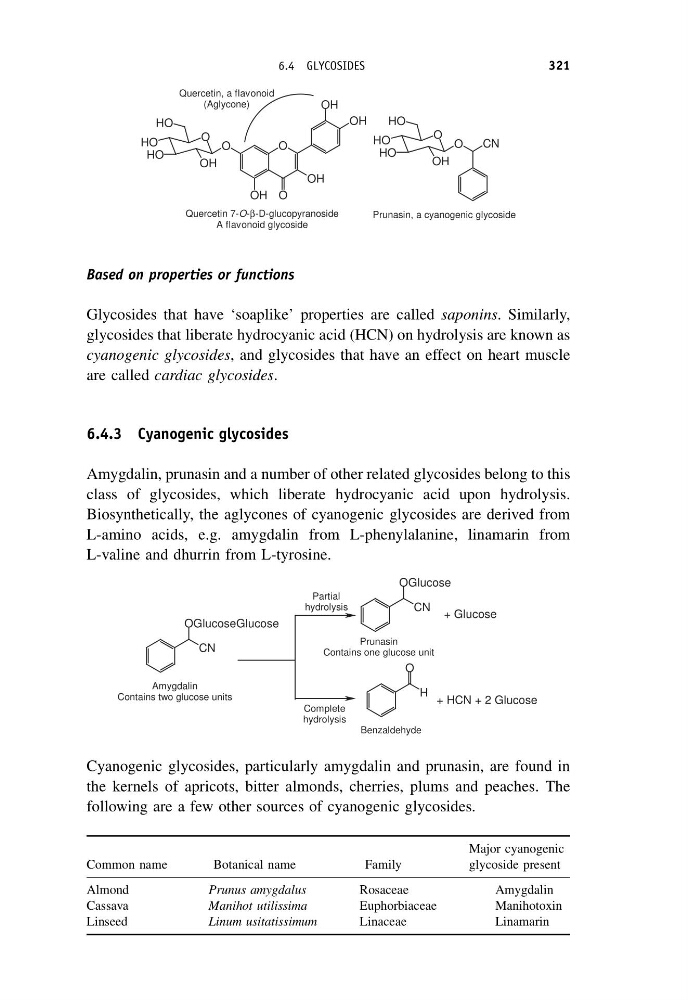
Prunasin, a cyanogenic glycoside
Quercetin 7-O-β-D-glucopyranoside
A flavonoid glycoside
Quercetin, a flavonoid
(Aglycone)
Based on properties or functions
Glycosides that have ‘soaplike’ properties are called saponins. Similarly,
glycosides that liberate hydrocyanic acid (HCN) on hydrolysis are known as
cyanogenic glycosides, and glycosides that have an effect on heart muscle
are called cardiac glycosides.
6.4.3 Cyanogenic glycosides
Amygdalin, prunasin and a number of other related glycosides belong to this
class of glycosides, which liberate hydrocyanic acid upon hydrolysis.
Biosynthetically, the aglycones of cyanogenic glycosides are derived from
L-amino acids, e.g. amygdalin from L-phenylalanine, linamarin from
L-valine and dhurrin from L-tyrosine.
OGlucoseGlucose
CN
OGlucose
CN
H
O
Prunasin
Contains one glucose unit
Amygdalin
Contains two glucose units
Partial
hydrolysis
+ Glucose
Complete
hydrolysis
+ HCN + 2 Glucose
Benzaldehyde
Cyanogenic glycosides, particularly amygdalin and prunasin, are found in
the kernels of apricots, bitter almonds, cherries, plums and peaches. The
following are a few other sources of cyanogenic glycosides.
Major cyanogenic
Common name
Botanical name
Family
glycoside present
Almond
Prunus amygdalus
Rosaceae
Amygdalin
Cassava
Manihot utilissima
Euphorbiaceae
Manihotoxin
Linseed
Linum usitatissimum
Linaceae
Linamarin
6.4 GLYCOSIDES
321
OH
O
H
O
H
O
H
O
CN
O
OH
O
H
O
H
O
H
O
O
O
OH
OH
OH
OH
Prunasin, a cyanogenic glycoside
Quercetin 7-O-β-D-glucopyranoside
A flavonoid glycoside
Quercetin, a flavonoid
(Aglycone)
Based on properties or functions
Glycosides that have ‘soaplike’ properties are called saponins. Similarly,
glycosides that liberate hydrocyanic acid (HCN) on hydrolysis are known as
cyanogenic glycosides, and glycosides that have an effect on heart muscle
are called cardiac glycosides.
6.4.3 Cyanogenic glycosides
Amygdalin, prunasin and a number of other related glycosides belong to this
class of glycosides, which liberate hydrocyanic acid upon hydrolysis.
Biosynthetically, the aglycones of cyanogenic glycosides are derived from
L-amino acids, e.g. amygdalin from L-phenylalanine, linamarin from
L-valine and dhurrin from L-tyrosine.
OGlucoseGlucose
CN
OGlucose
CN
H
O
Prunasin
Contains one glucose unit
Amygdalin
Contains two glucose units
Partial
hydrolysis
+ Glucose
Complete
hydrolysis
+ HCN + 2 Glucose
Benzaldehyde
Cyanogenic glycosides, particularly amygdalin and prunasin, are found in
the kernels of apricots, bitter almonds, cherries, plums and peaches. The
following are a few other sources of cyanogenic glycosides.
Major cyanogenic
Common name
Botanical name
Family
glycoside present
Almond
Prunus amygdalus
Rosaceae
Amygdalin
Cassava
Manihot utilissima
Euphorbiaceae
Manihotoxin
Linseed
Linum usitatissimum
Linaceae
Linamarin
6.4 GLYCOSIDES
321