

and/or sugar, glycosides are extremely important pharmaceutically and
medicinally. For example, digitoxin is a cardiac glycoside found in the
foxglove plant (Digitalis purpurea).
6.4.1 Biosynthesis
The biosynthetic pathways are widely variable depending on the type of
aglycone as well as the glycone units present in the glycosides. The
aglycone and the sugar parts are biosynthesized separately, and then coupled
to form a glycoside. The coupling of the sugar and aglycone takes place in
the same way, irrespective of the structural type of the aglycone. Phosphorylation of a sugar yields a sugar 1-phosphate, which reacts with a uridine
triphosphate (UDP) to form a uridine diphosphate sugar (UDP-sugar) and
inorganic phosphate. This UDP-sugar reacts with the aglycone to form the
glycoside and a free UDP.
Sugar
Phosphorylation Sugar 1-phosphate
UTP
UDP-sugar + PPi
Aglycone
Sugar-aglycone
(Glycoside)
+ UDP
6.4.2 Classification
Based on sugar component
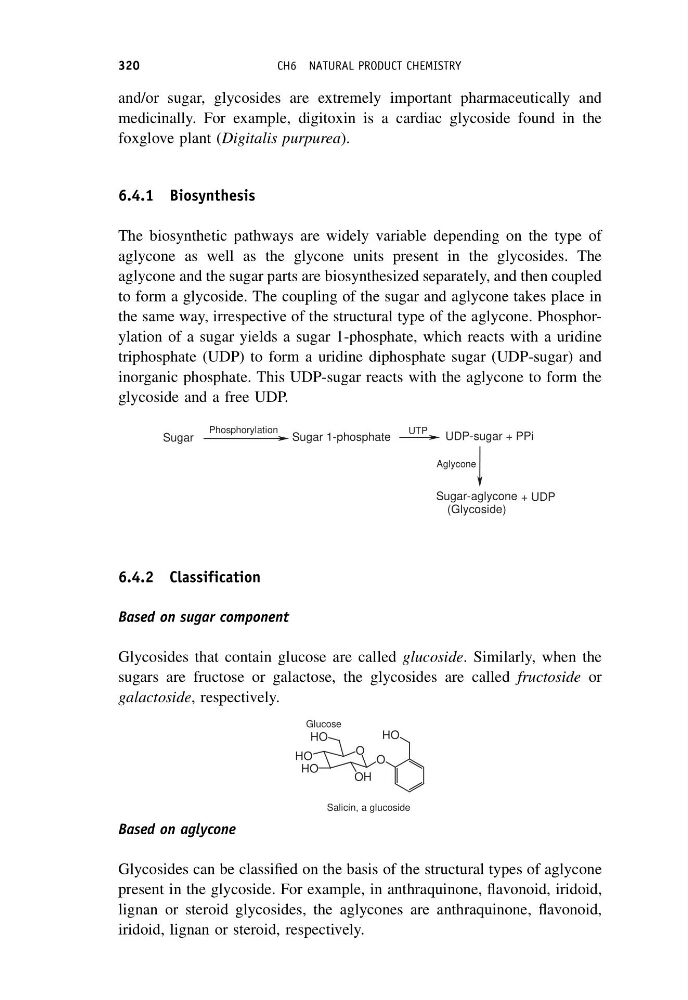
Glycosides that contain glucose are called glucoside. Similarly, when the
sugars are fructose or galactose, the glycosides are called fructoside or
galactoside, respectively.
O
O
OH
O
H
O
H
O
H
O
H
Salicin, a glucoside
Glucose
Based on aglycone
Glycosides can be classified on the basis of the structural types of aglycone
present in the glycoside. For example, in anthraquinone, flavonoid, iridoid,
lignan or steroid glycosides, the aglycones are anthraquinone, flavonoid,
iridoid, lignan or steroid, respectively.
320
CH6 NATURAL PRODUCT CHEMISTRY
medicinally. For example, digitoxin is a cardiac glycoside found in the
foxglove plant (Digitalis purpurea).
6.4.1 Biosynthesis
The biosynthetic pathways are widely variable depending on the type of
aglycone as well as the glycone units present in the glycosides. The
aglycone and the sugar parts are biosynthesized separately, and then coupled
to form a glycoside. The coupling of the sugar and aglycone takes place in
the same way, irrespective of the structural type of the aglycone. Phosphorylation of a sugar yields a sugar 1-phosphate, which reacts with a uridine
triphosphate (UDP) to form a uridine diphosphate sugar (UDP-sugar) and
inorganic phosphate. This UDP-sugar reacts with the aglycone to form the
glycoside and a free UDP.
Sugar
Phosphorylation Sugar 1-phosphate
UTP
UDP-sugar + PPi
Aglycone
Sugar-aglycone
(Glycoside)
+ UDP
6.4.2 Classification
Based on sugar component
Glycosides that contain glucose are called glucoside. Similarly, when the
sugars are fructose or galactose, the glycosides are called fructoside or
galactoside, respectively.
O
O
OH
O
H
O
H
O
H
O
H
Salicin, a glucoside
Glucose
Based on aglycone
Glycosides can be classified on the basis of the structural types of aglycone
present in the glycoside. For example, in anthraquinone, flavonoid, iridoid,
lignan or steroid glycosides, the aglycones are anthraquinone, flavonoid,
iridoid, lignan or steroid, respectively.
320
CH6 NATURAL PRODUCT CHEMISTRY