

Muscarine Muscarine, molecular formula C 9 H 20 NO 2
þ , first isolated from
fly agaric Amanita muscaria, occurs in certain mushrooms, especially in the
species of the genera Inocybe and Clitocybe. It is a parasympathomimetic
substance. It causes profound activation of the peripheral parasympathetic
nervous system, which may result in convulsions and death. Muscarine
mimics the action of the neurotransmitter acetylcholine at the muscarinic
acetylcholine receptors.
Macrocyclic alkaloids
This group of alkaloids possess a macrocycle, and in most cases nitrogen is
a part of the ring system. Macrocyclic spermine group of alkaloids is one of
such examples. These polyamine alkaloids are found in a number of plant
families, e.g. Acanthaceae, Scrophulariaceae, Leguminosae, Ephedraceae
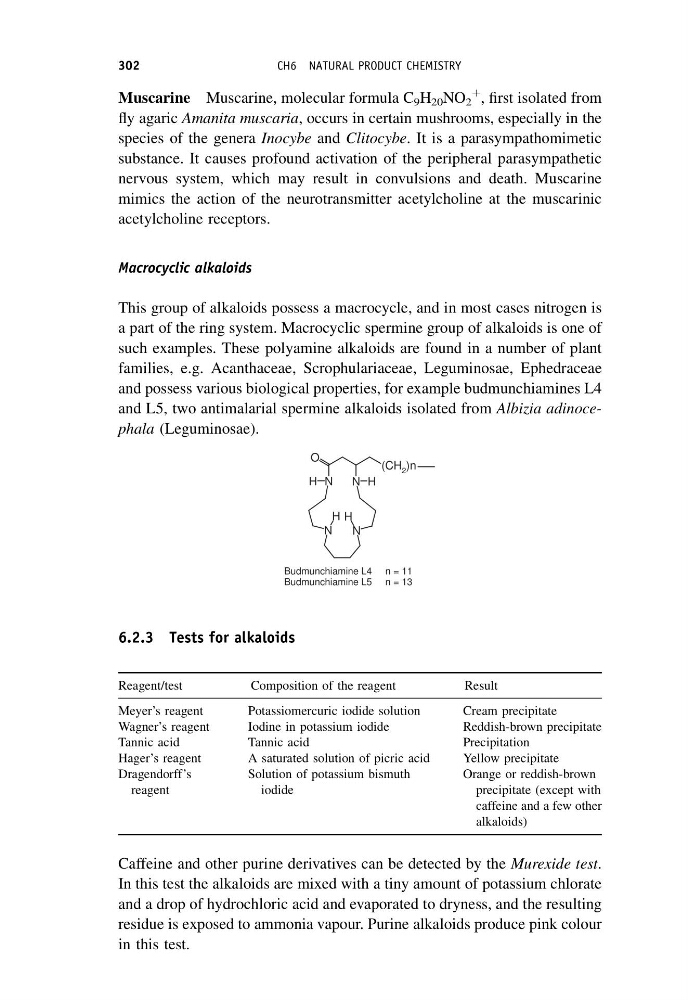
and possess various biological properties, for example budmunchiamines L4
and L5, two antimalarial spermine alkaloids isolated from Albizia adinocephala (Leguminosae).
N
N
N
N
O
(CH 2 )n
H
H
H H
Budmunchiamine L4 n = 11
Budmunchiamine L5 n = 13
6.2.3 Tests for alkaloids
Reagent/test
Composition of the reagent
Result
Meyer’s reagent
Potassiomercuric iodide solution
Cream precipitate
Wagner’s reagent
Iodine in potassium iodide
Reddish-brown precipitate
Tannic acid
Tannic acid
Precipitation
Hager’s reagent
A saturated solution of picric acid
Yellow precipitate
Dragendorff’s
Solution of potassium bismuth
Orange or reddish-brown
reagent
iodide
precipitate (except with
caffeine and a few other
alkaloids)
Caffeine and other purine derivatives can be detected by the Murexide test.
In this test the alkaloids are mixed with a tiny amount of potassium chlorate
and a drop of hydrochloric acid and evaporated to dryness, and the resulting
residue is exposed to ammonia vapour. Purine alkaloids produce pink colour
in this test.
302
CH6 NATURAL PRODUCT CHEMISTRY
þ , first isolated from
fly agaric Amanita muscaria, occurs in certain mushrooms, especially in the
species of the genera Inocybe and Clitocybe. It is a parasympathomimetic
substance. It causes profound activation of the peripheral parasympathetic
nervous system, which may result in convulsions and death. Muscarine
mimics the action of the neurotransmitter acetylcholine at the muscarinic
acetylcholine receptors.
Macrocyclic alkaloids
This group of alkaloids possess a macrocycle, and in most cases nitrogen is
a part of the ring system. Macrocyclic spermine group of alkaloids is one of
such examples. These polyamine alkaloids are found in a number of plant
families, e.g. Acanthaceae, Scrophulariaceae, Leguminosae, Ephedraceae
and possess various biological properties, for example budmunchiamines L4
and L5, two antimalarial spermine alkaloids isolated from Albizia adinocephala (Leguminosae).
N
N
N
N
O
(CH 2 )n
H
H
H H
Budmunchiamine L4 n = 11
Budmunchiamine L5 n = 13
6.2.3 Tests for alkaloids
Reagent/test
Composition of the reagent
Result
Meyer’s reagent
Potassiomercuric iodide solution
Cream precipitate
Wagner’s reagent
Iodine in potassium iodide
Reddish-brown precipitate
Tannic acid
Tannic acid
Precipitation
Hager’s reagent
A saturated solution of picric acid
Yellow precipitate
Dragendorff’s
Solution of potassium bismuth
Orange or reddish-brown
reagent
iodide
precipitate (except with
caffeine and a few other
alkaloids)
Caffeine and other purine derivatives can be detected by the Murexide test.
In this test the alkaloids are mixed with a tiny amount of potassium chlorate
and a drop of hydrochloric acid and evaporated to dryness, and the resulting
residue is exposed to ammonia vapour. Purine alkaloids produce pink colour
in this test.
302
CH6 NATURAL PRODUCT CHEMISTRY