

6.3 Carbohydrates
Carbohydrates are the primary fuel for our muscles and the brain. Eating a
high carbohydrate diet will ensure maintenance of muscle and liver glycogen (storage forms of carbohydrate), improve performance and delay
fatigue. The word carbohydrate means ‘hydrate of carbon’. Thus, carbohydrates are a group of polyhydroxy aldehydes, ketones or acids or their
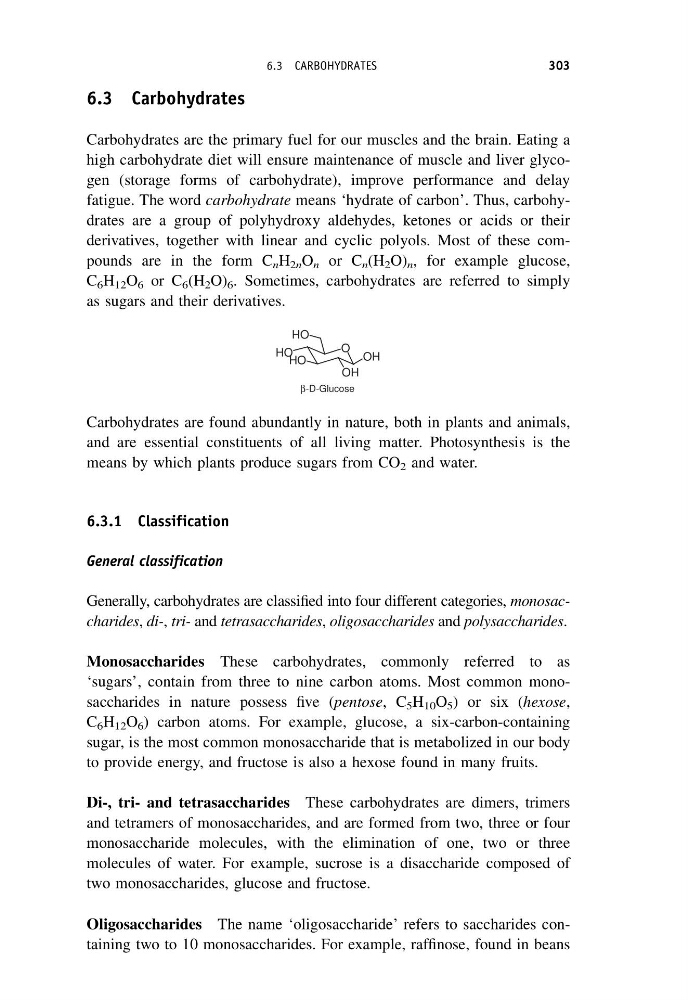
derivatives, together with linear and cyclic polyols. Most of these compounds are in the form C n H 2n O n or C n (H 2 O) n , for example glucose,
C 6 H 12 O 6 or C 6 (H 2 O) 6 . Sometimes, carbohydrates are referred to simply
as sugars and their derivatives.
O
OH
O
H
O
H O
H
OH
β-D-Glucose
Carbohydrates are found abundantly in nature, both in plants and animals,
and are essential constituents of all living matter. Photosynthesis is the
means by which plants produce sugars from CO 2 and water.
6.3.1 Classification
General classification
Generally, carbohydrates are classified into four different categories, monosaccharides, di-, tri- and tetrasaccharides, oligosaccharides and polysaccharides.
Monosaccharides These carbohydrates, commonly referred to as
‘sugars’, contain from three to nine carbon atoms. Most common monosaccharides in nature possess five (pentose, C 5 H 10 O 5 ) or six (hexose,
C 6 H 12 O 6 ) carbon atoms. For example, glucose, a six-carbon-containing
sugar, is the most common monosaccharide that is metabolized in our body
to provide energy, and fructose is also a hexose found in many fruits.
Di-, tri- and tetrasaccharides These carbohydrates are dimers, trimers
and tetramers of monosaccharides, and are formed from two, three or four
monosaccharide molecules, with the elimination of one, two or three
molecules of water. For example, sucrose is a disaccharide composed of
two monosaccharides, glucose and fructose.
Oligosaccharides The name ‘oligosaccharide’ refers to saccharides containing two to 10 monosaccharides. For example, raffinose, found in beans
6.3 CARBOHYDRATES
303
Carbohydrates are the primary fuel for our muscles and the brain. Eating a
high carbohydrate diet will ensure maintenance of muscle and liver glycogen (storage forms of carbohydrate), improve performance and delay
fatigue. The word carbohydrate means ‘hydrate of carbon’. Thus, carbohydrates are a group of polyhydroxy aldehydes, ketones or acids or their
derivatives, together with linear and cyclic polyols. Most of these compounds are in the form C n H 2n O n or C n (H 2 O) n , for example glucose,
C 6 H 12 O 6 or C 6 (H 2 O) 6 . Sometimes, carbohydrates are referred to simply
as sugars and their derivatives.
O
OH
O
H
O
H O
H
OH
β-D-Glucose
Carbohydrates are found abundantly in nature, both in plants and animals,
and are essential constituents of all living matter. Photosynthesis is the
means by which plants produce sugars from CO 2 and water.
6.3.1 Classification
General classification
Generally, carbohydrates are classified into four different categories, monosaccharides, di-, tri- and tetrasaccharides, oligosaccharides and polysaccharides.
Monosaccharides These carbohydrates, commonly referred to as
‘sugars’, contain from three to nine carbon atoms. Most common monosaccharides in nature possess five (pentose, C 5 H 10 O 5 ) or six (hexose,
C 6 H 12 O 6 ) carbon atoms. For example, glucose, a six-carbon-containing
sugar, is the most common monosaccharide that is metabolized in our body
to provide energy, and fructose is also a hexose found in many fruits.
Di-, tri- and tetrasaccharides These carbohydrates are dimers, trimers
and tetramers of monosaccharides, and are formed from two, three or four
monosaccharide molecules, with the elimination of one, two or three
molecules of water. For example, sucrose is a disaccharide composed of
two monosaccharides, glucose and fructose.
Oligosaccharides The name ‘oligosaccharide’ refers to saccharides containing two to 10 monosaccharides. For example, raffinose, found in beans
6.3 CARBOHYDRATES
303