

OH
O
H
O
O
OMe
OAc
OMe
OMe
O
H
OMe
N
Ph
Aconitine
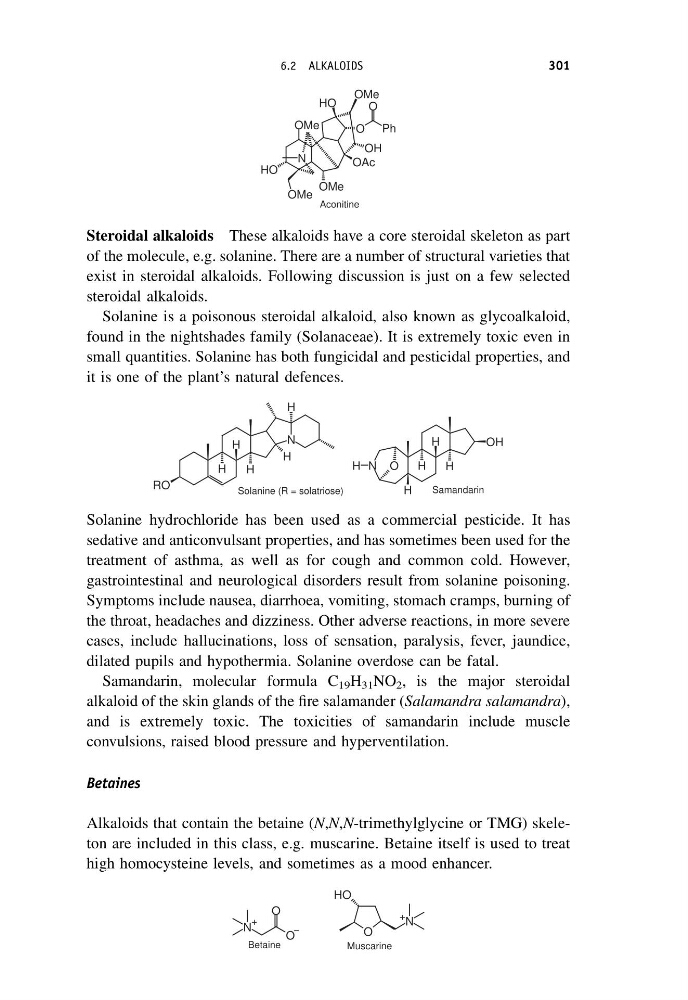
Steroidal alkaloids These alkaloids have a core steroidal skeleton as part
of the molecule, e.g. solanine. There are a number of structural varieties that
exist in steroidal alkaloids. Following discussion is just on a few selected
steroidal alkaloids.
Solanine is a poisonous steroidal alkaloid, also known as glycoalkaloid,
found in the nightshades family (Solanaceae). It is extremely toxic even in
small quantities. Solanine has both fungicidal and pesticidal properties, and
it is one of the plant’s natural defences.
N
RO
H
H
H
H
H
H
H
H
N O
H
H
OH
Solanine (R = solatriose)
Samandarin
Solanine hydrochloride has been used as a commercial pesticide. It has
sedative and anticonvulsant properties, and has sometimes been used for the
treatment of asthma, as well as for cough and common cold. However,
gastrointestinal and neurological disorders result from solanine poisoning.
Symptoms include nausea, diarrhoea, vomiting, stomach cramps, burning of
the throat, headaches and dizziness. Other adverse reactions, in more severe
cases, include hallucinations, loss of sensation, paralysis, fever, jaundice,
dilated pupils and hypothermia. Solanine overdose can be fatal.
Samandarin, molecular formula C 19 H 31 NO 2 , is the major steroidal
alkaloid of the skin glands of the fire salamander (Salamandra salamandra),
and is extremely toxic. The toxicities of samandarin include muscle
convulsions, raised blood pressure and hyperventilation.
Betaines
Alkaloids that contain the betaine (N,N,N-trimethylglycine or TMG) skeleton are included in this class, e.g. muscarine. Betaine itself is used to treat
high homocysteine levels, and sometimes as a mood enhancer.
N
+
O
O
Betaine
O
O
H
N
+
Muscarine
6.2 ALKALOIDS
301
O
H
O
O
OMe
OAc
OMe
OMe
O
H
OMe
N
Ph
Aconitine
Steroidal alkaloids These alkaloids have a core steroidal skeleton as part
of the molecule, e.g. solanine. There are a number of structural varieties that
exist in steroidal alkaloids. Following discussion is just on a few selected
steroidal alkaloids.
Solanine is a poisonous steroidal alkaloid, also known as glycoalkaloid,
found in the nightshades family (Solanaceae). It is extremely toxic even in
small quantities. Solanine has both fungicidal and pesticidal properties, and
it is one of the plant’s natural defences.
N
RO
H
H
H
H
H
H
H
H
N O
H
H
OH
Solanine (R = solatriose)
Samandarin
Solanine hydrochloride has been used as a commercial pesticide. It has
sedative and anticonvulsant properties, and has sometimes been used for the
treatment of asthma, as well as for cough and common cold. However,
gastrointestinal and neurological disorders result from solanine poisoning.
Symptoms include nausea, diarrhoea, vomiting, stomach cramps, burning of
the throat, headaches and dizziness. Other adverse reactions, in more severe
cases, include hallucinations, loss of sensation, paralysis, fever, jaundice,
dilated pupils and hypothermia. Solanine overdose can be fatal.
Samandarin, molecular formula C 19 H 31 NO 2 , is the major steroidal
alkaloid of the skin glands of the fire salamander (Salamandra salamandra),
and is extremely toxic. The toxicities of samandarin include muscle
convulsions, raised blood pressure and hyperventilation.
Betaines
Alkaloids that contain the betaine (N,N,N-trimethylglycine or TMG) skeleton are included in this class, e.g. muscarine. Betaine itself is used to treat
high homocysteine levels, and sometimes as a mood enhancer.
N
+
O
O
Betaine
O
O
H
N
+
Muscarine
6.2 ALKALOIDS
301