

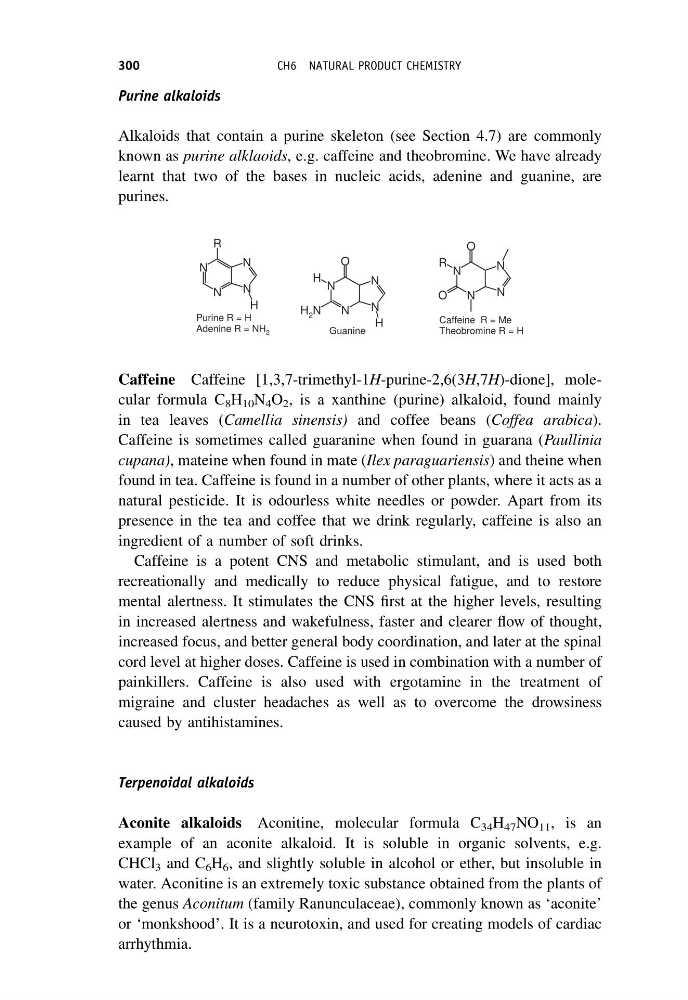
Purine alkaloids
Alkaloids that contain a purine skeleton (see Section 4.7) are commonly
known as purine alklaoids, e.g. caffeine and theobromine. We have already
learnt that two of the bases in nucleic acids, adenine and guanine, are
purines.
N
N
N
N
H
R
Purine R = H
Adenine R = NH 2
N
N
N
N
H
N
H 2
O
H
Guanine
N
N
N
N
O
O
R
Caffeine R = Me
Theobromine R = H
Caffeine Caffeine [1,3,7-trimethyl-1H-purine-2,6(3H,7H)-dione], molecular formula C 8 H 10 N 4 O 2 , is a xanthine (purine) alkaloid, found mainly
in tea leaves (Camellia sinensis) and coffee beans (Coffea arabica).
Caffeine is sometimes called guaranine when found in guarana (Paullinia
cupana), mateine when found in mate (Ilex paraguariensis) and theine when
found in tea. Caffeine is found in a number of other plants, where it acts as a
natural pesticide. It is odourless white needles or powder. Apart from its
presence in the tea and coffee that we drink regularly, caffeine is also an
ingredient of a number of soft drinks.
Caffeine is a potent CNS and metabolic stimulant, and is used both
recreationally and medically to reduce physical fatigue, and to restore
mental alertness. It stimulates the CNS first at the higher levels, resulting
in increased alertness and wakefulness, faster and clearer flow of thought,
increased focus, and better general body coordination, and later at the spinal
cord level at higher doses. Caffeine is used in combination with a number of
painkillers. Caffeine is also used with ergotamine in the treatment of
migraine and cluster headaches as well as to overcome the drowsiness
caused by antihistamines.
Terpenoidal alkaloids
Aconite alkaloids Aconitine, molecular formula C 34 H 47 NO 11 , is an
example of an aconite alkaloid. It is soluble in organic solvents, e.g.
CHCl 3 and C 6 H 6 , and slightly soluble in alcohol or ether, but insoluble in
water. Aconitine is an extremely toxic substance obtained from the plants of
the genus Aconitum (family Ranunculaceae), commonly known as ‘aconite’
or ‘monkshood’. It is a neurotoxin, and used for creating models of cardiac
arrhythmia.
300
CH6 NATURAL PRODUCT CHEMISTRY
Alkaloids that contain a purine skeleton (see Section 4.7) are commonly
known as purine alklaoids, e.g. caffeine and theobromine. We have already
learnt that two of the bases in nucleic acids, adenine and guanine, are
purines.
N
N
N
N
H
R
Purine R = H
Adenine R = NH 2
N
N
N
N
H
N
H 2
O
H
Guanine
N
N
N
N
O
O
R
Caffeine R = Me
Theobromine R = H
Caffeine Caffeine [1,3,7-trimethyl-1H-purine-2,6(3H,7H)-dione], molecular formula C 8 H 10 N 4 O 2 , is a xanthine (purine) alkaloid, found mainly
in tea leaves (Camellia sinensis) and coffee beans (Coffea arabica).
Caffeine is sometimes called guaranine when found in guarana (Paullinia
cupana), mateine when found in mate (Ilex paraguariensis) and theine when
found in tea. Caffeine is found in a number of other plants, where it acts as a
natural pesticide. It is odourless white needles or powder. Apart from its
presence in the tea and coffee that we drink regularly, caffeine is also an
ingredient of a number of soft drinks.
Caffeine is a potent CNS and metabolic stimulant, and is used both
recreationally and medically to reduce physical fatigue, and to restore
mental alertness. It stimulates the CNS first at the higher levels, resulting
in increased alertness and wakefulness, faster and clearer flow of thought,
increased focus, and better general body coordination, and later at the spinal
cord level at higher doses. Caffeine is used in combination with a number of
painkillers. Caffeine is also used with ergotamine in the treatment of
migraine and cluster headaches as well as to overcome the drowsiness
caused by antihistamines.
Terpenoidal alkaloids
Aconite alkaloids Aconitine, molecular formula C 34 H 47 NO 11 , is an
example of an aconite alkaloid. It is soluble in organic solvents, e.g.
CHCl 3 and C 6 H 6 , and slightly soluble in alcohol or ether, but insoluble in
water. Aconitine is an extremely toxic substance obtained from the plants of
the genus Aconitum (family Ranunculaceae), commonly known as ‘aconite’
or ‘monkshood’. It is a neurotoxin, and used for creating models of cardiac
arrhythmia.
300
CH6 NATURAL PRODUCT CHEMISTRY