

an antitussive for severe cough. Side-effects of morphine treatment generally include impairment of mental performance, euphoria, drowsiness,
loss of appetite, constipation, lethargy and blurred vision.
Phenylethylamines
Phenylethylamine, a neurotransmitter or neuromodulator, is a monoamine.
Although the nitrogen is not a part of the ring, phenylethylamine and its
derivatives are classified as alkaloids. Phenylethylamine itself is a colourless
liquid, and it is biosynthesized from phenylalanine through enzymatic
decarboxylation. The phenylethylamine moiety can be found in various
complex ring systems, e.g. the ergoline system in lysergic acid diethylamide
(LSD) or the morphinan system in morphine. A number of alkaloids of this
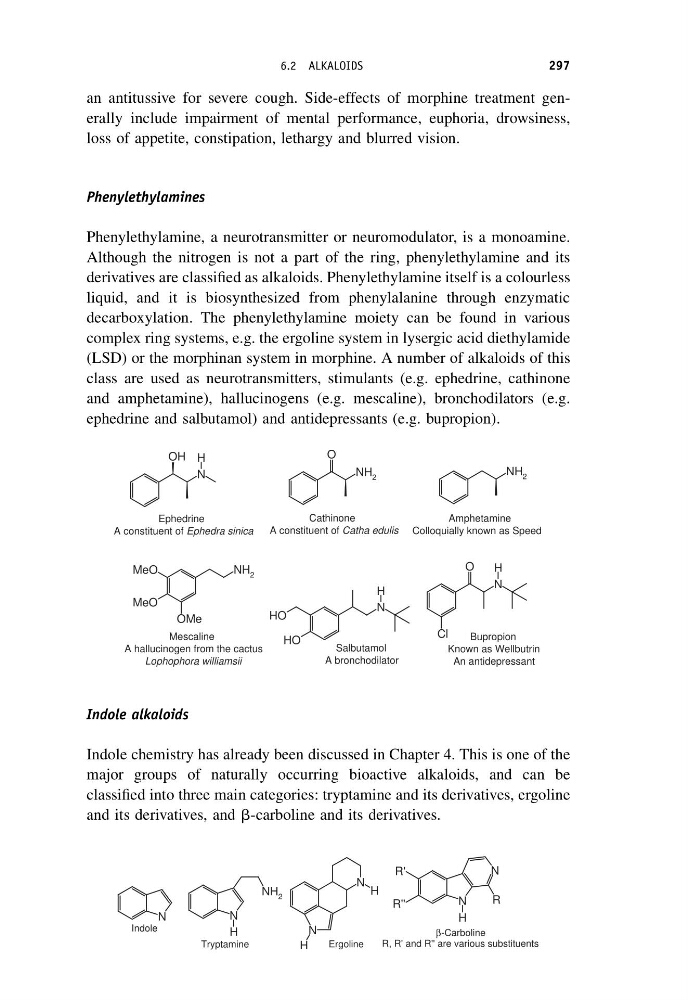
class are used as neurotransmitters, stimulants (e.g. ephedrine, cathinone
and amphetamine), hallucinogens (e.g. mescaline), bronchodilators (e.g.
ephedrine and salbutamol) and antidepressants (e.g. bupropion).
N
H
OH
NH 2
O
NH 2
Ephedrine
A constituent of Ephedra sinica
Cathinone
A constituent of Catha edulis
Amphetamine
Colloquially known as Speed
NH 2
OMe
MeO
MeO
N
O
H
O
H
H
N
O
H
Cl
Mescaline
A hallucinogen from the cactus
Lophophora williamsii
Salbutamol
A bronchodilator
Bupropion
Known as Wellbutrin
An antidepressant
Indole alkaloids
Indole chemistry has already been discussed in Chapter 4. This is one of the
major groups of naturally occurring bioactive alkaloids, and can be
classified into three main categories: tryptamine and its derivatives, ergoline
and its derivatives, and b-carboline and its derivatives.
N
N
NH 2
H
N
N
H
H
N
N
H
R'
R''
R
Indole
Tryptamine
Ergoline
β-Carboline
R, R' and R'' are various substituents
6.2 ALKALOIDS
297
loss of appetite, constipation, lethargy and blurred vision.
Phenylethylamines
Phenylethylamine, a neurotransmitter or neuromodulator, is a monoamine.
Although the nitrogen is not a part of the ring, phenylethylamine and its
derivatives are classified as alkaloids. Phenylethylamine itself is a colourless
liquid, and it is biosynthesized from phenylalanine through enzymatic
decarboxylation. The phenylethylamine moiety can be found in various
complex ring systems, e.g. the ergoline system in lysergic acid diethylamide
(LSD) or the morphinan system in morphine. A number of alkaloids of this
class are used as neurotransmitters, stimulants (e.g. ephedrine, cathinone
and amphetamine), hallucinogens (e.g. mescaline), bronchodilators (e.g.
ephedrine and salbutamol) and antidepressants (e.g. bupropion).
N
H
OH
NH 2
O
NH 2
Ephedrine
A constituent of Ephedra sinica
Cathinone
A constituent of Catha edulis
Amphetamine
Colloquially known as Speed
NH 2
OMe
MeO
MeO
N
O
H
O
H
H
N
O
H
Cl
Mescaline
A hallucinogen from the cactus
Lophophora williamsii
Salbutamol
A bronchodilator
Bupropion
Known as Wellbutrin
An antidepressant
Indole alkaloids
Indole chemistry has already been discussed in Chapter 4. This is one of the
major groups of naturally occurring bioactive alkaloids, and can be
classified into three main categories: tryptamine and its derivatives, ergoline
and its derivatives, and b-carboline and its derivatives.
N
N
NH 2
H
N
N
H
H
N
N
H
R'
R''
R
Indole
Tryptamine
Ergoline
β-Carboline
R, R' and R'' are various substituents
6.2 ALKALOIDS
297