

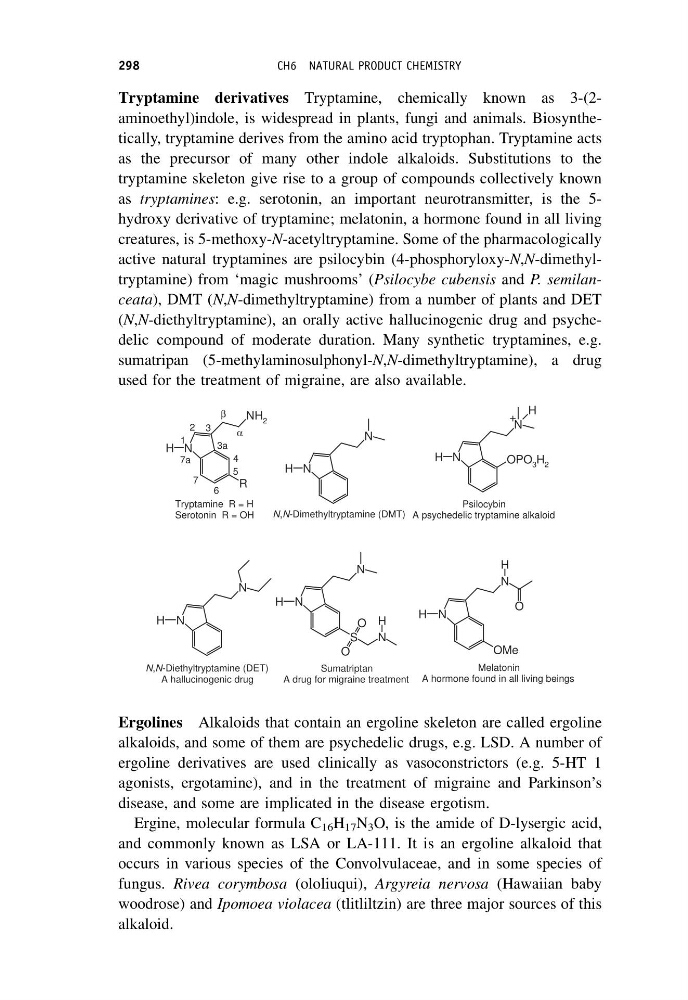
Tryptamine derivatives Tryptamine, chemically known as 3-(2aminoethyl)indole, is widespread in plants, fungi and animals. Biosynthetically, tryptamine derives from the amino acid tryptophan. Tryptamine acts
as the precursor of many other indole alkaloids. Substitutions to the
tryptamine skeleton give rise to a group of compounds collectively known
as tryptamines: e.g. serotonin, an important neurotransmitter, is the 5hydroxy derivative of tryptamine; melatonin, a hormone found in all living
creatures, is 5-methoxy-N-acetyltryptamine. Some of the pharmacologically
active natural tryptamines are psilocybin (4-phosphoryloxy-N,N-dimethyltryptamine) from ‘magic mushrooms’ (Psilocybe cubensis and P. semilanceata), DMT (N,N-dimethyltryptamine) from a number of plants and DET
(N,N-diethyltryptamine), an orally active hallucinogenic drug and psychedelic compound of moderate duration. Many synthetic tryptamines, e.g.
sumatripan (5-methylaminosulphonyl-N,N-dimethyltryptamine), a drug
used for the treatment of migraine, are also available.
N
NH 2
H
R
1
2 3
4
5
6
7
3a
7a
α
β
Tryptamine R = H
Serotonin R = OH
N
N
H
N,N-Dimethyltryptamine (DMT)
N
N
H
OPO 3 H 2
H
+
Psilocybin
A psychedelic tryptamine alkaloid
N
N
H
N
N
H
S
O
O
N
H
N
N
H
OMe
O
H
N,N-Diethyltryptamine (DET)
A hallucinogenic drug
Sumatriptan
A drug for migraine treatment
Melatonin
A hormone found in all living beings
Ergolines Alkaloids that contain an ergoline skeleton are called ergoline
alkaloids, and some of them are psychedelic drugs, e.g. LSD. A number of
ergoline derivatives are used clinically as vasoconstrictors (e.g. 5-HT 1
agonists, ergotamine), and in the treatment of migraine and Parkinson’s
disease, and some are implicated in the disease ergotism.
Ergine, molecular formula C 16 H 17 N 3 O, is the amide of D-lysergic acid,
and commonly known as LSA or LA-111. It is an ergoline alkaloid that
occurs in various species of the Convolvulaceae, and in some species of
fungus. Rivea corymbosa (ololiuqui), Argyreia nervosa (Hawaiian baby
woodrose) and Ipomoea violacea (tlitliltzin) are three major sources of this
alkaloid.
298
CH6 NATURAL PRODUCT CHEMISTRY
as the precursor of many other indole alkaloids. Substitutions to the
tryptamine skeleton give rise to a group of compounds collectively known
as tryptamines: e.g. serotonin, an important neurotransmitter, is the 5hydroxy derivative of tryptamine; melatonin, a hormone found in all living
creatures, is 5-methoxy-N-acetyltryptamine. Some of the pharmacologically
active natural tryptamines are psilocybin (4-phosphoryloxy-N,N-dimethyltryptamine) from ‘magic mushrooms’ (Psilocybe cubensis and P. semilanceata), DMT (N,N-dimethyltryptamine) from a number of plants and DET
(N,N-diethyltryptamine), an orally active hallucinogenic drug and psychedelic compound of moderate duration. Many synthetic tryptamines, e.g.
sumatripan (5-methylaminosulphonyl-N,N-dimethyltryptamine), a drug
used for the treatment of migraine, are also available.
N
NH 2
H
R
1
2 3
4
5
6
7
3a
7a
α
β
Tryptamine R = H
Serotonin R = OH
N
N
H
N,N-Dimethyltryptamine (DMT)
N
N
H
OPO 3 H 2
H
+
Psilocybin
A psychedelic tryptamine alkaloid
N
N
H
N
N
H
S
O
O
N
H
N
N
H
OMe
O
H
N,N-Diethyltryptamine (DET)
A hallucinogenic drug
Sumatriptan
A drug for migraine treatment
Melatonin
A hormone found in all living beings
Ergolines Alkaloids that contain an ergoline skeleton are called ergoline
alkaloids, and some of them are psychedelic drugs, e.g. LSD. A number of
ergoline derivatives are used clinically as vasoconstrictors (e.g. 5-HT 1
agonists, ergotamine), and in the treatment of migraine and Parkinson’s
disease, and some are implicated in the disease ergotism.
Ergine, molecular formula C 16 H 17 N 3 O, is the amide of D-lysergic acid,
and commonly known as LSA or LA-111. It is an ergoline alkaloid that
occurs in various species of the Convolvulaceae, and in some species of
fungus. Rivea corymbosa (ololiuqui), Argyreia nervosa (Hawaiian baby
woodrose) and Ipomoea violacea (tlitliltzin) are three major sources of this
alkaloid.
298
CH6 NATURAL PRODUCT CHEMISTRY