

5.8.2 Sigmatropic rearrangements
Sigmatropic rearrangements are unimolecular processes, and involve the
movement of a s bond with the simultaneous rearrangement of the
p system. In this rearrangement reaction, a s bond is broken in the reactant
and a new s bond is formed in the product, and the p bonds rearrange.
However, the number of p bonds does not change, i.e. the reactant and the
product possess the same number of p bonds. Sigmatropic reactions are
usually uncatalysed, although Lewis acid catalysts are sometimes used.
Sigmatropic rearrangement plays an important role in the biosynthesis of
vitamin D in our bodies.
O
O
Heat
Bond broken
New bond formed
This reaction can occur through hydrogen shift, alkyl shift (Cope rearrangement) or Claisen rearrangement.
Hydrogen shift
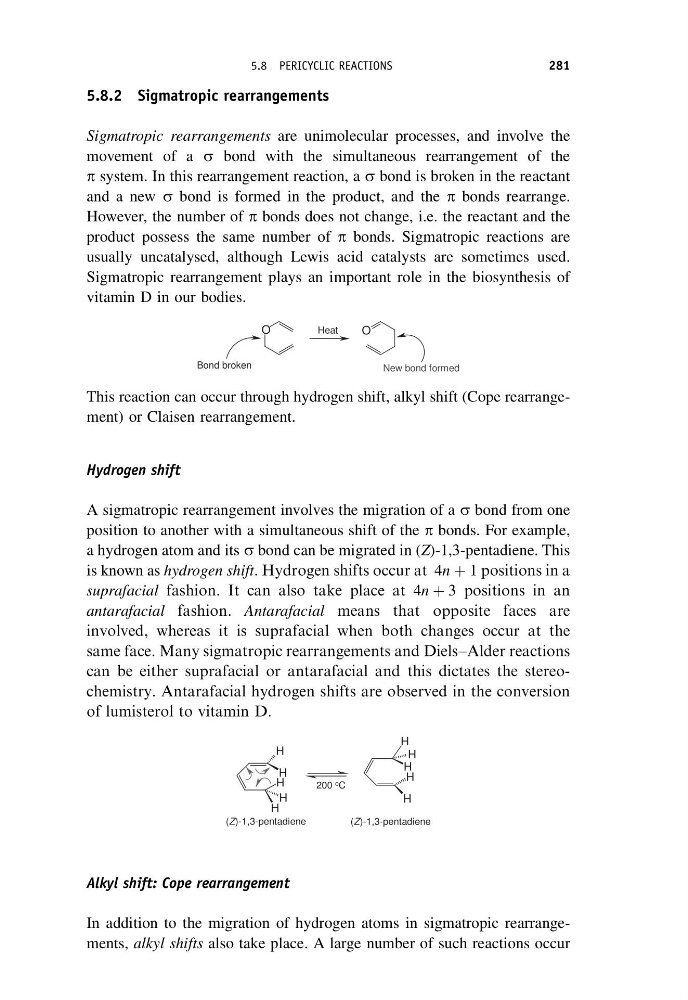
A sigmatropic rearrangement involves the migration of a s bond from one
position to another with a simultaneous shift of the p bonds. For example,
a hydrogen atom and its s bond can be migrated in (Z)-1,3-pentadiene. This
is known as hydrogen shift. Hydrogen shifts occur at 4n þ 1 positions in a
suprafacial fashion. It can also take place at 4n þ 3 positions in an
antarafacial fashion. Antarafacial means that opposite faces are
involved, whereas it is suprafacial when both changes occur at the
same face. Many sigmatropic rearrangements and Diels–Alder reactions
can be either suprafacial or antarafacial and this dictates the stereochemistry. Antarafacial hydrogen shifts are observed in the conversion
of lumisterol to vitamin D.
H
H
H
H
H
H
H
H
H
H
200 o C
(Z)-1,3-pentadiene
(Z)-1,3-pentadiene
Alkyl shift: Cope rearrangement
In addition to the migration of hydrogen atoms in sigmatropic rearrangements, alkyl shifts also take place. A large number of such reactions occur
5.8 PERICYCLIC REACTIONS
281
Sigmatropic rearrangements are unimolecular processes, and involve the
movement of a s bond with the simultaneous rearrangement of the
p system. In this rearrangement reaction, a s bond is broken in the reactant
and a new s bond is formed in the product, and the p bonds rearrange.
However, the number of p bonds does not change, i.e. the reactant and the
product possess the same number of p bonds. Sigmatropic reactions are
usually uncatalysed, although Lewis acid catalysts are sometimes used.
Sigmatropic rearrangement plays an important role in the biosynthesis of
vitamin D in our bodies.
O
O
Heat
Bond broken
New bond formed
This reaction can occur through hydrogen shift, alkyl shift (Cope rearrangement) or Claisen rearrangement.
Hydrogen shift
A sigmatropic rearrangement involves the migration of a s bond from one
position to another with a simultaneous shift of the p bonds. For example,
a hydrogen atom and its s bond can be migrated in (Z)-1,3-pentadiene. This
is known as hydrogen shift. Hydrogen shifts occur at 4n þ 1 positions in a
suprafacial fashion. It can also take place at 4n þ 3 positions in an
antarafacial fashion. Antarafacial means that opposite faces are
involved, whereas it is suprafacial when both changes occur at the
same face. Many sigmatropic rearrangements and Diels–Alder reactions
can be either suprafacial or antarafacial and this dictates the stereochemistry. Antarafacial hydrogen shifts are observed in the conversion
of lumisterol to vitamin D.
H
H
H
H
H
H
H
H
H
H
200 o C
(Z)-1,3-pentadiene
(Z)-1,3-pentadiene
Alkyl shift: Cope rearrangement
In addition to the migration of hydrogen atoms in sigmatropic rearrangements, alkyl shifts also take place. A large number of such reactions occur
5.8 PERICYCLIC REACTIONS
281